Philippines Becomes First Nation to Declare National Energy Emergency Over Iran Conflict
Philippines declared the world's first national energy emergency over the Iran conflict, with only 45 days of fuel supply left and diesel prices more than doubled since February 28.
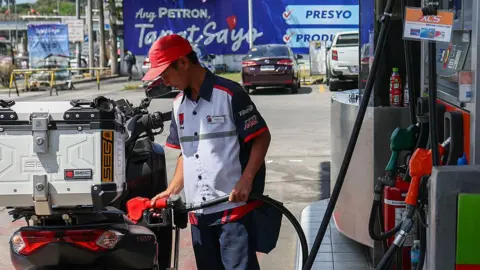
A worker at a Quezon City petrol station resorted to black tape on Monday to manually adjust the price board after the digital display ran out of digits to accommodate the surging cost of fuel. By Tuesday, President Ferdinand Marcos Jr. had signed an executive order making the Philippines the world's first country to declare a state of national energy emergency in response to the Middle East conflict.
Executive Order No. 110 reads: "A state of national energy emergency is hereby declared in light of the ongoing conflict in the Middle East, and the resulting imminent danger posed upon the availability and stability of the country's energy supply." The declaration is anchored on the determination by Energy Secretary Sharon Garin that hostilities involving the United States, Israel, and Iran have heightened geopolitical tensions in a region critical to global oil production and transportation, creating uncertainty in global energy markets, severe supply chain disruption, and significant upward pressure on international oil prices.
The Philippines is acutely exposed. The executive order further cites the closure of the Strait of Hormuz, a critical energy corridor for global oil shipments, as disrupting the flow of petroleum products to international markets and constraining global fuel supply. The country imports 98% of its oil from the Gulf, and diesel and petrol prices have more than doubled since the war broke out on February 28.
The order mandates the adoption of the Unified Package for Livelihoods, Industry, Food, and Transport, known as UPLIFT, and an UPLIFT Committee meant to "safeguard national interest" by "mitigating the impact of the conflict in the Middle East." Members of the UPLIFT Committee include the executive secretary and the secretaries of energy, transportation, social welfare, agriculture, finance, budget, and economy, planning, and development, with Marcos himself serving as chair. The Department of Energy, the Philippine National Oil Company, and PNOC Exploration Corporation are authorized to procure fuel and petroleum products to ensure timely supply and, when necessary, make advance payments exceeding 15 percent of contract amounts.
The supply pressure is urgent. Garin told reporters the country had around 45 days of fuel supply based on current consumption levels, even as diesel prices are expected to spike above 130 pesos per liter and gasoline may surpass 100 pesos per liter this week. The government is working to procure 1 million barrels of oil from countries within and outside Southeast Asia to build a buffer stock, though Garin acknowledged there will likely be uncertainties in the next round of orders. Garin also said the country would "temporarily" depend more heavily on coal-fired power plants to meet energy needs in response to surging liquefied natural gas costs.
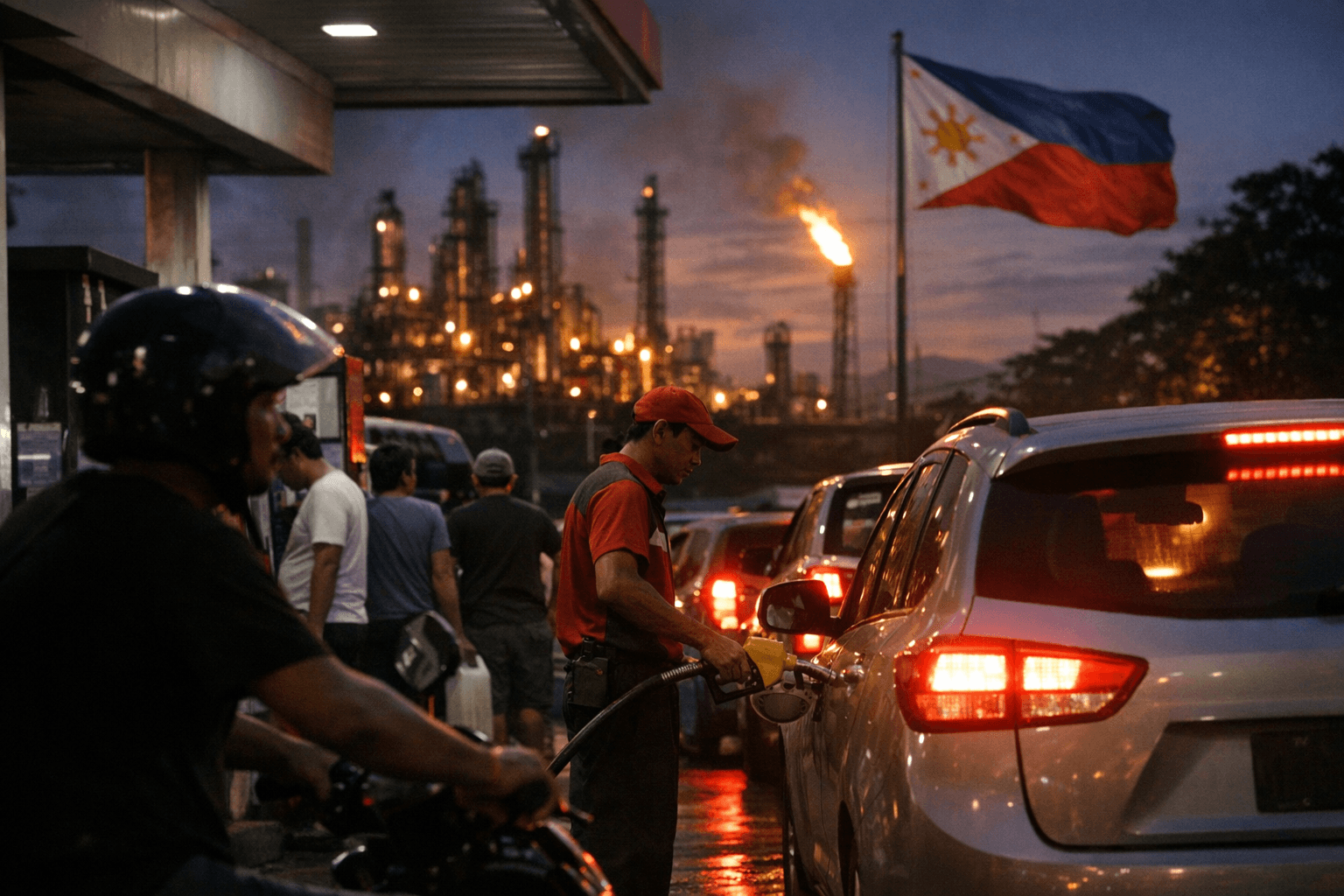
Socioeconomic Planning Secretary Arsenio Balisacan told a Senate committee that the inflation rate could shoot up to double-digit levels, with diesel prices seen rising 176% to 162.50 pesos per liter in May under the "most severe scenario" of crude hitting $200 per barrel. Inflation had already reached a 13-month high of 2.4% in February, before the latest price surges.
The government has moved quickly on conservation. All national government agencies, state universities and colleges, and local government branches have been ordered to reduce fuel consumption by at least 10%. Government offices must set air-conditioning units no lower than 24 degrees Celsius, and flexible work arrangements are now mandatory. The announcement came just 24 hours after Palace Press Officer Claire Castro insisted that the country was not yet experiencing an oil crisis but was instead facing a "price disruption."
Subsidies for transport drivers, reduced ferry services, and a four-day work week for civil servants are already in effect. A presidential palace spokesperson said the four-day week could be extended further if the Middle East crisis worsened. The state of national energy emergency will remain in force for one year from issuance, unless otherwise extended or lifted by the president.
Marcos signed the order as diesel prices entered their third consecutive week of mega price hikes driven by the conflict, with no clear resolution to the Strait of Hormuz closure in sight. For a country that built its energy economy almost entirely on Gulf imports, the margin for error has narrowed to 45 days.
Know something we missed? Have a correction or additional information?
Submit a Tip