Physical Intelligence Seeks Another $1 Billion as Valuation Doubles to $5.6 Billion
Physical Intelligence is in talks to raise $1B at an $11B valuation, doubling its worth in four months as Founders Fund and Lightspeed circle the deal.

Inside a nondescript San Francisco building marked only by a pi symbol, robotic arms fumble through the mundane: one struggles to fold black pants, another tries turning a shirt inside out, a third peels a zucchini with mechanical determination. The company behind that tableau, Physical Intelligence, is now in discussions for a funding round that would make it one of the most richly valued robotics startups on earth.
Physical Intelligence is in discussions to raise about $1 billion in new funding at a valuation exceeding $11 billion, according to Bloomberg. Founders Fund is set to participate, with Lightspeed Venture Partners also in talks to invest alongside returning backers Thrive Capital and Lux Capital. The deal is still in early stages and details could change.
The deal would effectively double the startup's valuation in four months, as its last funding round, a $600 million haul, valued Physical Intelligence at $5.6 billion. Alphabet's independent growth fund CapitalG led that round, with participation from existing investors Lux Capital, Thrive Capital, and Amazon founder Jeff Bezos. Index Ventures and T. Rowe Price were among the new investors who participated. The company's fundraising arc has been steep: Physical Intelligence raised $600 million to reach its $5.6 billion valuation and was founded in 2024 by Karol Hausman, Adnan Esmail, Brian Ichter, Lachy Groom, Quan Vuong, and Sergey Levine. Before the November 2024 round that brought in Jeff Bezos and OpenAI at a $2.4 billion valuation, the company's March seed round reportedly came in at just $70 million with a $400 million valuation.

The pitch to investors rests on a deceptively simple analogy. Co-founder Sergey Levine, a UC Berkeley associate professor, describes the company's ambition as: "Think of it like ChatGPT, but for robots." At last count, the company had raised just over $1 billion and employed about 80 people working to build general-purpose AI models that can power robots to perform tasks from folding laundry to peeling vegetables. Physical Intelligence is already working with companies across logistics, grocery, and even a chocolate maker to test real-world automation, but there is no revenue model yet, no customer announcements, and no commercialization timeline.
That last point is precisely what divides the robotics investment community. Co-founder Lachy Groom, who became an early Stripe employee before angel investing in Figma, Notion, and Ramp, found his next act at Physical Intelligence. When asked about runway, Groom has clarified the company doesn't burn much, then added that under the right terms, he'd raise more: "There's no limit to how much money we can really put to work. There's always more compute you can throw at the problem."
The research-first strategy puts Physical Intelligence in direct philosophical opposition to Pittsburgh-based Skild AI. Skild AI, which is building general-purpose robotic software, raised a $1.4 billion funding round that values it at more than $14 billion. Skild's live revenue grew from zero to about $30 million in just a few months in 2025, with deployments spanning security, warehouses, and factory assembly. Skild has taken shots at competitors, arguing on its blog that most "robotics foundation models" are just vision-language models "in disguise" that lack "true physical common sense" because they rely too heavily on internet-scale pretraining rather than physics-based simulation and real robotics data.
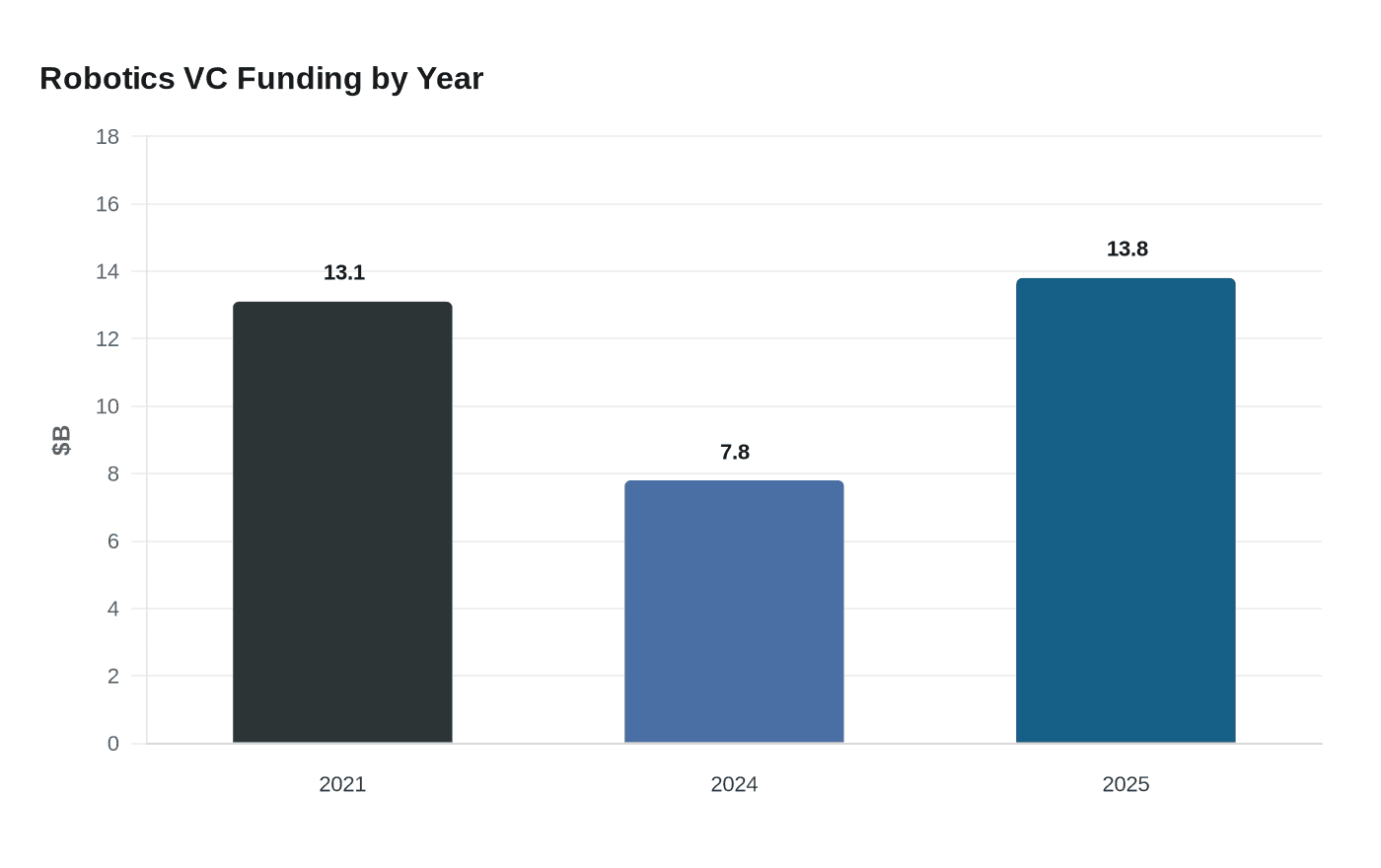
The broader capital surge underpins both companies' ambitions. Robotics startups raised $13.8 billion in funding in 2025, up from $7.8 billion in 2024 and topping even the $13.1 billion raised in the peak venture funding year of 2021. The question investors are now pricing is whether Physical Intelligence's bet on foundational research, before any committed revenue path, represents the next platform shift in automation or simply the latest iteration of a frothy funding cycle. At a potential $11 billion valuation with 80 employees and no disclosed customers, the market's answer will carry consequences well beyond a single San Francisco building marked by a Greek letter.
This article was produced by Prism’s automated news system from verified source data, official records, and press releases, then run through automated quality and moderation checks before publishing. The system is built and supervised by the people who set the standards it runs under. Read our full AI policy.
Know something we missed? Have a correction or additional information?
Submit a Tip