Platner wins Maine Democratic Senate primary despite campaign scandals
Platner’s 72% win showed Maine Democrats shrugged off campaign scandals, setting up a November showdown with Susan Collins in a race likely to help decide Senate control.

Graham Platner won Maine’s Democratic Senate primary with a commanding first-round majority, turning a campaign shadowed by scandals into a clear test of how much voters will forgive when a candidate still looks strong on biography, message and general-election odds. The military veteran and oyster farmer finished far ahead of outgoing Gov. Janet Mills and the rest of the field, and Maine’s ranked-choice system never came into play.
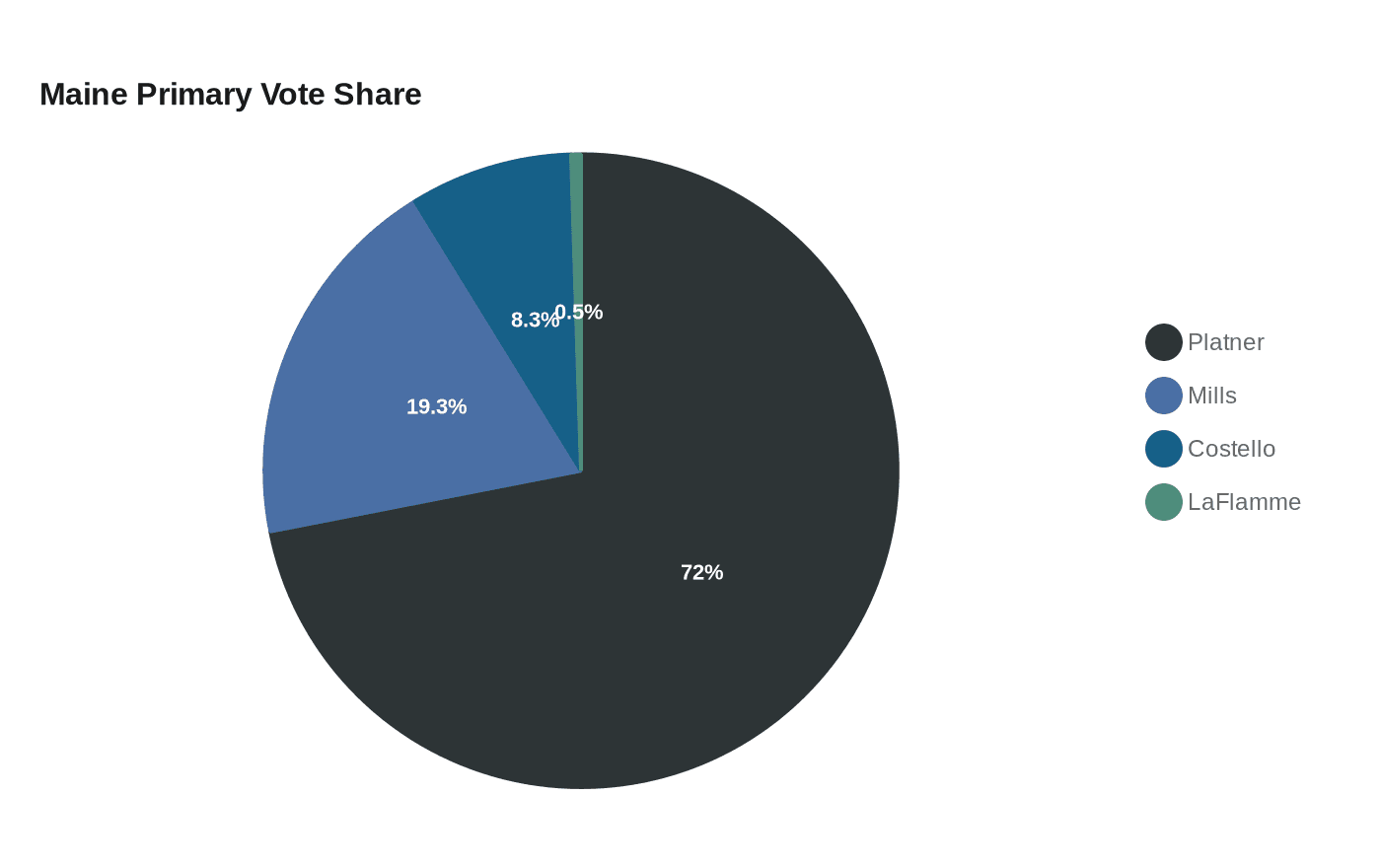
The Associated Press called the race at 6:23 p.m. on June 9, with Platner at 72.0% and 150,970 votes as 95% of precincts were estimated counted. Mills, who suspended her campaign on April 30 after saying she lacked the financial resources to continue, took 19.3%. David A. Costello received 8.3%, and Andrea LaFlamme’s write-in effort drew 0.5%.
Platner’s margin mattered as much as his victory. Maine uses ranked-choice voting in state primaries and in general elections for federal offices, a system designed to push nominees toward majority support through successive ballot redistributions if no candidate clears the threshold. Platner did not need that rescue. His first-choice total already put him over the line, making the primary a blunt verdict rather than a prolonged count town by town.
That outcome also sharpened the political meaning of the race. Platner quickly pivoted from his primary win to the general election against Republican Sen. Susan Collins, whose seat is among the most closely watched in the country. The race is for Maine’s Class II Senate seat, and the general election is set for November 3, 2026.

Collins has repeatedly outperformed national expectations in Maine. She first won election to the Senate in 1996 and was reelected in 2002, 2008, 2014 and 2020; her official biography says that 2020 victory made her the first-ever Republican woman to win a fifth term. The Cook Political Report rates the 2026 contest as a Toss-up, underscoring why Platner’s primary win immediately rippled beyond Democratic circles.
Maine’s elections calendar has already framed this as a high-turnout, high-stakes year. Absentee voting for the June 9 primary began statewide on May 11, and the secretary of state said the contest covered the U.S. Senate, both congressional districts, governor and all 151 state House and 35 state Senate seats. Ranked-choice voting was first used in Maine’s June 12, 2018 primary, but in this race the first round settled everything.
For Democrats, Platner’s win suggested that scandal alone was not enough to sink a candidate who still looked, to many voters, like the party’s best chance to challenge Collins. For both parties, it was a reminder that Maine’s Senate race could become a defining contest in the fight for control of Congress.
This article was produced by Prism’s automated news system from verified source data, official records, and press releases, then run through automated quality and moderation checks before publishing. The system is built and supervised by the people who set the standards it runs under. Read our full AI policy.
Know something we missed? Have a correction or additional information?
Submit a Tip