Practical Breath-Anchoring Guide and Short Script to Tame Monkey Mind
JoAnn Fox’s short essay promises an accessible breath anchor and short script to tame the monkey mind; try a one‑ to two‑minute breath anchor or explore the Pure Land recitation method for deeper practice.
If your head feels like "an uncontrollable, chattering distraction," there are two clear breath‑anchoring routes in circulation: quick secular anchors designed for one to two minutes of clarity at work, and a long‑view Pure Land recitation practice that ties each inhale and exhale to a devotional name. Below are practical, source‑rooted steps, a ready short script you can use now, and how to choose which path suits your day.
1. What JoAnn Fox offered in her post
JoAnn Fox published a short, practical essay titled "Taming the Monkey Mind with Mindfulness" on the blog Buddhism for Everyone on March 1, 2026. The original report describes the piece as a "practical post" and "short essay" that "explains the classic metaphor of the 'monkey mind,' offers an accessible breathing anchor practice" and promises a "short script." The precise wording of Fox's script wasn’t supplied in the material I worked from, but her framing—practical and short—sets the expectation for time‑bound, usable tools rather than long theoretical treatments.
2. Meet the monkey mind (framing from the London piece)
First, put a name on the trouble: "First, meet your ‘monkey mind’, a metaphor based on a Buddhist idea where the monkey is an uncontrollable, chattering distraction inside your head." The London excerpt goes further: "When stress levels are high, the symbol is described as ‘a mad monkey bitten by a scorpion’. It homes in on worst‑case scenarios and raises your blood pressure by endlessly re‑running them." Those two lines explain why a compact breath anchor can be effective: it interrupts the replay loop and calms physiology. As the excerpt also notes, "When you tune into what’s really happening, you start to notice thought patterns about your own feelings," which is the first step toward making different choices under pressure.
3. A one‑ to two‑minute breath anchor you can use now (secular, workplace friendly)
If you have a minute or two, follow this time‑bounded anchor drawn from the London framing and its emphasis on brevity and accessibility. Sit or stand where you are, soften your shoulders, and place a hand on your belly to feel movement. Breathe naturally and count silently: inhale 1, exhale 1 — continuing for 8–12 breaths, keeping the breath neither forced nor held; "Focusing for just a minute or two on your breath is a magical way of controlling your physical, emotional and mental state. Just taking that simple step can raise your level of empathy and focus your attention." You don’t need a formal meditation posture or long schedule; as Danby says, "You don’t need to meditate to get the benefits of mindfulness...You just have to breathe."
4. The Pure Land breath‑recitation method (procedural text from the Ymba excerpt)
For readers interested in a traditional, devotional route, the Pure Land text excerpt provides stepwise, breath‑linked recitation instructions. The excerpt prescribes: "Regulating the Breath When the mind is at peace and the breath is regular, you should first visualize yourself seated in a circular zone of light, then visualize the breath going in and out of your nose as you silently recite the Buddha’s name once with each breath. You should regulate the breath so that it is neither slow nor hurried, the mind and the breath reinforcing each other, following each other in and out. Whether walking or standing, reclining or sitting, proceed in this manner without interruption. [...] In this way, everyone can practice the Pure Land method. One crucial point to remember: once the fixed periods are established, they should be adhered to without deviation, even during sickness or other suffering. The above notwithstanding, whenever we have a free moment, we should immediately think of the Buddha’s name." The text continues with the practice aim: "To replace sentient beings’ thoughts with Buddha‑thoughts, while not necessarily a sublime method, is still a rare expedient which can turn delusion into enlightenment. [...] You should strive to keep the Buddha’s name constantly in mind, whether awake or dreaming." It even prescribes sleep‑time habituation: "To achieve this, train yourself to recite the Buddha’s name in bed until falling asleep. Moreover, before climbing into bed, you should awaken the mind of recitation. Tell yourself that there is no better way to escape Birth and Death than constant recitation of the Buddha’s name, when awake or asleep. If each day you remind yourself of this, you will grow accustomed to recitation and naturally succeed." If you pursue this path, note the explicit commitments: visualization, one recitation per breath, continuous practice across postures, and adherence to fixed periods.
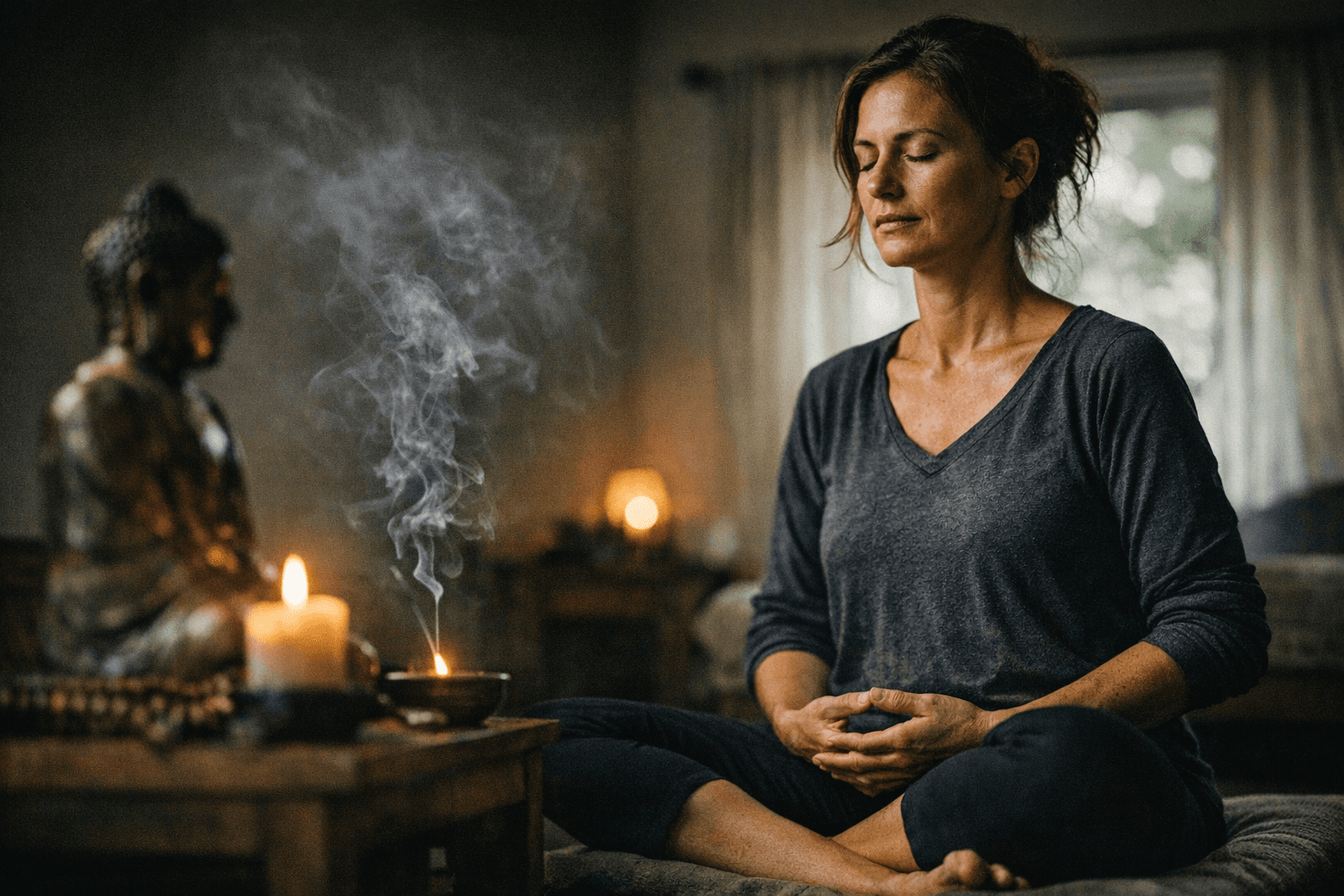
- "Settle your posture. Breathe naturally. As you inhale, think 'in'; as you exhale, think 'out.' Count each cycle: one, two, three—for eight breaths. Notice where the body softens. Return to one if the mind wanders." This script is intentionally secular and brief; it follows the research insight that short practices (one‑to‑two minutes) are highly practical in daily life and can "raise your level of empathy and focus your attention."
5. A short, usable breath‑anchoring script (secular and adaptable)
Use this compact script as a practical tool you can speak silently to yourself anywhere. It leans on the time‑bound simplicity the London piece recommends and the anchoring regularity emphasized in both traditions:
6. How to choose between a short anchor and a recitation practice
The materials present two distinct ends of the breath‑anchoring spectrum. The London excerpt emphasizes pragmatic, short interventions for clarity and decision‑making—"Mindfulness is a way of developing the ability to discipline the mind, take control of that chattering and bring focus to thinking"—and includes Danby's practical reminder that you don't have to sit for long to gain benefit. By contrast, the Ymba Pure Land instructions treat breath‑linked recitation as continuous devotion aimed at "escape [from] Birth and Death" and turning "delusion into enlightenment," with strict adherence to fixed periods and even sleep recitation. JoAnn Fox’s March 1, 2026 essay promises "an accessible breathing anchor practice" and a "short script," but the supplied excerpt does not say whether Fox recommends a secular anchor, a devotional recitation, or a hybrid; you should choose based on your intent—stress relief and decision clarity favors the one‑ to two‑minute secular anchors; devotional goals or full‑time recitation practice require the commitments described in the Pure Land text.
- Use time bounds to make practice shareable: the London material highlights the power of "just a minute or two"—frame sessions as short and trackable to increase uptake.
- Anchor to context: the Ymba excerpt insists on "fixed periods" and adherence "without deviation, even during sickness or other suffering"—if you want habit durability, decide on specific times and defend them.
- Build micro‑moments: the Pure Land text advises "whenever we have a free moment, we should immediately think of the Buddha’s name." Translate that into secular terms by setting phone reminders for one‑minute anchors.
- Sleep habit: if you pursue the devotional route, the Ymba instructions are explicit—"train yourself to recite the Buddha’s name in bed until falling asleep"—while a secular adaptation could be three minutes of breath awareness before lights‑out.
7. Practical implementation and habit tips grounded in the sources
8. Closing: a practical invitation, not a prescription
Taming the monkey mind doesn't require a single school of practice. JoAnn Fox’s post promises an "accessible breathing anchor practice" and a "short script" useful to readers seeking practical tools; the London material shows that tiny, time‑bound breaths shift physiology and attention ("You just have to breathe"), and the Pure Land excerpt demonstrates how breath plus name recitation becomes a life‑long devotional vehicle when one is ready for that commitment. Choose a tool you can actually do tomorrow—eight mindful breaths at your desk, or a committed recitation period—and let the practice you can maintain, not the one that sounds most sacred, do the work.
Know something we missed? Have a correction or additional information?
Submit a Tip