Premium Baby Shower Packages, Pricing Models, and Scaling Strategies for 2026
The baby shower market rewards operators who think in packages, not piecemeal quotes — here's how to build tiered offerings, protect margins, and scale profitably in 2026.

The baby shower has quietly become one of the most reliably profitable social event categories for boutique studios and venue operators. Unlike weddings, which demand months of runway and armies of vendors, a premium baby shower can be planned in weeks, staffed lean, and still command thousands of dollars per booking. The operators who succeed in 2026 are the ones who stop quoting line items and start selling experiences.
Building Your Three-Tier Package Architecture
The foundation of any scalable baby shower offering is a tiered package structure. Creating "Bronze," "Silver," and "Gold" packages caters to different budgets while building in clear upsell opportunities at every level. Think of the entry tier as a proof-of-concept for clients on the fence, not a discounted version of your best work. It should cover the non-negotiables: venue access, basic décor from your in-house inventory, and coordination on the day.
The mid-tier is where most bookings will land and where your margin story gets interesting. A well-constructed middle package builds on base venue access with a curated in-house décor setup, designed, installed, and removed by your team, with selections intentionally streamlined to create a cohesive, elegant look while keeping the planning process simple and efficient. This operational simplicity is a margin lever: your team executes the same install repeatedly, getting faster and more cost-efficient with every event.
The premium tier is where customization earns its keep. Full-room installations, specialty sourcing, and fully custom themes should be included only when approved separately and priced accordingly. Flag these as scope expansions from the start, not surprises discovered mid-planning.
Pricing Models That Protect Your Margin
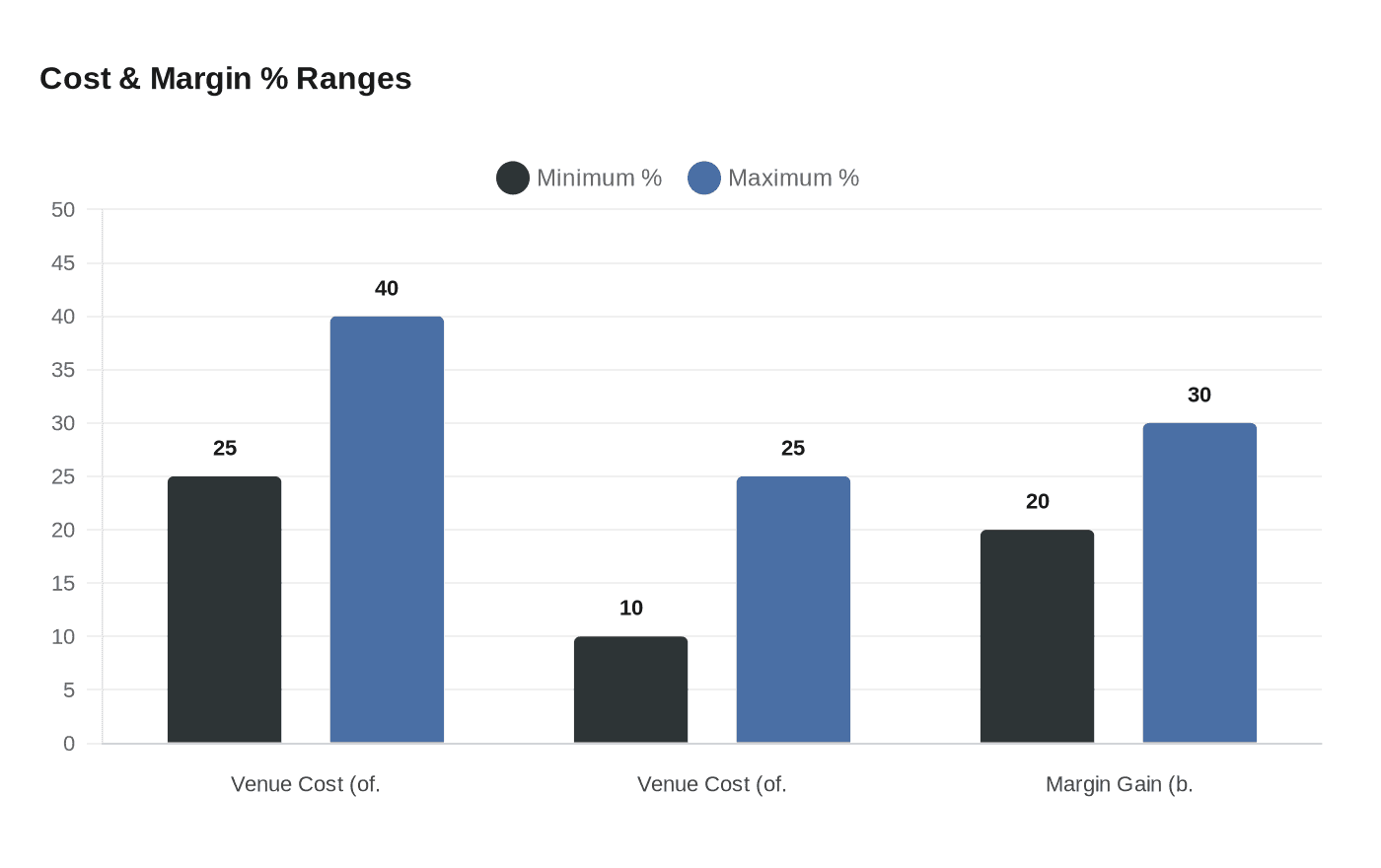
Venue costs typically represent the largest single expense in any event budget, accounting for 25% to 40% of the total client spend. Understanding this ratio is critical: it tells you exactly how much room you have to price your planning and décor services on top before clients feel the pinch.
Dynamic pricing is another key lever: charging more for peak days and less for off-peak times encourages bookings throughout the year rather than clustering demand on Saturday afternoons. A Sunday morning baby brunch, priced 15% to 20% below your Saturday rate, fills a slot that would otherwise sit empty and builds weekday revenue momentum.
Value-based pricing means building your rates around what makes your offering unique, whether that's a stunning space, exceptional service, or a distinctive aesthetic, and quantifying that value into your price points. A venue with a well-lit content-creation wall, for instance, can justify a premium because it directly delivers social media value to clients who are already thinking about documentation before the event even happens.
On the planner side, venue costs typically make up 10% to 25% of a client's overall budget for an in-person event, which means a well-packaged studio offering that bundles space with planning services captures a larger share of total client spend than a bare-bones venue rental alone.
The Add-On and Upsell Layer
Combining planning, décor, and audiovisual services can increase overall margins by 20% to 30% compared to selling each service separately, while providing value to clients through simplified coordination. The key word is "bundled": clients pay for convenience, and you protect your margin by controlling the vendor relationships.
High-value in-house upsells include catering, bar services, AV equipment rental, specialty lighting, décor packages, floral services, and event coordination. Of these, florals and specialty lighting tend to carry the highest perceived value relative to cost, making them ideal candidates for premium add-on pricing.
To hit monthly revenue targets, ancillary options must be integrated into the initial sales pitch, not offered as afterthoughts. Baking A/V costs and premium furniture packages into tiered offerings, rather than quoting them separately, significantly increases attachment rates.
Vendor markups on services like catering, audiovisual equipment, and décor typically add 10% to 15% to supplier costs, contributing an additional $1,000 to $20,000 monthly for active agencies, with higher earnings for operators managing luxury events where vendor costs are substantial.
Vendor Partnerships as a Margin Lever
Venue commissions represent a significant income source, with event agencies earning 10% to 20% of venue rental fees. For established companies, this can generate $2,000 to $10,000 monthly depending on event volume and venue partnerships, with stronger relationships at premium venues often unlocking higher commission rates.
For boutique studios handling planning without their own space, building a preferred vendor network is the equivalent of owning real estate without the capital outlay. Negotiate preferred-supplier agreements with florists, bakers, and photographers who operate in the premium tier. Assigning a single dedicated planner as the client's point of contact, and coordinating all vendors through that person, ensures every element stays on-brief and on-budget.
Implementing strict payment schedules with deposits and progress payments protects against client cancellations and payment delays that can eliminate margins even on events that otherwise run well. A standard structure: 30% deposit at signing, 50% thirty days before the event, and the balance 72 hours prior.
Scaling: From One-Off Events to a Repeatable System
Event venues can achieve profit margins between 10% and 60%, but that range hinges almost entirely on strategic planning and operational management. The operators at the top of that range are running repeatable systems, not reinventing the event every time.
Generating the majority of revenue from social events becomes significantly more achievable by making the booking process simple: an online calendar, instant pricing calculator, and packages that make immediate sense to a client planning under time pressure.
Capacity utilization is the other half of the scaling equation. The true capacity utilization rate for an event venue depends entirely on how many events are booked relative to total available hours to generate enough gross profit to absorb fixed monthly operating expenses. For baby shower-focused studios, the math is favorable: events are typically two to four hours long, meaning a venue can realistically host two events per day on weekends without schedule overlap.
A seamless and memorable experience leads to positive reviews, repeat business, and word-of-mouth referrals, and in the baby shower segment, referrals are the primary acquisition channel. A guest at today's event is a potential client for tomorrow's. Every detail you execute well, from the arrival setup to the breakdown speed, is marketing.
Protecting Profitability as You Grow
New operators often underestimate costs, neglect marketing, and fail to build strong vendor relationships — and proactive planning is the clearest way to prevent these margin-eroding mistakes.
Higher net profit margin means more cash retained from each dollar of revenue, allowing owners to reinvest without adding top-line sales pressure. As volume grows, the fixed costs of your coordinator, décor inventory, and studio space spread across more events, and your per-event profit climbs without requiring additional overhead.
The operators who build the most durable baby shower businesses in 2026 will be the ones who treat packaging as a product design problem: intentional, tested, and refined over time. Every tier should earn its price point. Every add-on should have a rehearsed pitch. And every event should close with a system for capturing referrals before the guests even leave the room.
Sources:
Know something we missed? Have a correction or additional information?
Submit a Tip