Prosecutors seek death penalty for ex‑president Yoon Suk Yeol
Special prosecutors asked a Seoul court to sentence former president Yoon Suk Yeol to death for an alleged insurrection tied to his December 2024 martial law decree.
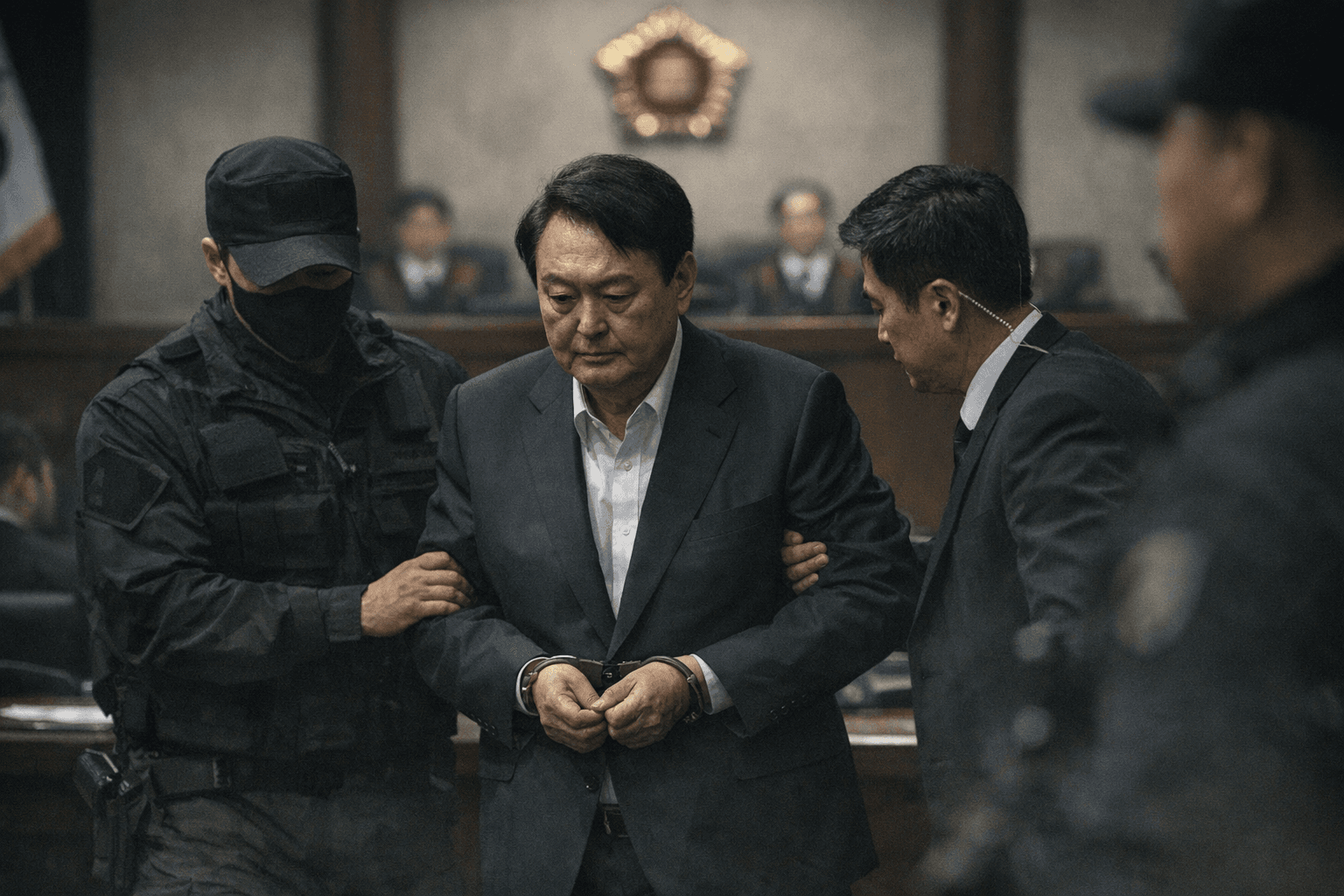
Special prosecutors asked a Seoul court on Jan. 13 to sentence former president Yoon Suk Yeol to death, accusing him of leading an insurrection when he briefly declared martial law in December 2024. The request was made during closing arguments before a three-judge panel at the Seoul Central District Court by the independent special counsel team led by Cho Eun-suk.
Prosecutors told the court that Yoon had acted as the “ringleader” of an attempt to subvert the constitutional order, characterizing the decree as “anti-state activities,” a “self-coup” and an effort to neutralize the constitutional structure of state governance. In urging the capital punishment, they argued that Yoon “showed absolutely no remorse,” and that his actions destroyed constitutional values including democracy and the rule of law while violating core fundamental rights.
The insurrection case against Yoon was tried together with related proceedings against former defence minister Kim Yong-hyun, for whom prosecutors sought life imprisonment, and former National Police Agency chief Cho Ji-ho, for whom they sought a 20-year term. The consolidated trial also encompasses five other defendants accused of playing parts in the implementation of the martial law plan.
Prosecutors presented a memo attributed to a former military officer among their exhibits, saying it contained a suggestion of “disposing” of hundreds of people, including journalists, labour activists and lawmakers. That document was cited by prosecutors as emblematic of the plan’s coercive and extra-legal ambitions.
Yoon rejected the charges in his final statement to the court, categorically denying that he was the ringleader and maintaining the declaration of martial law was within his presidential powers. He said the measure was meant to signal a national crisis and to protect the country, arguing that governance had been paralyzed by opposition obstruction. Yoon has repeatedly branded the investigations “frenzied,” accusing prosecutors of “manipulation” and “distortion.”
The case sits at the intersection of criminal law, constitutional order and politics in a country that has seen dramatic turmoil since the December episode. Parliament impeached Yoon after the martial law declaration, and he was removed from office last April following a snap election that brought Lee Jae-myung to the presidency. Yoon was arrested in January 2025 and has been detained through multiple criminal proceedings, including what reports say are as many as eight separate trials stemming from the martial law incident and other allegations.
Legally, a conviction for directing a rebellion under South Korean law carries only two possible punishments: death or life imprisonment. South Korea has not carried out an execution since 1997, maintaining a de facto moratorium even though capital punishment remains on the statute books. Judges will also consider precedent in which a former leader’s capital sentence was later reduced to life imprisonment.
The case is likely to have wide political and diplomatic repercussions. Domestically it will test public confidence in the judiciary and the resilience of democratic institutions after an episode that split parties and civil society. Internationally, the outcome could prompt scrutiny of South Korea’s approach to transitional justice and human rights, particularly given the unusual prospect of capital punishment being sought for a former democratic leader.
The three-judge panel was expected to deliver a verdict and sentence in the coming weeks following the Jan. 13 closing arguments. The decision will reverberate across Korea’s politics and the region, shaping debates about accountability, rule of law and the bounds of executive power.
This article was produced by Prism’s automated news system from verified source data, official records, and press releases, then run through automated quality and moderation checks before publishing. The system is built and supervised by the people who set the standards it runs under. Read our full AI policy.
Did this article answer your question?


