Putin Hosts Tightened Victory Day Parade Amid Ceasefire and War Threats
Moscow locked down Red Square for Putin’s Victory Day parade, as a ceasefire and recent drone strikes exposed the security stakes behind the show.

Extra security measures turned Red Square into a tightly controlled stage for Vladimir Putin’s Victory Day parade, with the Kremlin relying on a U.S.-brokered three-day ceasefire to reduce the risk of Ukrainian disruption while Russia marked one of its most important state holidays.
Victory Day, observed on May 9, commemorates the Soviet Union’s defeat of Nazi Germany in World War II and remains a central symbol of wartime memory and national identity in Russia. But this year’s parade was described as Russia’s most scaled-back Victory Day display in years, a sign that the war in Ukraine had become impossible to separate from the ritual meant to project confidence and continuity.
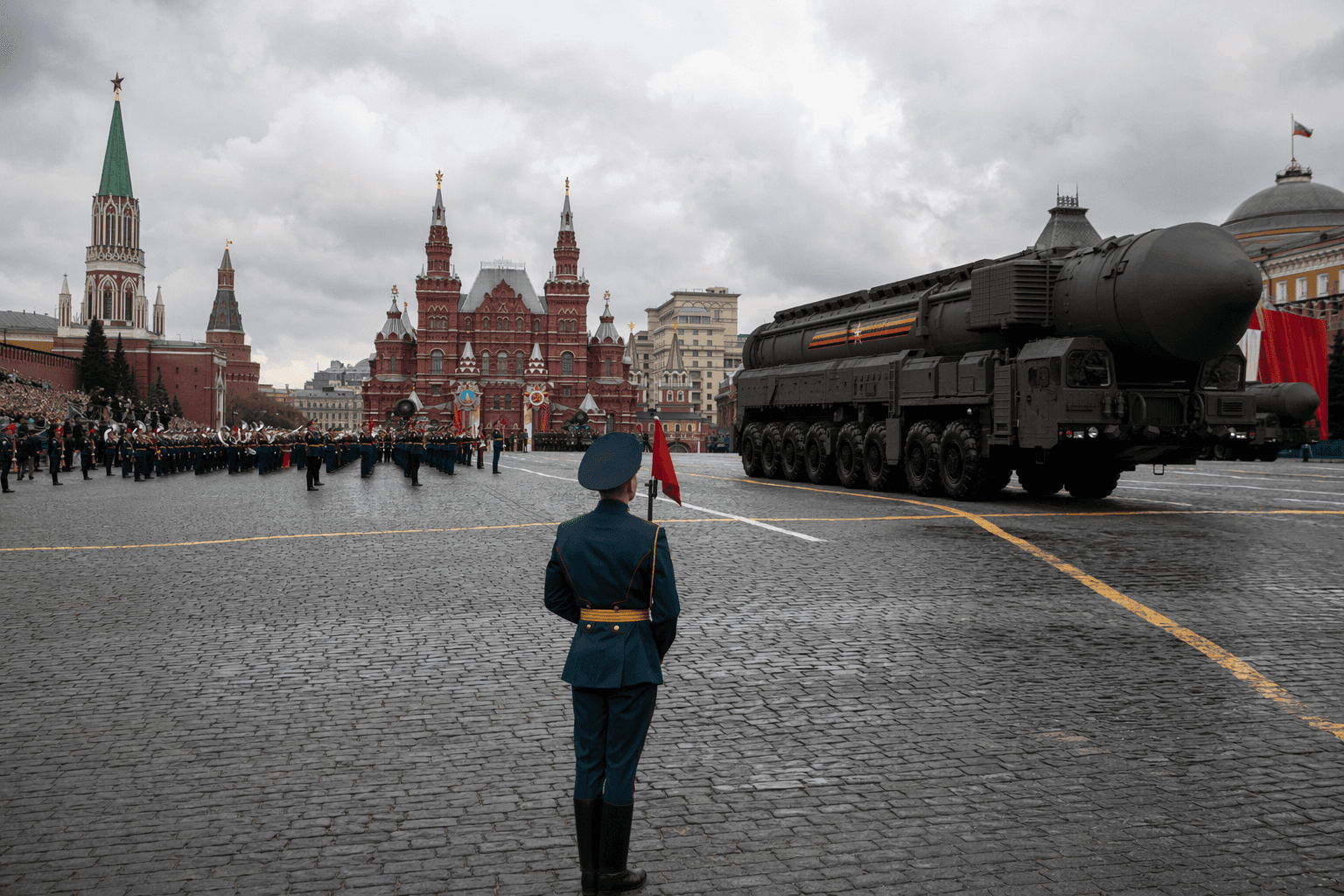
Security concerns were sharpened by recent Ukrainian drone strikes on Moscow in the days before the event. That threat hung over the capital even as Putin prepared to use the parade to show order, control and resilience in the face of a grinding war that has strained Russia’s military posture.
Foreign guests were part of the choreography, but the guest list appeared slimmer than in prior years. In 2025, the Kremlin said 29 foreign leaders would attend the Victory Parade in Moscow, and military personnel from 13 countries were expected to march. That roster included Xi Jinping, Alexander Lukashenko, Aleksandar Vučić, Robert Fico and Luiz Inácio Lula da Silva, underscoring the Kremlin’s effort to cast the parade as an international event as well as a domestic one.
This year’s more restrained gathering pointed in the opposite direction. Fewer foreign leaders were coming than in previous years, a quiet measure of Russia’s growing diplomatic isolation even as Putin continued to present Victory Day as proof of state endurance. The contrast mattered: the Kremlin still used the holiday to summon the language of unity and sacrifice, but the tightened perimeter around Moscow made plain that vulnerability, not just strength, now shaped the spectacle.
Putin has continued to speak with confidence about victory in Ukraine, and the parade was built to reinforce that message. Yet the scale of the security operation, the thinner foreign attendance and the temporary ceasefire all suggested the same underlying reality: Russia’s most symbolic public celebration now requires extraordinary precautions to go forward at all.
Know something we missed? Have a correction or additional information?
Submit a Tip