QinetiQ and AMS Achieve Maiden Flight With Recycled-Titanium 3D-Printed Hinge
QinetiQ’s Flight Test Organisation flew an Agusta A109S on Feb 27, 2026, with a structural hinge 3D printed from recycled titanium, a milestone QinetiQ and AMS describe as a “world first” and say cuts CO2e by 93.5%.
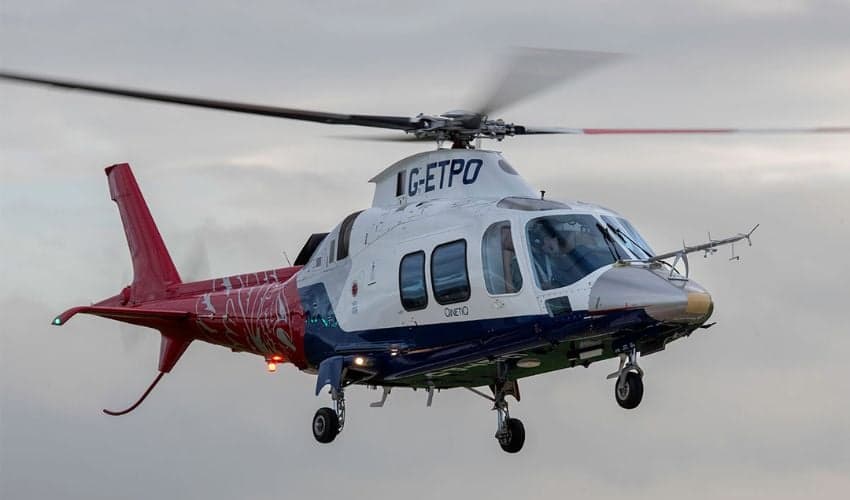
QinetiQ and Additive Manufacturing Solutions Ltd. (AMS) completed a maiden flight on Feb 27, 2026 that carried a structural hinge 3D printed from recycled titanium, a milestone the companies describe as a “world first.” QinetiQ’s Flight Test Organisation at MOD Boscombe Down, Wiltshire, flew the QinetiQ-owned Agusta A109S fitted with the part, which was integrated into an Air Data Boom destined for the Empire Test Pilots’ School (ETPS).
The component was a hinge that forms part of the helicopter’s air‑data sensing assembly. QinetiQ designed and integrated the hinge onto the A109S, while AMS manufactured the part using powder produced from titanium recovered from a decommissioned aircraft. Aerospace Testing International reports the manufacturing used laser powder bed fusion (LPBF) to produce the hinge, and QinetiQ carried out the flight testing from Boscombe Down.
AMS describes its contribution as a proprietary recycling process that converts scrap titanium into powder meeting additive‑manufacturing quality requirements. VoxelMatters and 3dprinting relay AMS’s claim of 97% material efficiency and “minimal material loss.” Aerospace Testing International separately states the material used was “98% recycled.” The two figures are reported in different outlets and are not presented as identical metrics in source material; QinetiQ and AMS characterise the environmental benefit further, saying the approach produces 93.5% less CO2 equivalent emissions compared with traditional supply chains.
QinetiQ’s statement on the project included comments from Simon Galt, Managing Director Air at QinetiQ: “Our testing and engineering expertise is helping to prove the technology which will reduce the UK’s dependency on other nations for aerospace grade titanium. Not only are we helping to strengthen UK supply chains, we are also leading the rest of the world in the very latest 3D printing technology.” AMS Director and CEO Rob Higham framed the achievement around AMS’s recycled feedstock work: “AMS has tirelessly built momentum and expertise within the additive powder market, with a sharp focus on providing recycled feedstocks. This milestone reflects the dedication of our team and QinetiQ’s commitment to a more resilient and sustainable future.”

Beyond the helicopter testbed, Unmanned Systems Technology flagged clear implications for UAVs and drone platforms that need high‑strength, lightweight structural solutions in demanding environments. AMS estimates the UK could become self‑sufficient in aerospace‑grade titanium if titanium contained in scrap aircraft were fully extracted and recycled; other reporting notes China and Russia currently supply the largest shares of global aerospace titanium.
The organisations present the environmental and material‑efficiency figures as claims and describe the flight as a world first. LPBF, reclaimed titanium feedstock, the 97% material efficiency claim, the 98% recycled figure and the 93.5% CO2e reduction are the core technical and sustainability metrics now in the public record; if AMS’s process scales to production volumes, it could materially alter sourcing and waste‑loss dynamics for UK aerospace and related additive‑manufacturing supply chains.
Know something we missed? Have a correction or additional information?
Submit a Tip