Quantinuum debuts on Nasdaq after $1.68 billion IPO surge
Quantinuum’s Nasdaq debut valued quantum computing hype at $1.68 billion, even as practical customer use remains limited and years away.
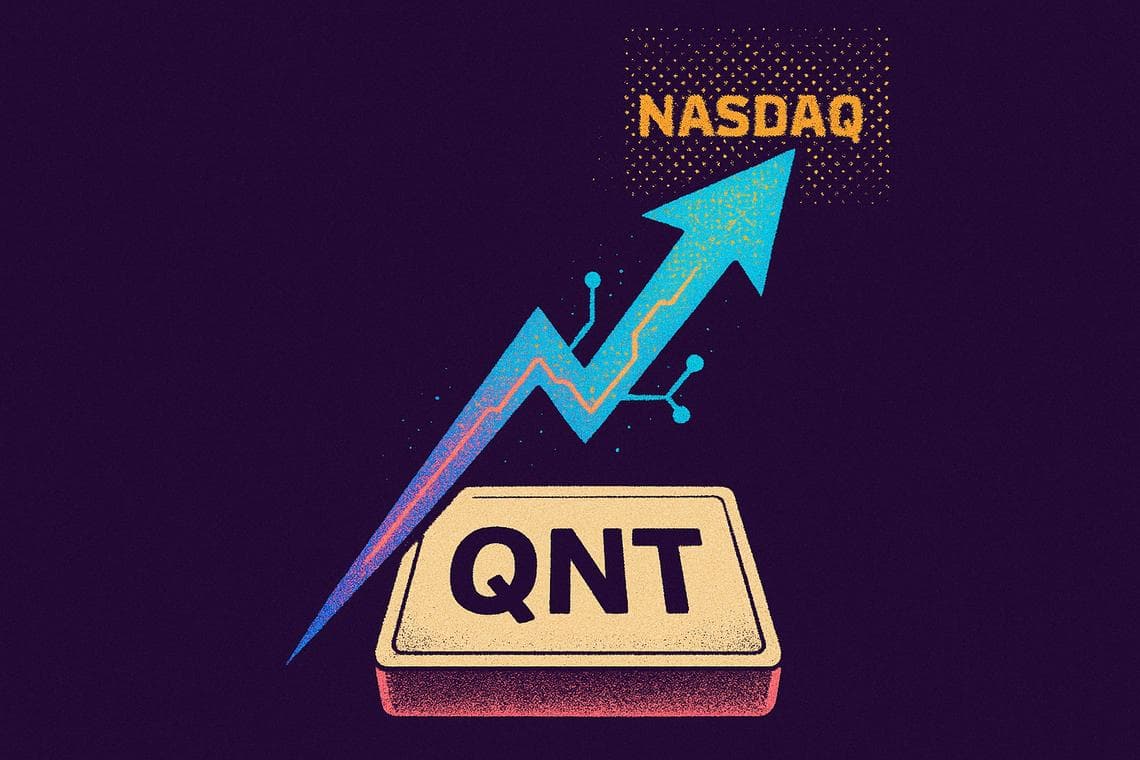
Quantinuum arrived on Nasdaq with investor demand strong enough to lift its upsized offering to $1.68 billion, a clear sign that public markets are still willing to pay for quantum computing exposure even before the technology has broad commercial use. The Honeywell-backed company priced shares at $60, above the marketed range of $53 to $55, and sold 28 million shares under the ticker QNT.
The debut put fresh market attention on a sector that is still defined more by promise than revenue. Quantinuum, formed in November 2021 from Honeywell Quantum Solutions and Cambridge Quantum, has pitched itself as a full-stack platform spanning hardware and software for hard computational problems. The company’s latest fundraising also underscores how quickly private-market valuations have climbed: Honeywell invested $300 million in January 2024 at a $5 billion pre-money valuation, then announced another roughly $600 million raise in September 2025 at a $10 billion pre-money valuation. After the offering, Honeywell was set to retain about 48.1% of the combined voting power.
The public-market appetite is being reinforced by policy support. On May 21, the U.S. Department of Commerce announced 9 letters of intent for $2.013 billion in federal incentives under the CHIPS and Science Act, covering two domestic quantum foundry companies and seven quantum computing companies. The goal is to accelerate utility-scale, fault-tolerant quantum computers and strengthen U.S. national security, with applications spanning defense, advanced materials, biopharmaceutical discovery, financial modeling and energy systems.

Quantinuum has leaned heavily on technical milestones to justify the capital. On June 5, 2024, the company announced its 56-qubit trapped-ion H2-1 system, saying it delivered a 100x improvement over a prior benchmark in random circuit sampling and an estimated 30,000x power reduction versus classical supercomputers for that workload. The company also said the system enabled four reliable logical qubits with Microsoft’s help, a step investors view as evidence that fault-tolerant computing is moving from theory toward engineering.
The company’s management reshuffle in February 2023 also marked a tighter push toward commercialization, with Rajeeb Hazra becoming chief executive and Ilyas Khan moving to chief product officer and vice chairman. J.P. Morgan and Morgan Stanley served as joint lead active book-running managers, with Jefferies and Evercore ISI also active. The offering carried a 30-day option for up to 4.2 million additional shares and was expected to close on June 5.

For now, Quantinuum’s market debut captures the central tension in quantum computing: public investors are rewarding long-term strategic potential, policy makers are backing the field with billions, and the underlying business is still far from the scale of everyday enterprise deployment.
This article was produced by Prism’s automated news system from verified source data, official records, and press releases, then run through automated quality and moderation checks before publishing. The system is built and supervised by the people who set the standards it runs under. Read our full AI policy.
Did this article answer your question?