Quick-Start Guide Teaches DMs 60-90 Minute Prep for One-Shots
This quick-start method shows how 60–90 minutes of prep will get you a tight one-shot ready for a 3–4 hour table session, with scene counts, pacing rules, and the exact admin you must clear beforehand.
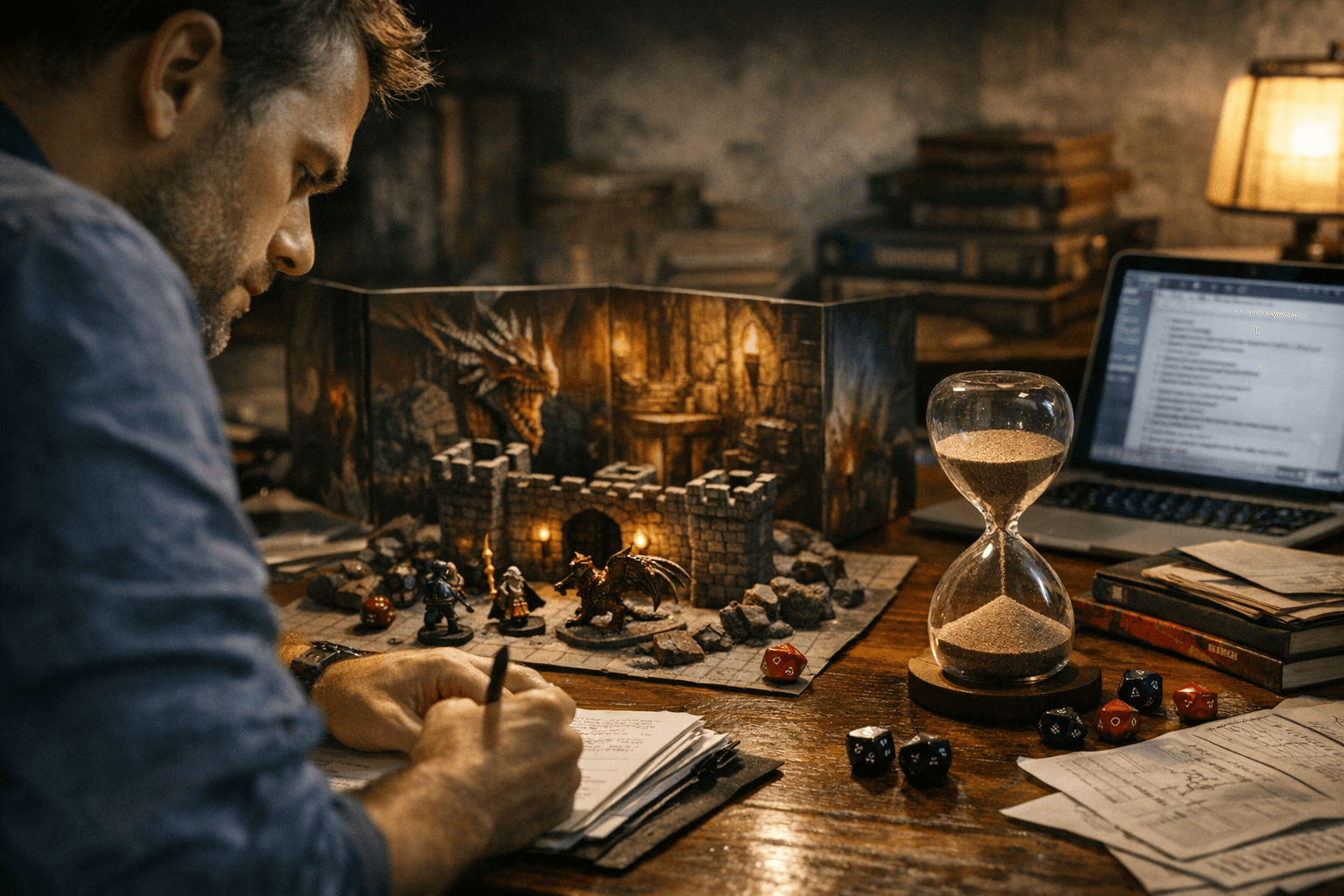
What this is: this DM quick-start guide condenses a reliable framework for prepping one-shot Dungeons & Dragons sessions (60–90 minutes of prep for a 3–4 hour table session). Think of this as an efficient blueprint to deliver a pacey, memora — a short, focused workflow you can execute in one evening and run the same week. The whole point is practical setup: spend an hour to 90 minutes now to avoid frantic rulings and stalled scenes at the table later.
Who this is for and how to set the guardrails. The guide is aimed at new and experienced DMs who need an efficient blueprint for one-shots; it assumes you know the people you’re prepping for and how long you have. Before you touch maps or stat blocks, decide what character options you’ll allow: Unearthed Arcana, certain homebrew sources, only official sources, or just options from the Player’s Handbook. As Friendlybard says, "be sure to communicate it to your players as soon as you can, preferably alongside level and equipment communications." That early communication is the single admin move that prevents character disputes five minutes into play.
60–90 minutes of prep: what to do with the time. Use your hour-and-a-half in three stages: set rules and scope (10–15 minutes), outline the adventure flow (30–45 minutes), and gather quick references (15–30 minutes). The outline is the part most DMs underprepare: "I struggled to keep one-shots within our 3-4 hour time slot until I figured out the best way for me to outline the flow of action." That’s the Friendlybard confession that drives the scene-count rule below — invest the bulk of your prep on a one-page flow of scenes and the likely beats inside each scene.
Scene-count heuristic to keep time honest. Friendlybard gives a simple party-size rule: "In players groups of two or three, I can usually fit 3-4 scenes into my outline. Any more than that, and it’s best to keep it to 2-3." Use that as your constraint. For a two- or three-player table, plan 3–4 clear scenes: hook, complication, climax, denouement. For larger groups, collapse to 2–3 scenes and make each scene multi-threaded so players can split spotlight time. Label each scene with an expected time window (20–45 minutes) so you can monitor pacing in real time.
- Decide allowed character-option sources and notify players "alongside level and equipment communications."
- Draft a 1-page scene flow with estimated minutes per scene based on party size.
- Pull up stat blocks and rules references for the monsters and key spells you expect: "Make sure you have stuff like stat blocks or rules references already pulled up to cut down on the time it takes to reference them."
- Note two bailout encounters or scenes you can skip or compress if time runs short.
- Prepare one NPC with a single memorable trait and a short quote to avoid long roleplay stalls.
Prep checklist you can finish in an evening. These are the exact items to complete during your 60–90 minute window:
- "Direct the pace of the game while being away of the time available for the session"
- "Slow down where the characters show interest"
- "Speed up where the party stops moving forward"
- "Be intentional with your narration and where you’re pointing the characters’ focus"
- "Let the PCs come up with creative solutions"
Running the one-shot: the pacing checklist to follow at the table. Friendlybard’s live-running advice is compact and essential; use it as your running script. "While you’re running a one-shot, remember to:" then apply these directives at the table:
Those five lines are not philosophy; they are prescriptive actions. Point narration to the next scene with a single sensory cue, slow down for roleplay the players are actually leaning into, and when you notice a stall, cut options or hand-wave a quick skill check to maintain momentum.
Narration, spotlight, and letting creativity win. Be intentional with every sentence you narrate; your words are the throttle. Use short, concrete prompts — a single sentence that describes the important change in the room — to steer players without railroading. When players answer creatively, reward that: "Let the PCs come up with creative solutions." That both shortens decisions at the table and creates the memorable beats that matter in a one-shot.
Flexibility is part of the plan. These tips are meant to help you prep a structured and short adventure that moves quickly. But Friendlybard reminds you that "As with all DMing, it’s vital to know your particular group and what’s fun for them. You know how much time you have for the session, and you know the people you’re prepping for. These tips are meant to help you prep a structured and short adventure that moves quickly. But if your players want to spend more time in a certain place, let them!" Build one or two soft stops into your flow where the group can linger if they choose; that’s part of staying both structured and player-friendly.
Final table admin and mental state. Before you start the session, run a quick check: character options communicated, stat blocks open, scene flow printed or on-screen, time windows noted. Then remember the simplest line Friendlybard left for DMs: "don’t forget to breathe and enjoy the game!" That matters — the best way to keep a one-shot within a 3–4 hour time slot is a calm, decisive DM.
Once you’ve set those guides down, it’s time to actually prep the adventure. Now it’s time to run the adventure! If you follow the 60–90 minute prep cadence, the party size scene rule, and the pacing checklist above, you’ll trade frantic improvisation for a one-shot that finishes on time and still delivers the dramatic moments players remember. That’s the whole point of the blueprint: spend the hour, run the show, and come away with a clean win at the table.
Know something we missed? Have a correction or additional information?
Submit a Tip