Rachel Goldberg-Polin on grief, love, and life after her son's death
A mother’s grief becomes a public witness to war, hostage-taking, and survival. Rachel Goldberg-Polin shows how love can outlast catastrophe.
A grief that stayed public
Rachel Goldberg-Polin has become one of the most recognizable faces of the hostage crisis not because she wanted attention, but because her son’s kidnapping made silence impossible. In her conversation with Anderson Cooper, she speaks as an American-Israeli mother still trying to live inside a loss that never stopped being political, personal, and global at once. Her account turns the familiar headlines about hostage deaths into something more intimate and more brutal: the long afterlife of a child’s absence.
That tension is what gives her testimony such force. Hersh Goldberg-Polin was 23 when Hamas attacked the Nova Music Festival area near the Gaza border on Oct. 7, 2023, killing about 1,200 people and taking more than 250 hostages. He was badly wounded in the attack and lost part of one arm before being taken into Gaza, which means his family’s story was never just about captivity, but also about the violence that began it.
From hostage campaign to bereavement
Rachel and her husband, Jon Polin, became relentless public advocates for the hostages, and their campaign helped define the emotional language of the crisis. They marked the number of days their son had been held, a simple but searing visual reminder that every day in captivity was also a day of family suspense, political bargaining, and rising dread. For many viewers, that public visibility made the Goldberg-Polins a symbol of endurance; for the family, it was an act of refusal, a way to insist that Hersh remained a person and not a statistic.
That public identity changed after his death. CBS News reported that Hersh was held for more than 300 days and was killed in late August 2024, and the family said his body was among six hostages recovered in Gaza in early September 2024. The shift from hostage advocacy to mourning did not end the politics around the family’s story. It deepened them, because the campaign for release became a campaign against forgetting what was lost when release never came.
Rachel has continued to press for the return of remaining captives and for a cease-fire deal, keeping her family’s grief connected to the still-open hostage crisis. That choice matters because it rejects the clean separation that headline coverage often tries to impose between one family’s tragedy and the larger machinery of war. Her son’s death is not presented as an isolated heartbreak, but as evidence of a conflict that keeps producing new bereavements even after a hostage’s name leaves the front page.
What her words reveal about mourning
In the interview, Rachel says grief has become a “badge of love.” The phrase is hard, plain, and devastating in its refusal to sentimentalize loss. It suggests that the pain itself is proof of attachment, and that loving Hersh now means carrying the ache of his absence rather than trying to escape it.
That idea gives her testimony a rare emotional precision. She is not speaking as someone trying to move on, but as someone trying to figure out how to live after losing a child, a task that has no neat finish line. Her grief is still bound to the circumstances of his death, which is why the interview resonates beyond one family: it captures how bereavement can become inseparable from public trauma when war enters the home and then stays there.
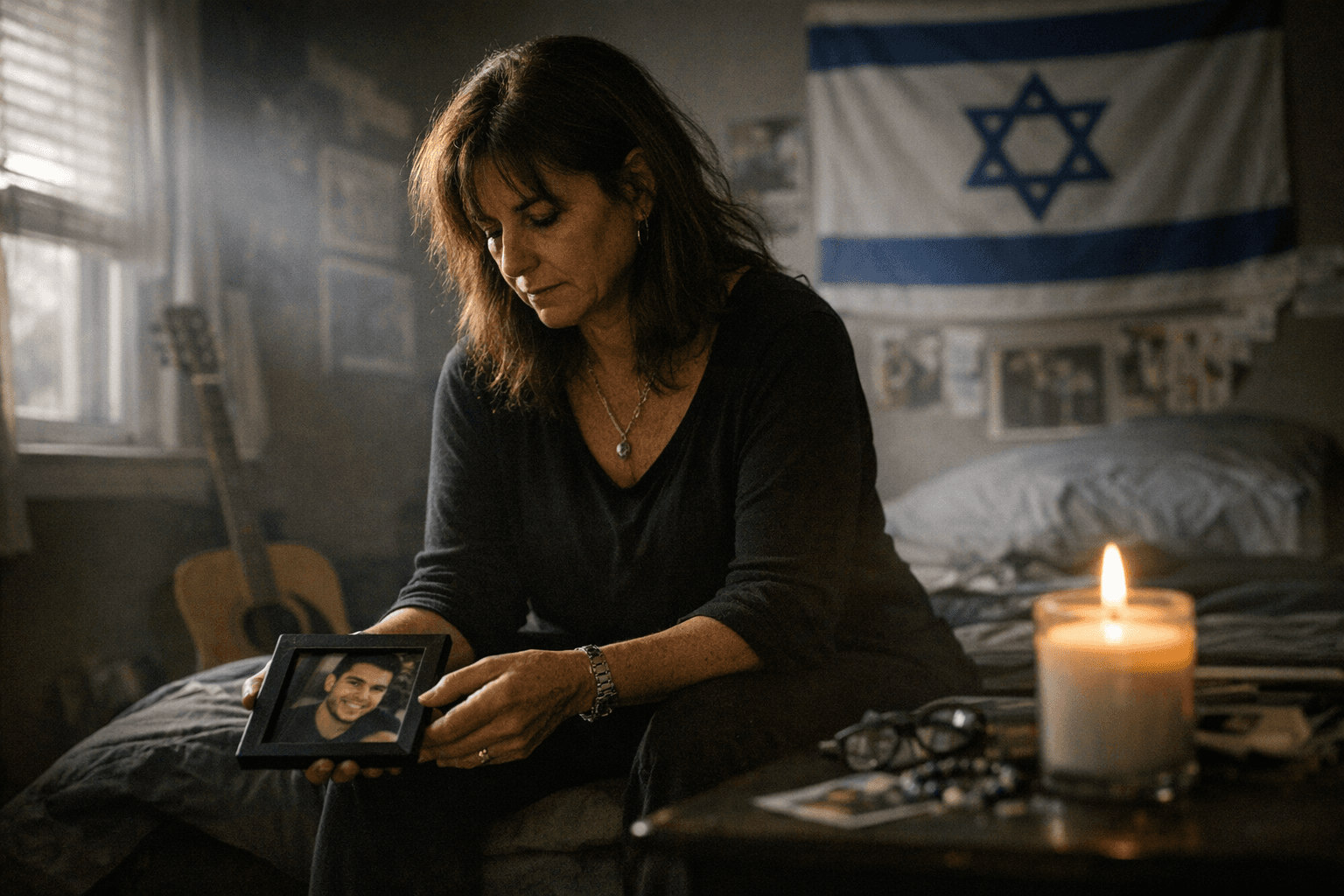
Rachel has also said the family kept Hersh’s room as it was, a detail that underscores how unresolved this story remains. The room becomes more than a preserved space. It is a domestic monument to interrupted life, a reminder that the person mourned is still imagined in the ordinary details of daily routine.
The wider war behind one family’s loss
The Goldberg-Polin story sits inside the broader October 7, 2023 Hamas-led assault on Israel, the attack that ignited the war in Gaza and set off an international hostage crisis. Hersh became one of the most visible faces of that crisis because his parents turned their private desperation into public advocacy. Their visibility also meant that his death reverberated far beyond their family, drawing renewed outrage and grief in Israel, the United States, and among hostage families who had spent months tethered to the same uncertain hope.
That wider context is essential to understanding why the story still matters in April 2026. CBS News has noted that 42 hostages were taken alive and survived for hundreds of days before being killed in captivity, a grim measure of how long the crisis has stretched the emotional and diplomatic fabric around the war. In that landscape, Rachel’s testimony is not only about mourning after death. It is also about the moral injury of watching a hostage crisis harden into a story of repeated loss.
The political stakes remain visible as well. After six hostages were found dead, mass protests erupted in Israel demanding a cease-fire, and Prime Minister Benjamin Netanyahu blamed Hamas and said Israel would hold the group accountable. That reaction shows how each hostage death continues to destabilize public trust, intensify pressure on leaders, and reopen arguments over negotiations, military strategy, and responsibility. Rachel’s grief sits squarely inside that argument, not apart from it.
Why her story cuts through the noise
What Rachel Goldberg-Polin reveals, more than anything, is how public grief changes when it collides with diplomacy, war, and international attention. Her son’s life was reduced to a hostage count, then to a death notice, but her testimony restores the human scale that those summaries erase. She reminds listeners that the real cost of hostage-taking is not only measured in days held or bodies recovered, but in the families left to carry love as a wound.
That is why the interview lands as more than another account of loss. It is a portrait of how a mother keeps speaking when the story has moved from hope to devastation, and how grief can become both witness and resistance. In the aftermath of Hersh Goldberg-Polin’s death, Rachel Goldberg-Polin’s voice keeps insisting on the same truth: love does not end when the hostage crisis does, and neither does the burden of what war leaves behind.
This article was produced by Prism’s automated news system from verified source data, official records, and press releases, then run through automated quality and moderation checks before publishing. The system is built and supervised by the people who set the standards it runs under. Read our full AI policy.
Did this article answer your question?