Reuters poll sees first annual decline for Indian equities in over a decade
Foreign investors have pulled more than $23 billion from Indian holdings this year, and analysts now see the Nifty 50 ending 2026 slightly lower.
Foreign investors have already pulled more than $23 billion from Indian holdings this year, a selloff that has turned one of the world’s most admired equity stories into a test of whether rich valuations can still be justified.
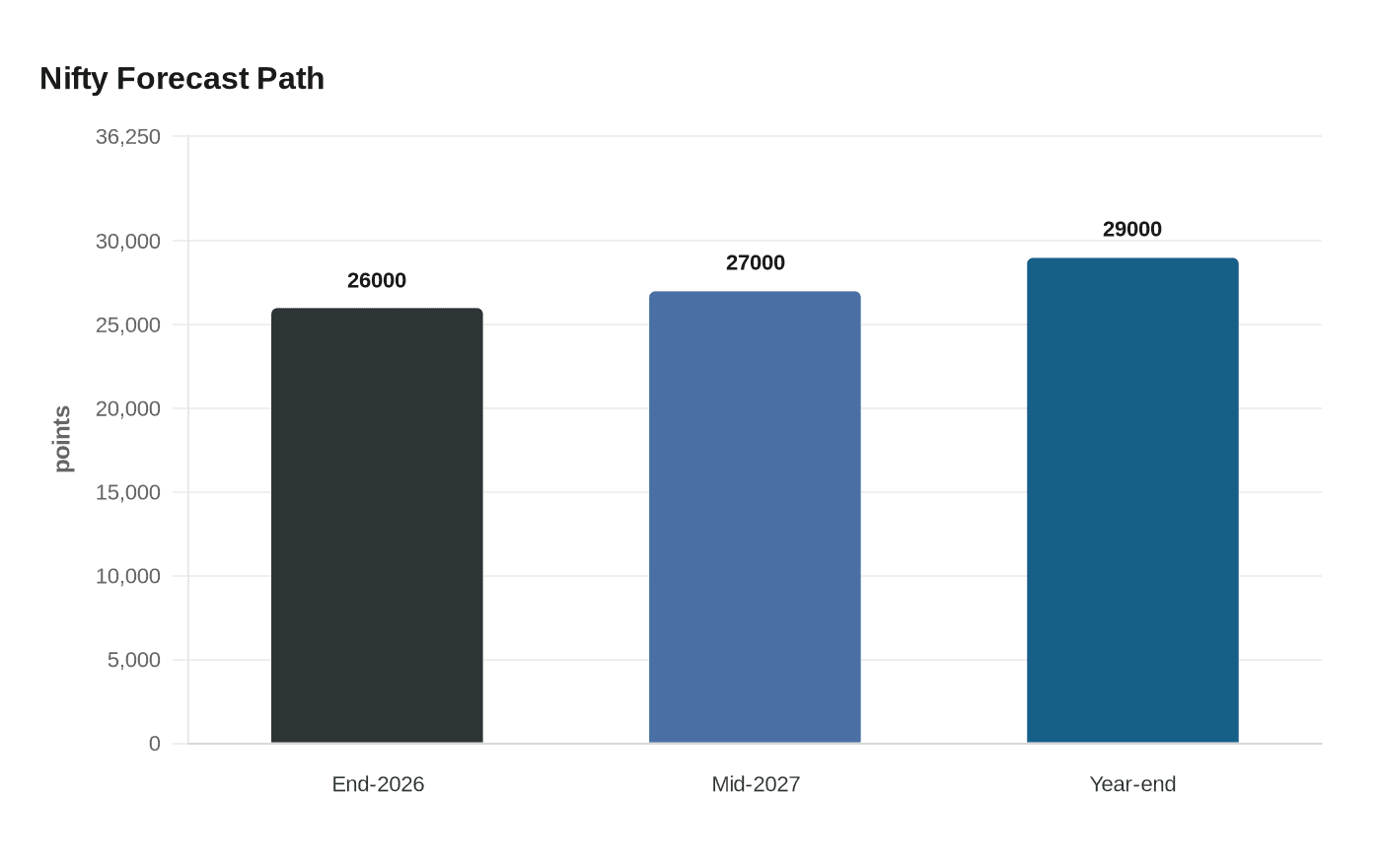
A May 15-27 poll of 24 analysts projected the Nifty 50 at about 26,000 by the end of 2026, implying an annual decline of about 0.5%. If that forecast holds, it would be the index’s first yearly loss since 2015. The same survey saw the benchmark recovering later, with the Nifty at 27,000 by mid-2027 and 29,000 by year-end, while the Sensex was forecast at 84,150 by end-2026 and 87,895 by mid-2027.
The warning sign is not just the direction of prices, but the backdrop behind them. Indian equities still trade at more than 20 times earnings, yet offer one of the world’s lowest dividend yields. That combination has left the market exposed as global investors rotate toward cheaper markets or better returns elsewhere, especially in AI-linked names. The shift has been most visible in the United States and South Korea, where the KOSPI has surged more than 200% in a year. India’s own information technology index has fallen by more than a third since December 2024, deepening the drag on benchmark performance.

The pullback marks a sharp reversal from the mood late last year, when analysts expected Indian stocks to hit record highs by mid-2026 even as foreign investors had already removed nearly $17 billion from the market. Since then, the outflows have accelerated and surpassed last year’s record pace, leaving benchmark indices behind most major global peers. The message from the market is blunt: India’s growth story is no longer being priced as a certainty, and earnings now have to catch up with the premium investors once paid for future promise.
Domestic money has not vanished, but it is under strain as the foreign retreat gathers pace. The Association of Mutual Funds in India said systematic investment plan collections totaled 31,115 crore in April 2026, and industry assets under management rose to 73.73 lakh crore in FY26. Those flows have been a crucial buffer against overseas selling, yet the latest poll suggested local buyers may not be enough on their own to absorb the exit.
For now, the market is treating India less as an unquestioned growth leader and more as a proof case. The next phase will depend on whether corporate earnings, policy support and domestic savings can justify valuations that remain high even after the slide.
This article was produced by Prism’s automated news system from verified source data, official records, and press releases, then run through automated quality and moderation checks before publishing. The system is built and supervised by the people who set the standards it runs under. Read our full AI policy.
Know something we missed? Have a correction or additional information?
Submit a Tip