Reuters review says Tesla tax structure likely saved hundreds of millions
Tesla paid zero federal income tax in 2025 while reporting billions in profit, and offshore subsidiaries in the Netherlands and Singapore likely shaved off more than $400 million.

Tesla’s latest tax picture sharpened an old contradiction: Elon Musk has denounced “shady” loopholes, yet Tesla’s structure likely helped it avoid hundreds of millions of dollars in U.S. tax. The company reported a federal tax bill of zero dollars for 2025, even as it posted $3.8 billion in GAAP net income and $4.4 billion in GAAP operating income for the year.
The simplest explanation is familiar. Tesla spent much of its history on the wrong side of profitability, and losses can generate deductions that reduce later tax bills. Federal clean-energy incentives also helped. Tesla’s 2024 annual report said qualifying customers may receive up to $7,500 in federal EV tax credits through 2032, underscoring how public policy has supported the business even while Tesla itself reported little or no current federal income tax.
But losses alone do not explain the full picture. Tesla’s own filings and a review of the company’s foreign structure point to another mechanism that is widely used by multinationals: profit shifting. Reuters said Tesla units in the Netherlands and Singapore posted $18 billion in profits in recent years that were not taxed there. Without that structure, those earnings would likely have been booked in the United States and taxed there instead. Reuters estimated the arrangement likely cut Tesla’s U.S. tax payments by more than $400 million.
That matters because the issue is not just whether Tesla was once a money-losing automaker. It is how profits were allocated across subsidiaries and jurisdictions. In plain terms, if a company can place income inside foreign affiliates, then move or attribute that income through internal pricing and ownership structures, it can change where governments think the money was earned. That practice is legal when it follows the rules, and it is common among large multinationals. It is also why tax policy debates so often turn on offshore entities, transfer pricing and the fine print of corporate structure rather than a company’s public image.
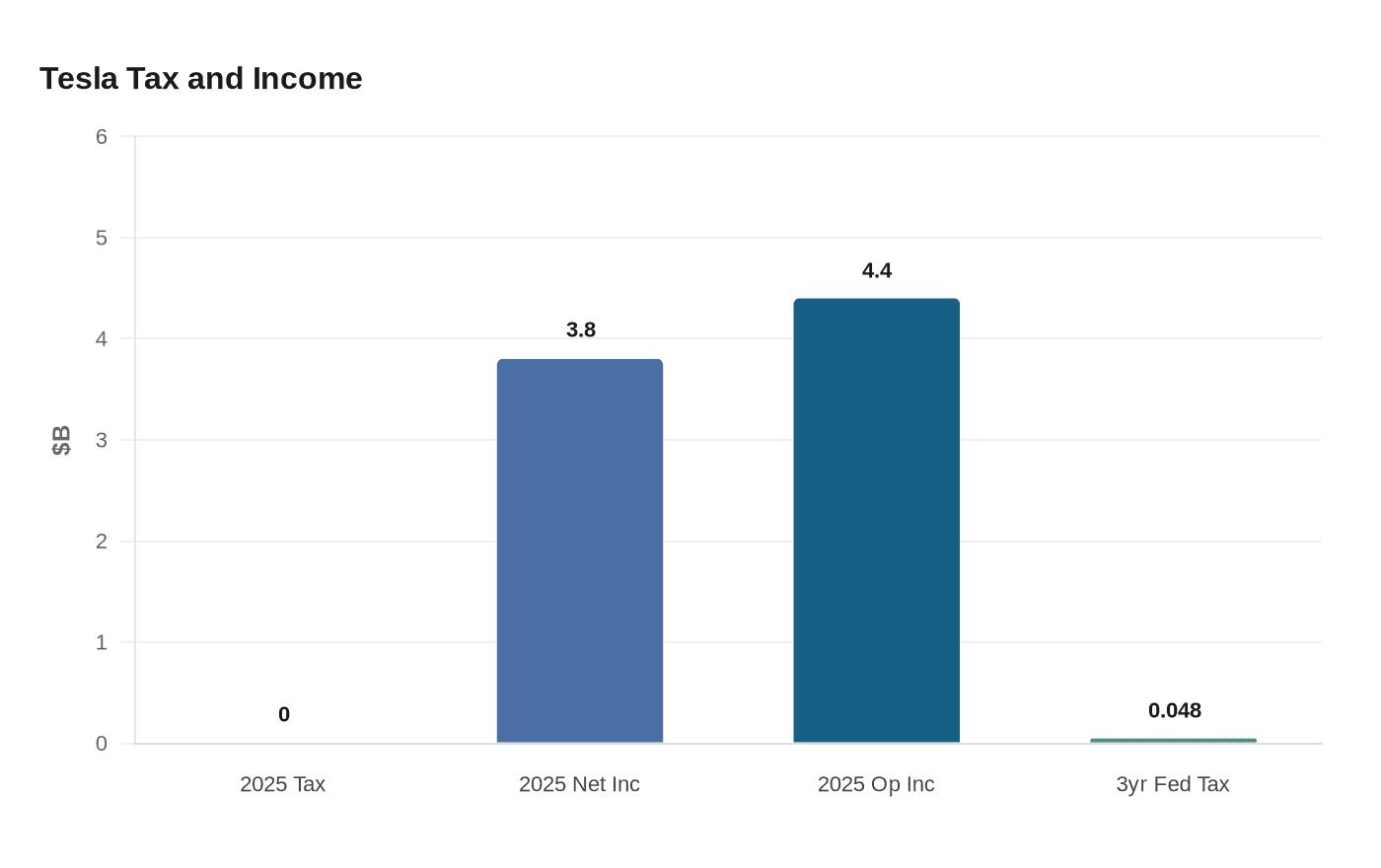
The scale is striking. Over the last 20 years, Tesla recorded $264 billion in U.S. revenue and said it owed no taxes to the U.S. government in all but one of those years. The Institute on Taxation and Economic Policy said Tesla’s 2024 annual report showed $2.3 billion of U.S. income and zero current federal income tax, and that over three years the company reported $10.8 billion of U.S. income and just $48 million in current federal tax, an effective rate of about 0.4% against the statutory 21% rate.
The politics are only getting louder. In March 2026, Bernie Sanders attacked Musk’s tax posture and said Musk’s effective tax rate was less than 3.3%. For investors and policymakers, the deeper concern is not just hypocrisy; it is how easily global corporate structures can turn a profitable American company into a near-zero taxpayer.
This article was produced by Prism’s automated news system from verified source data, official records, and press releases, then run through automated quality and moderation checks before publishing. The system is built and supervised by the people who set the standards it runs under. Read our full AI policy.
Did this article answer your question?

