Romania to Host B9 Nordic Summit in 2026, Deepening NATO Eastern Flank Coordination
Romania will host a B9-Nordic summit on May 13 as Bucharest's defense spending hits 2.5% of GDP and Washington signals high-level U.S. representation.
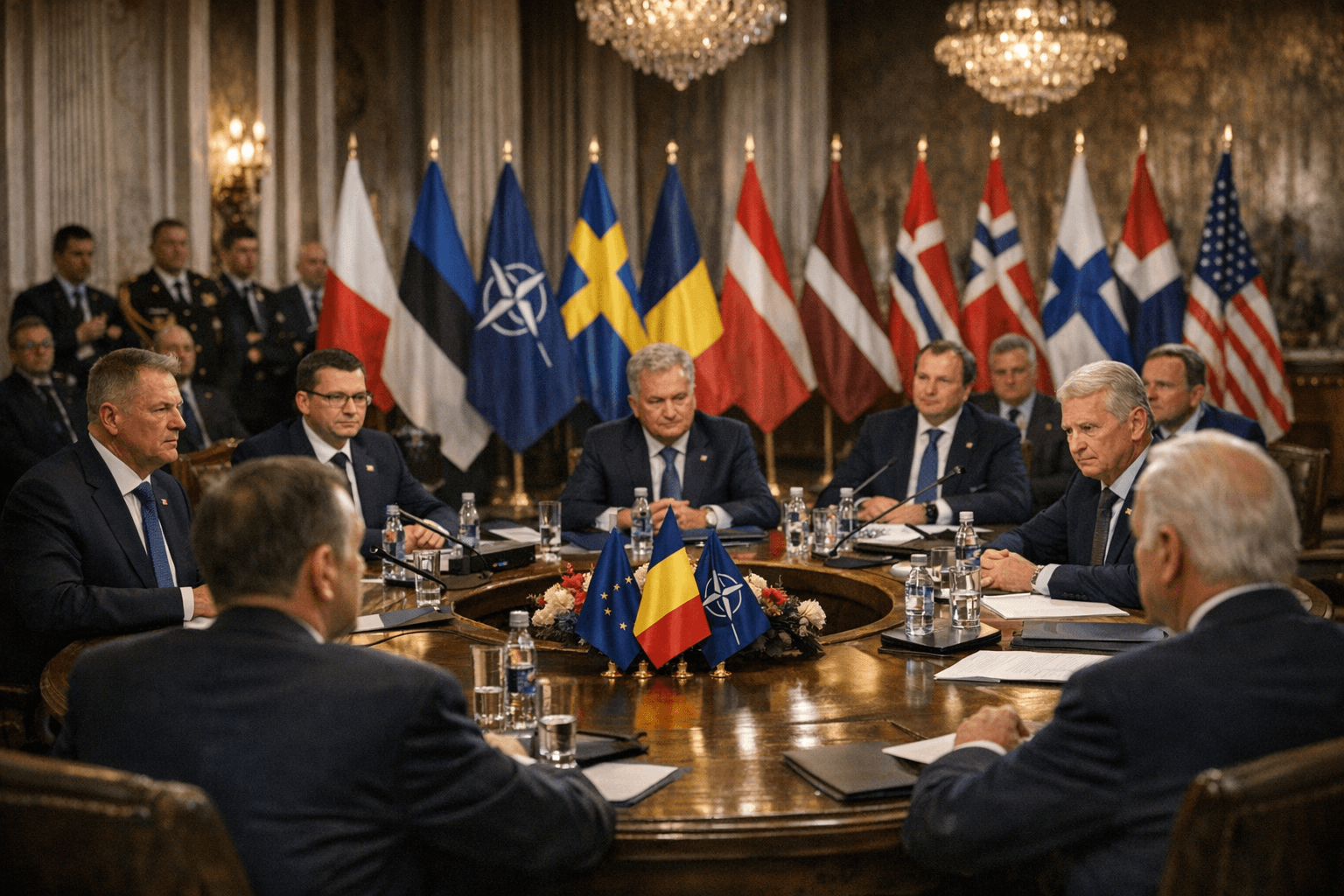
Romania will host a joint summit of the Bucharest Nine and the Nordic countries in Bucharest on May 13, bringing together NATO's eastern and northern flanks under one roof for the first time at this format's level. Romanian President Nicușor Dan and Polish President Karol Nawrocki will co-chair the session, with NATO Secretary General Mark Rutte confirmed to attend after accepting Dan's personal invitation during talks at NATO headquarters on March 19.
President Donald Trump declined to attend in person, thanking Romania through diplomatic channels but confirming he would not be present. Negotiations are underway to secure the participation of Secretary of State Marco Rubio, whose presence would confirm the event's high-level status. In his letter to Dan, Trump specifically thanked Romania for increasing its defense spending as a percentage of GDP and for its support in the context of the U.S.-Iran conflict in the Middle East.
That spending commitment is a concrete deliverable the summit's host can already point to. Rutte, after his March 19 meeting with Dan at NATO headquarters, welcomed Romania's commitment to raise defense spending to 2.5% of GDP in 2026, stressing the importance of not only funding but also developing military capabilities. Rutte described Romania as "a steadfast ally" with a crucial role in ensuring security in the Black Sea area.
The May 13 meeting formalizes an ambition that Dan and Nawrocki telegraphed at their bilateral summit in Warsaw on February 5: expanding the B9's security cooperation orbit to include Finland, Sweden, Norway, Denmark, and Iceland. The B9 format was launched in 2015 by then-presidents Klaus Iohannis and Andrzej Duda in direct response to Russian aggression, grouping Romania, Poland, Bulgaria, Hungary, the Czech Republic, Slovakia, and the three Baltic states. Folding the Nordics into the conversation, even informally, reflects a strategic logic that runs from the Baltic Sea to the Black Sea: NATO's northern and eastern flanks share exposure to the same adversary and increasingly depend on the same logistical corridors.
Romania's geography makes it indispensable to that architecture. Sitting at the southeastern corner of the alliance, Bucharest controls access to the Black Sea littoral and serves as a transit hub for forces moving between Central Europe and the broader theater. The country has agreed to temporarily host U.S. forces and assets, a burden-sharing arrangement that Secretary of State Rubio acknowledged directly when he called Romania's foreign minister to praise Bucharest's response to recent regional developments. Rutte mentioned NATO's "Eastern Sentry" posture, noting that since its announcement in September, the alliance has brought together more allied forces and assets to protect the eastern flank on land, at sea, and in the air.
French President Emmanuel Macron has also confirmed his attendance at the summit, with Ukrainian President Volodymyr Zelensky also expected to participate. That roster transforms the May 13 session from a regional coordination meeting into a high-stakes convening of the alliance's political center of gravity.
Observers will watch for concrete outputs: new rotational force commitments, joint air and missile defense procurement frameworks, and infrastructure investment pledges that translate the summit's political alignment into operational readiness. Whether the Nordic integration yields a formal B11 or B12 arrangement, or remains a parallel consultative track, will be the defining structural question of the Bucharest meeting. Romania, having secured Rutte, pursued Rubio, and drawn Macron and Zelensky to its capital, has already demonstrated that its leverage as host extends well beyond geography.
This article was produced by Prism’s automated news system from verified source data, official records, and press releases, then run through automated quality and moderation checks before publishing. The system is built and supervised by the people who set the standards it runs under. Read our full AI policy.
Did this article answer your question?