Russia shows nuclear warhead drills in signal to NATO and Ukraine
Russia displayed warheads moving onto Iskander-M launchers in a three-day nuclear drill, sharpening its signal to NATO as tensions over Ukraine stayed high.

Russia’s display of troops loading nuclear warheads onto mobile Iskander-M missile launch systems was a message, not a battlefield drill. The footage showed warheads being delivered, loaded and moved to launch sites as Moscow used a major nuclear exercise to underscore that it still holds escalation tools while its war with Ukraine and confrontation with the West continue.
The three-day exercise began on Tuesday and stretched across Russia and Belarus. Russia’s Defense Ministry said the forces practiced bringing units to the highest levels of combat readiness for the use of nuclear weapons. The choice of imagery mattered: mobile launchers, sealed warheads and movement to firing positions are meant to project readiness, concealability and survivability, the core advantages of a road-mobile nuclear-capable system.
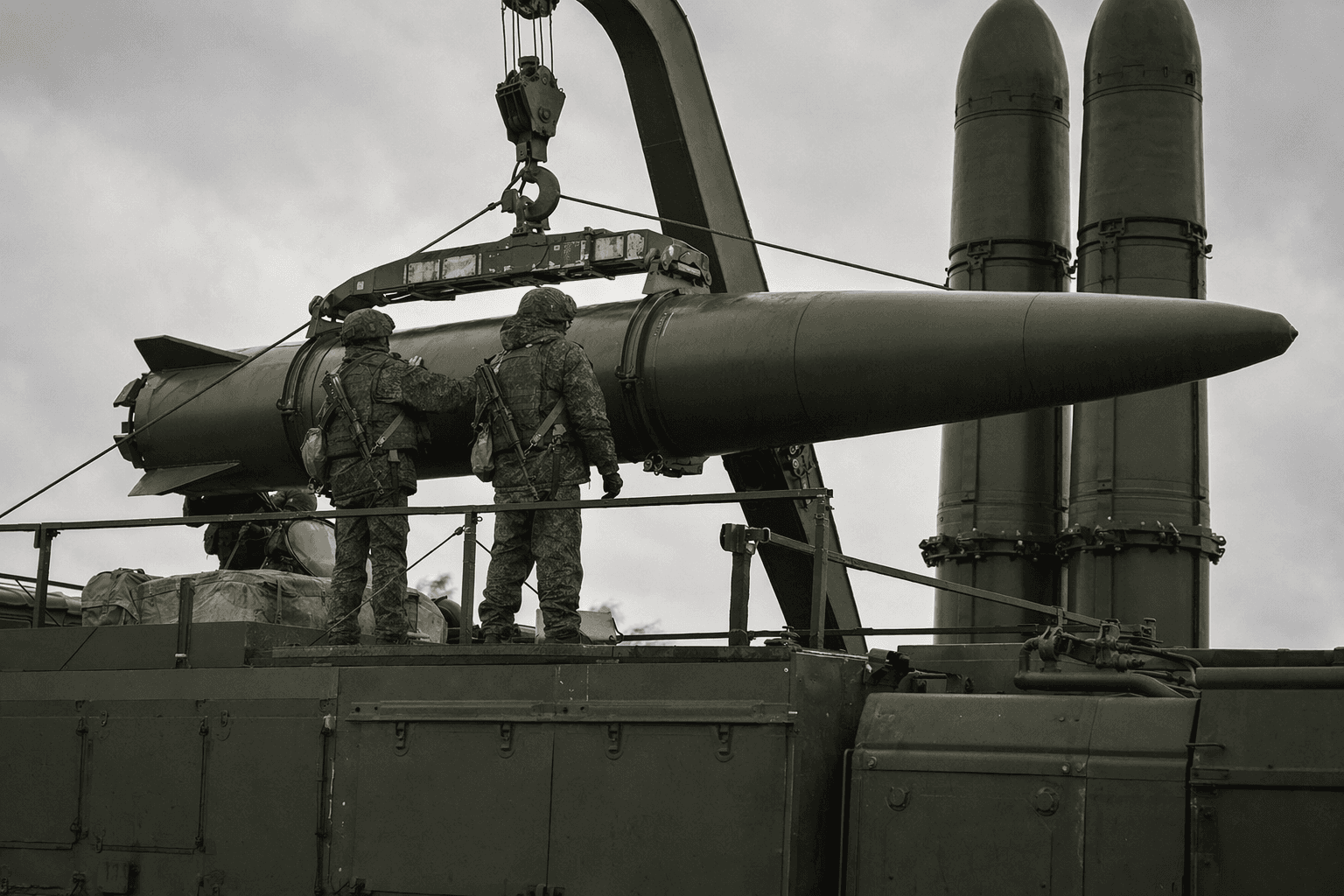
The Iskander-M is a short-range ballistic missile platform reported to have a range of up to 500 kilometers, or 310 miles, and can carry either conventional or nuclear warheads. By showing warheads being handled openly in a state choreographed drill, Moscow was signaling to NATO capitals that it can pair battlefield pressure with nuclear messaging whenever it chooses.
The timing sharpened that message. Sergei Ryabkov warned on May 19, 2026, that the risks of a direct Russia-NATO clash were increasing and said the consequences of such a clash could be catastrophic. The Kremlin has repeatedly framed the fighting in Ukraine as an existential struggle with the West, and this exercise fit that broader narrative, reinforcing the idea that Moscow sees nuclear signaling as part of its political and military toolkit.
Belarus’ role made the drill more sensitive. NATO says Belarus continues to enable Russia’s war against Ukraine by making its territory and infrastructure available to Russian forces. NATO’s Washington Summit Declaration on July 10, 2024 condemned Russia’s irresponsible nuclear rhetoric and coercive nuclear signalling, including the stationing of nuclear weapons in Belarus. That backdrop gives the exercise weight far beyond the mechanics of troop movements and launcher drills.
The exercise also came against a sobering strategic backdrop. The Federation of American Scientists estimated that nine countries held roughly 12,187 nuclear warheads at the beginning of 2026, with the United States and Russia together accounting for about 86% of that total. FAS estimated Russia’s stockpile at about 4,380 operational warheads and 1,200 retired warheads awaiting dismantlement. NATO has also been rehearsing its own deterrence posture, with STEADFAST DETERRENCE 2026 concluding on May 13, 2026, after about 8,000 military and civilian participants. The overlap shows how both sides are actively staging deterrence, even as miscalculation remains the central risk.
Know something we missed? Have a correction or additional information?
Submit a Tip