Russian Missile Strike on Dnipro Kills Four, Deepens Diplomatic Strain
A Russian missile strike on Dnipro on December 1 killed at least four people and wounded roughly 40, Ukrainian officials said, adding fresh urgency to diplomatic efforts to halt the fighting. The attack struck civilian areas and businesses while talks to end the war were underway elsewhere, underscoring the international stakes and potential legal consequences.

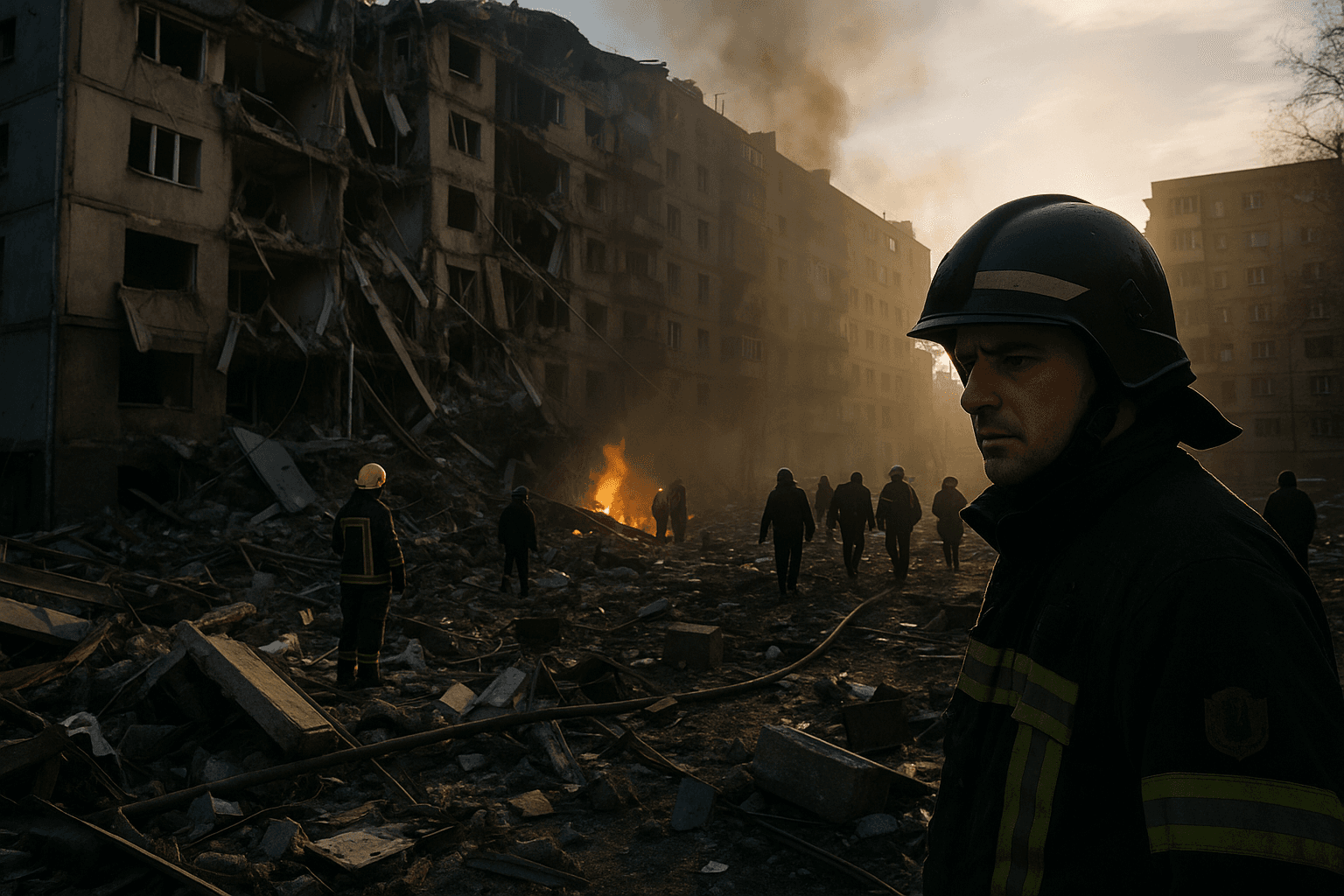
A missile strike on the Ukrainian city of Dnipro on December 1 killed four people and wounded about 40 others, regional officials said, as emergency services dealt with shattered glass, collapsed facades and damaged vehicles across a commercial district. Several of the wounded were reported to be in serious condition, and local authorities said the blast tore through businesses, an office building and parked cars, leaving smouldering wreckage and disrupted livelihoods.
Eyewitnesses described scenes of confusion as first responders extracted people from rubble and assisted the injured. Regional emergency services reported multiple incidents of structural damage and said rescue teams were working through the evening to secure the area and account for those impacted. The toll and the visible damage fed into a growing narrative in Kyiv and among its allies that civilian areas continue to be directly exposed to long range strikes.
The attack came amid heightened diplomatic activity aimed at ending the conflict, and at a time when President Volodymyr Zelenskiy was traveling for talks abroad. That juxtaposition underlined the difficulty of securing cease fires or meaningful progress at the negotiating table while kinetic operations continue to threaten urban centers far from the front lines. Western capitals engaged in shuttle diplomacy have warned that continued strikes on civilian infrastructure will complicate efforts to sustain political momentum toward de escalation.
Dnipro, a major city on the Dnieper River and a hub for logistics and industry in central Ukraine, has repeatedly been within range of Russian long range weaponry since the full scale invasion began. Attacks on such population centers carry both immediate humanitarian consequences and broader implications for the economy and civic life, damaging markets, offices and transportation and undermining civilian morale.
From the standpoint of international law, indiscriminate or disproportionate attacks that fail to distinguish between military targets and civilians can amount to breaches of the laws of armed conflict. Legal scholars and diplomats note that determining responsibility and intent requires careful on the ground investigation, forensic analysis of munitions and corroboration of targeting patterns. Those processes take time but affect the prospects for accountability and any future reparations.
The strike in Dnipro also reverberates in global politics. Governments that have sought to broker or support diplomatic engagement face renewed pressure from domestic constituencies and allies to press Moscow over attacks on noncombatants. Humanitarian agencies, already stretched by months of high intensity conflict and winter needs, warned that continued strikes would increase displacements and hamper relief access across the region.
As rescue operations continued in Dnipro, Ukrainian officials said the city would require repairs and support to tend to the injured and rebuild damaged businesses. The strike served as a grim reminder that even amid diplomatic overtures, the violence on the ground can intensify in ways that reshape negotiations, deepen international divisions and prolong civilian suffering.
This article was produced by Prism’s automated news system from verified source data, official records, and press releases, then run through automated quality and moderation checks before publishing. The system is built and supervised by the people who set the standards it runs under. Read our full AI policy.
Did this article answer your question?