Sail Repair: Patch or Sew for Immediate and Permanent Fixes
Learn the exact steps to stabilize a ripped sail at sea with tape, trim and seal frays with a hot knife, then reinforce or permanently stitch patches back in harbour using Seamstick, Tex‑90 thread and zigzag stitching.
1. Quick triage: spread, inspect, and don’t panic
Spread the sail out on a clean, dry surface and check carefully for any other damage, “If you notice a small hole, a worn spot or a loosened seam in your sails, never fear.” Sails are panelled and not naturally flat; experiment with temporary folds and tucks away from the tear to get the cloth to lie as flat as possible before you start a patch or stitch. Regular inspection pays, catching a worn spot early avoids a corner or laminate failure later.
2. Trim and seal frayed edges before you do anything else
Frayed edges should be neatly trimmed to ensure a good result and the edges of the damage are best sealed carefully with a lighter so the surrounding fabric does not tear further. For synthetic fabrics I favour a hot knife, “it’s called a hot knife... burn the edges and try to create a clean seam but also cauterize or seal the edge of the fabric”, it creates a neat, non‑fraying edge that’s much easier to tape or sew. After you burn/trim, inspect again for hidden runs or delamination.
3. Clean and dry the repair area so tape will stick
If the sail is dirty, greasy or salty, use isopropanol or soapy water to clean the surface and allow the sail to dry completely before applying tape or adhesive. Tape adhesion and basting tape both fail quickly on salt and grime; this is a small step that prevents wasted patches and rework. For large repairs I’ll wash the area and let it fully air‑dry ashore, patience here saves a second trip.
4. At‑sea stabilization: tape the tear and round patch corners
For a quick, reliable field fix, follow Cmsails’ “Tape a Tear (Quick & Easy)” routine: clean and dry the area, round off patch corners to avoid peeling, choose matching Dacron or spinnaker repair tape depending on cloth, tape both sides if possible, rub firmly and let it cure. Sticky‑back spinnaker repair tape works well for small holes; Venture double‑sided sailmaker’s tape is recommended when you need a stronger bond or a backing for a patch. Cmsails’ experience: “This can often last surprisingly long if well done,” but treat it as stabilizing until you can perform a reinforced repair if you have a long passage ahead.
5. Cut patches to the right size and lay them carefully
Cut a patch at least 1" (≈2.5 cm), Sailrite says “at least 1" larger in circumference than the hole”, and Cmsails advises “Cut a patch 2–3 cm larger than the tear in all directions.” Use double‑sided tape or Seamstick basting tape to hold the patch, then lay the patch down starting at least 5 cm away from the start of the tear and smooth it down gently so there are no high spots or creases. If you can’t avoid a crease, cut the tape and continue with a new overlapping piece, do not cram cloth into a wrinkle that will create stress lines.
6. Make tape repairs last: rub, cure and (where possible) stitch
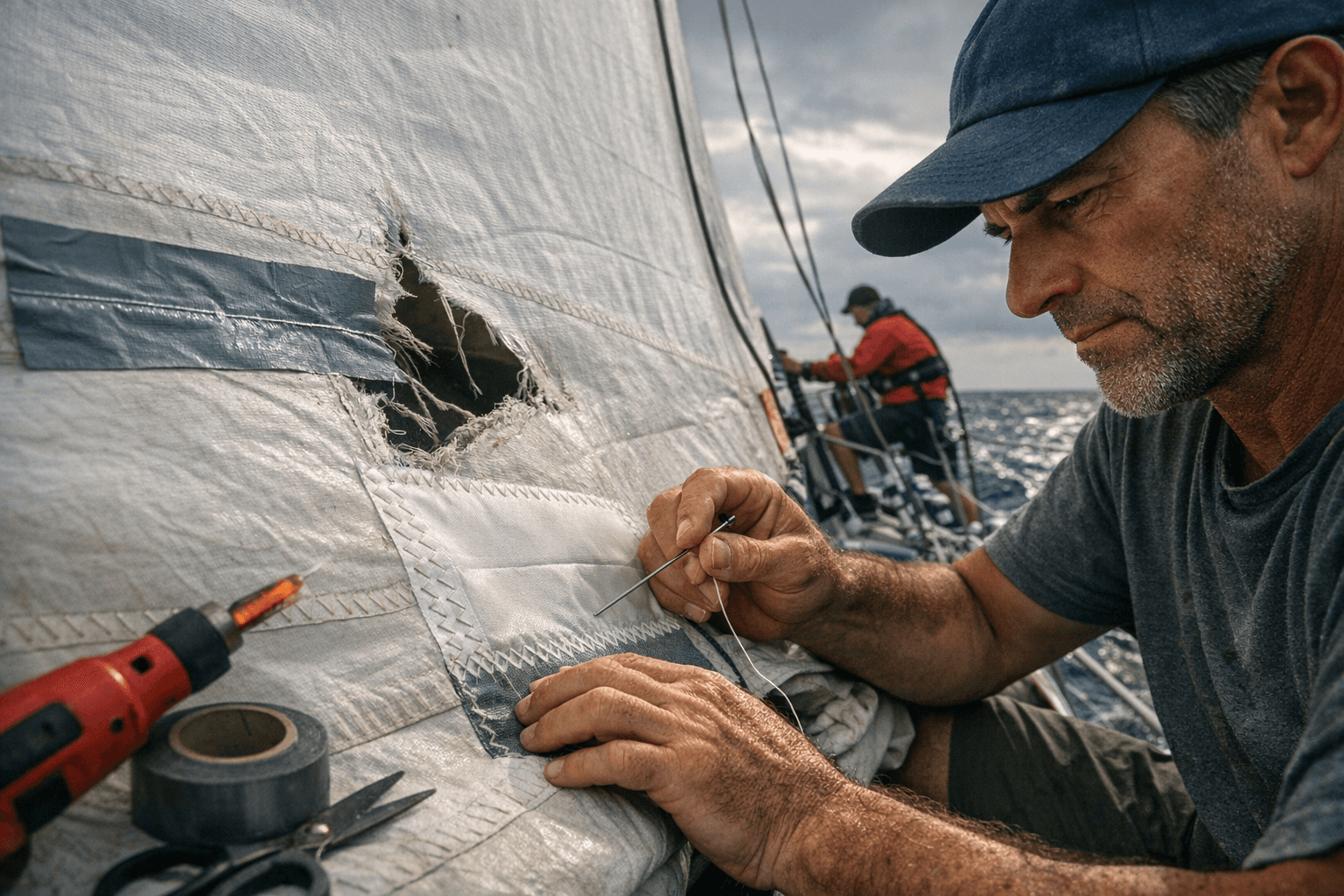
Once applied, rub the patch firmly and give it time to cure; a well‑done tape repair can hold for a surprisingly long time. Yachting World’s key distinction: “The main difference between your repair and that of the sailmaker is a stitched border”, if you’re crossing an ocean, add stitching to the taped patch. Use basting tape (Seamstick) to hold your patch before sewing so it doesn’t shift under the needle.
7. Sewing technique: threads, stitches and staggering needle holes
Thread a sailmaking needle with sailmaking thread and cut a length long enough for the job; “To reduce friction when sewing, you can wax the thread or use a pre‑waxed thread.” Machine zigzag stitches are ideal around a patch edge, Yachting World: “Ideally this should be in a zigzag pattern around the outside of a patch.” If you hand‑sew, use a strong whip stitch and “Always stagger stitches from opposite sides, don’t stack needle holes.” These details turn a tape job into a permanent, loft‑grade repair.
8. Reinforce corners, eyelets and batten pockets properly
Corners and eyelets take huge loads, Cmsails’ fix is multi‑layered Dacron cut into a triangle or rounded triangle and hand‑ or machine‑stitched in place. For temporary corner fixes, use webbing loops instead of metal rings and lash or stitch them back with heavy twine; for batten issues, sew or lash a failed Velcro flap shut temporarily, patch a chafed pocket and file the batten end smooth, or splint broken battens with tape and zip ties. Don’t skimp here: a cheap corner patch that peels creates a new failure.
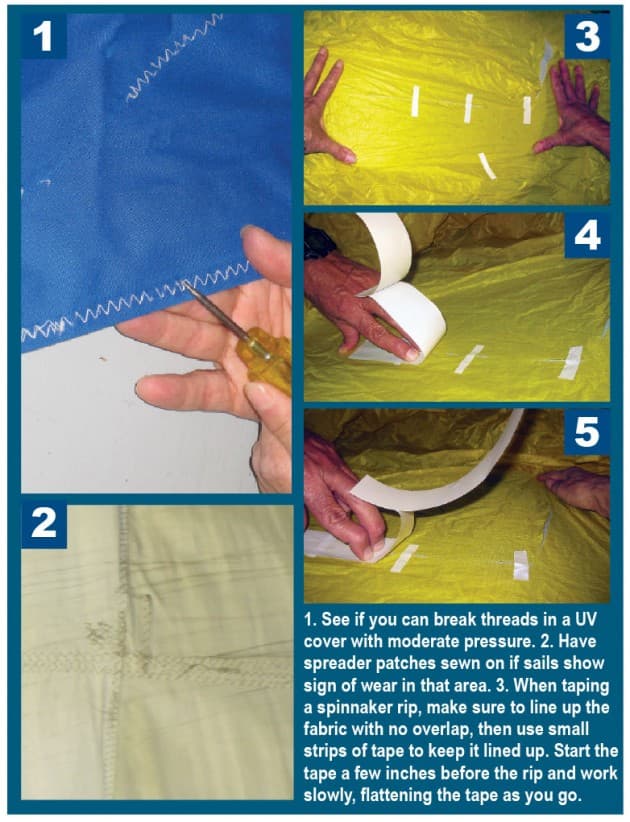
9. Chafed seams and blown stitching: rip, tape, restitch
Remove old, UV‑rotten thread with a seam ripper before you restitch, then tape the seam in place to hold alignment and restitch with strong polyester sailmaking thread. Cmsails warns that widespread UV‑rotted stitching is beyond an onboard permanent fix, when “UV‑rotted stitching everywhere” is present you’ll need loft work or replacement. For isolated blown seams, a tidy restitch will restore full load capability.
10. Spinnaker specifics: match cloth weight and follow tape rules
Use sticky‑back spinnaker repair tape for small holes and Venture double‑sided tape for larger spinnaker patches; many modern spinnakers are constructed with tape only, so a correctly executed tape repair can be “as good as new.” The patch must be the same weight of cloth as the sail so it moves and stretches together, “If you put stronger, heavier fabric to repair a lighter one it will create point loading at the patch edges, creating a weak spot.” Yachting World’s visual reminder: some jobs require “All hands for a spinnaker repair on an ARC yacht. Photo: crew of Meegan.”
11. When to patch/sew and when to send it to the loft
Cmsails’ fixability table is blunt: a small tear in a panel, ✅ fixable (tape or sew); a blowout near an edge, ✅ sew with reinforcement; a corner patch delamination, ✅ hand‑sew webbing or patch. But a 2 m+ panel tear with laminate failure, 🚫 not fixable aboard, temporary only; and “UV‑rotted stitching everywhere”, 🚫 replace sail or restitch at a loft. Svb24 sums it up: “Not every damage immediately requires the purchase of a new sail or a professional repair by a sailmaker. A thorough repair is often enough to restore functionality to your sail.”
12. Tools and kit: what I keep on board
My go‑kit mirrors the explicit items in the guides: isopropanol and soapy water for cleaning; a lighter and a hot knife for sealing edges; matching Dacron and spinnaker repair tape plus double‑sided sailmaker’s tape (Venture); SewReady Seamstick 3/8" Basting Tape (50 yds.) and Tex 90 (V‑92) White UV Bonded Polyester Thread 4 oz. (1,350 yds.); Gingher 8" scissors; a seam ripper; wax or pre‑waxed sailmaking thread; heavy twine, zip ties and a couple of webbing loops. Sailrite catalogue codes like “X‑HT‑200691” and the named products make restocking quick and predictable.
- Lay the sail flat, trim and seal frays with hot knife or lighter.
- Clean the area with isopropanol and dry thoroughly.
- Trace a patch from new sailcloth (patch at least 1" / 2–3 cm larger), baste with Seamstick or double‑sided tape, then zigzag machine stitch or hand whip‑stitch, staggering holes.
13. Practical workflow I use on a harbour repair
This sequence follows Sailrite’s and Cmsails’ combined workflows and converts an emergency patch into a permanent repair.
14. Final practical notes and a reality check
Round patch corners, don’t try to “close the wound” where fabric is missing, “the cloth should stay in the same place as it was before to avoid generating unnecessary loads and stress lines.” If you’re still crossing an ocean, stitch a taped patch, Yachting World: “if you’re still crossing an ocean it’s worth doing.” Repairs save money and time when done correctly; but know the thresholds in the Cmsails table, some laminate failures and widespread UV‑rot are loft jobs, not DIY triumphs.
Concluding point: do the prep, trim, seal, clean, size the patch correctly, and then choose tape for a fast, often durable field fix or stitch for permanence; those exact small steps are what separate a repair that lasts from one that fails on the next blow.
Know something we missed? Have a correction or additional information?
Submit a Tip

