San Francisco proposes tax district to convert downtown offices into housing
Supervisors advanced a proposal to return property taxes to developers across a Market Street zone to make office-to-housing conversions financially viable.
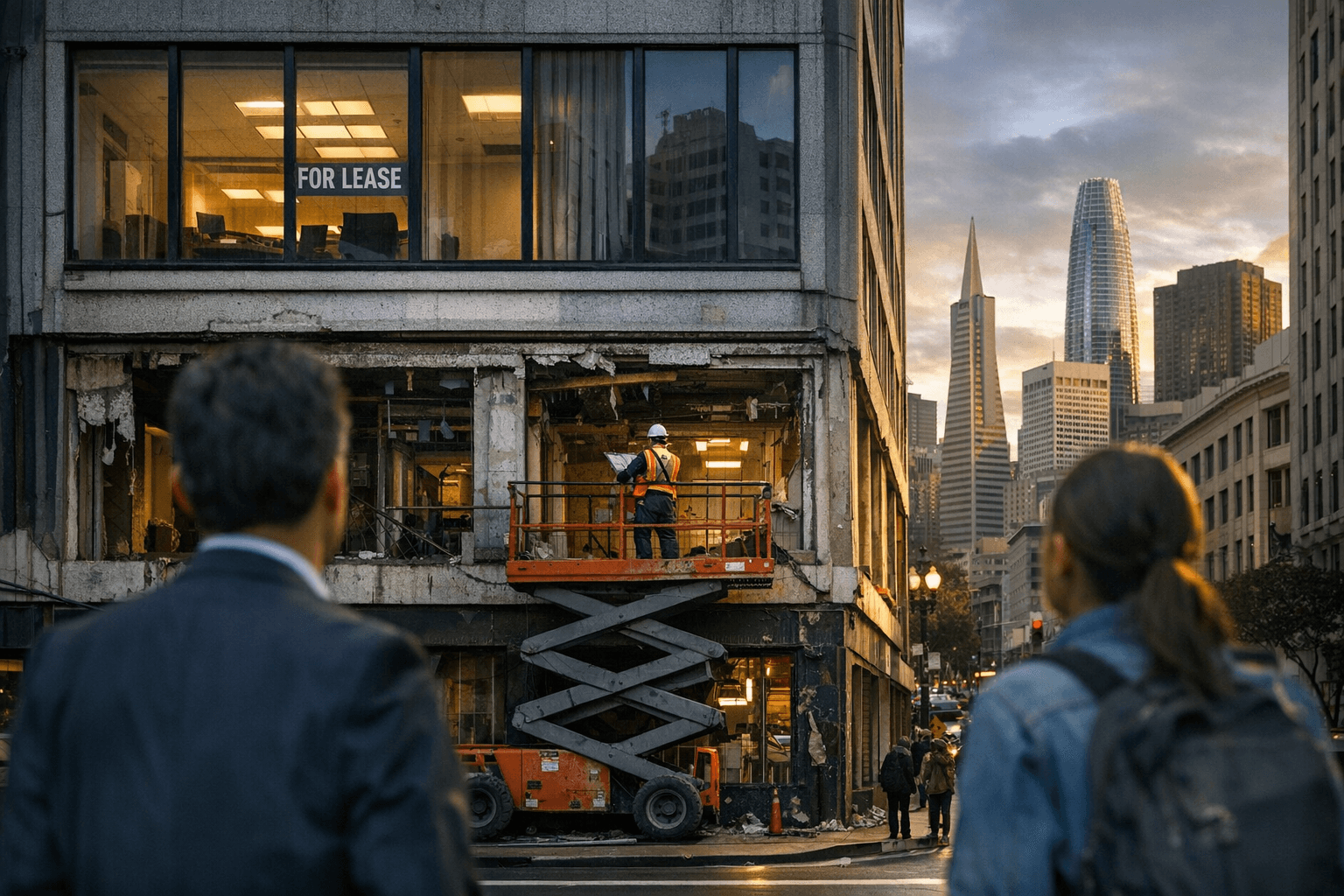
Supervisors on the Board of Supervisors’ Budget and Finance Committee advanced a proposal to return property taxes to developers within a zone that runs down Market Street from the waterfront to Civic Center, covering the Financial District, SoMa and Union Square, aimed at closing a financing gap that has stalled conversions. Business Journal reporting framed the measure as part of a new financing district concept intended to make office-to-residential projects workable where costs and regulatory hurdles have previously prevented them.
Downtown vacancy remains acute. Mission Local noted that “since the COVID-19 pandemic cratered the city’s commercial real estate boom, San Francisco’s downtown office buildings have emptied out, and its nearby stores and restaurants closed. Five years later, more than a third of San Francisco offices remain empty,” while SPUR cited Jones Lang Lasalle data showing the office vacancy rate climbed to 35 percent. A city planning brief places the end-of-2022 downtown vacancy at nearly 28 percent, or almost 23 million square feet of unleased space, and projects vacancy will stay high through 2026 as leases expire and tenants reduce footprints.
City policy has already shifted to encourage conversions. Mission Local reports that voters approved Proposition C, the ballot measure sponsored by then-Mayor London Breed that waived transfer taxes on office-to-housing conversions, and in March 2025 the Board of Supervisors eliminated affordable housing fees for those conversions. Despite those steps, Mission Local observed that “that extra incentive is necessary, say its backers, because developers still aren’t biting,” noting there is just one office-to-residential conversion in San Francisco’s pipeline and another potential project was scrapped because financing did not come together.
City analysis suggests substantial capacity if conversions move forward. A planning brief estimates conversion of vacant office buildings could physically accommodate roughly 11,200 housing units downtown, with a precise scenario calculating 11,235 units if 40 percent of unleased space were converted based on an 80 percent livable yield and a 650 square-foot average unit. The areas covered in that estimate include the central business district, SoMa, Yerba Buena, Mission Bay, and Jackson Square/Northern Waterfront.
Local project activity remains limited but concrete. New permits were filed to convert parts of 995 Market Street in Mid-Market, recently renamed Frontier Tower after a reported sale to Germany-based Deep Ink Ventures. The application proposes renovating eight floors into eight co-living units totaling 25,720 square feet of housing within the 186-foot, 16-story tower that retains 61,820 square feet of office space and a 4,800-square-foot garage for 16 cars; design work is by Creates Cool and each proposed dwelling would occupy a full floor with five bedrooms and shared living spaces.
Policy analysts and advocates offer targeted steps alongside the tax-return idea. Mission Local recommended focusing on buildings with good natural light, offering low-interest loans and faster permitting, saying “that alone could get more projects moving.” An SF planning brief urged piloting tax reductions or creating infrastructure financing districts downtown, and recommended that any affordable housing percentage for incentivized projects “should be determined after conducting further financial feasibility analysis.” SPUR stated that “converting obsolete office buildings into housing delivers economic, social, environmental, and fiscal benefits to the city and the state,” and pointed to its 2023 report with ULI San Francisco that identified six policy imperatives and flagged earlier feasibility barriers caused by high development costs.
Key mechanics remain to be detailed: the precise formula for returning property taxes, eligibility rules, and potential affordability requirements were not disclosed in the proposals advanced at the committee level, leaving critical fiscal and regulatory questions for supervisors, developers and the city to resolve.
Know something we missed? Have a correction or additional information?
Submit a Tip