Senate Banking Committee unveils crypto bill to clarify regulator roles
Senate Republicans put crypto regulators on a collision course, splitting SEC and CFTC turf while leaving stablecoin rewards and DeFi oversight as the biggest fault lines.
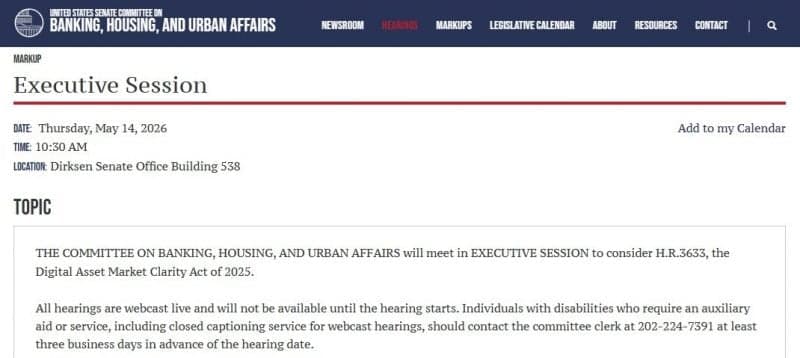
The Senate Banking Committee moved a long-awaited crypto bill into the open, setting up a May 14 executive session in the Dirksen Senate Office Building at 10:30 a.m. ET and signaling a new bid to redraw who polices digital assets in the United States. The CLARITY Act is built to settle the central fight in crypto regulation: whether the Securities and Exchange Commission or the Commodity Futures Trading Commission owns the market, and where the line falls for securities, commodities and stablecoins.
Committee Republicans said the bill followed more than six months of bipartisan negotiations with regulators, law enforcement, academics and industry. Their pitch is blunt: current digital-asset markets are trapped in fragmented oversight and outdated rules, while the new framework would draw a bright line between SEC and CFTC jurisdiction and preserve investor protections, law-enforcement tools and U.S.-based innovation. That framing also reflects a broader political argument from Chairman Tim Scott and his allies that regulation-by-enforcement has failed to give the industry clear rules.
The biggest winners in the bill’s architecture are crypto firms that want to raise money and operate under a bespoke regime instead of the SEC’s full registration system. The committee says the measure would create a tailored disclosure framework for responsible digital asset projects and would let companies raise as much as $50 million a year, up to $200 million in total, without registering with the SEC. It also draws a line around decentralized finance, protecting software developers and peer-to-peer activity while aiming compliance pressure at centralized intermediaries that interact with DeFi.

Banks, meanwhile, are fighting to protect deposits and lending capacity. In a May 8 letter, the American Bankers Association, Bank Policy Institute, Consumer Bankers Association, Financial Services Forum, Independent Community Bankers of America and National Bankers Association warned that payment-stablecoin yield could trigger deposit flight and weaken credit. The latest Section 404 language narrows one flashpoint by banning rewards on idle stablecoin balances that resemble bank deposits, while still allowing activity-based rewards such as payments. But the banks say the revised text still needs changes.
The bill also hands more compliance responsibility to digital asset intermediaries. Senate Republicans say it would pull them into Bank Secrecy Act obligations, requiring AML programs, customer identification, recordkeeping and suspicious activity reporting, while also giving Treasury tools to confront high-risk foreign activity and authorize a law-enforcement pilot. Stablecoin rules still depend on joint action from the SEC, CFTC and Treasury, leaving one of the market’s most contentious issues exposed to delay even as lawmakers push the broader bill toward markup.
This article was produced by Prism’s automated news system from verified source data, official records, and press releases, then run through automated quality and moderation checks before publishing. The system is built and supervised by the people who set the standards it runs under. Read our full AI policy.
Did this article answer your question?

