Senate blocks Iran war powers vote as four Republicans defect
Four Republicans joined Democrats, but the Senate still fell one vote short, leaving Congress unable to force new limits on Trump’s Iran campaign.

The Senate blocked a Democratic bid to force President Donald Trump to seek congressional authorization before continuing military action against Iran, underscoring how difficult it remains for Congress to restrain a president on war powers even when a few Republicans break ranks. The chamber rejected the motion to discharge the resolution from committee by 47-48, with four Republicans crossing over and John Fetterman of Pennsylvania the lone Democrat to vote no.
The measure, led by Sen. Raphael Warnock of Georgia, would have directed the president to remove U.S. armed forces from hostilities within or against Iran unless Congress explicitly approved the action. Its defeat preserved the White House’s freedom to argue that the conflict has eased under a cease-fire and a framework agreement with Tehran, even as lawmakers on both sides said they still had not seen enough detail about the deal.

The fight turned on the 1973 War Powers Act, which is meant to end military action after 60 days without congressional authorization, with a possible 30-day withdrawal period if needed. Critics say the administration’s position that the clock restarted after a cease-fire is disputed. Trump has argued the cease-fire removed the need for Congress to act, while Democrats and some Republicans say the conflict has not ended and no permanent agreement has been reached.
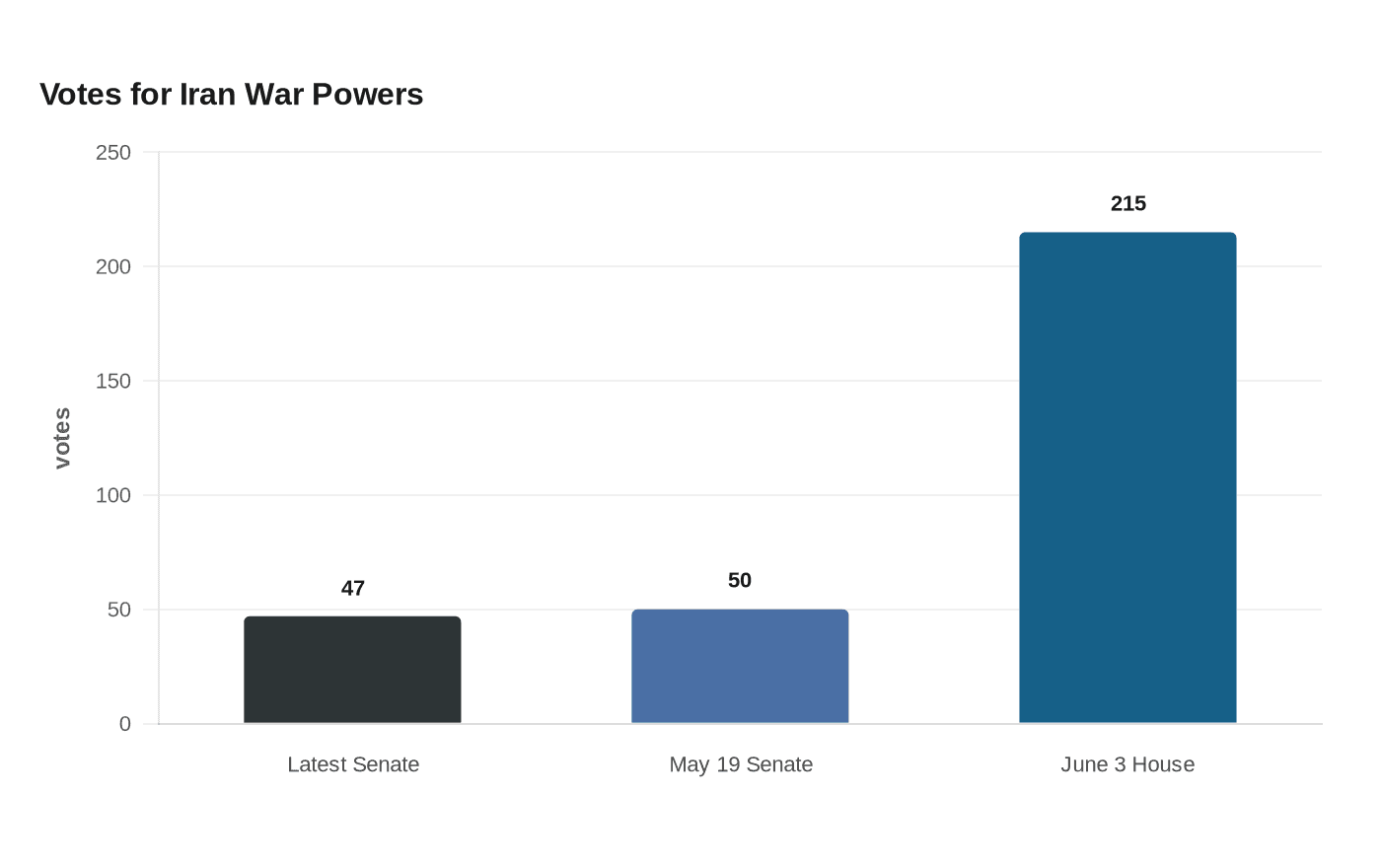
The vote also exposed how close Congress has come, and how often it has still fallen short. On May 19, the Senate advanced a similar war powers resolution 50-47, with the same four Republicans, Susan Collins of Maine, Bill Cassidy of Louisiana, Lisa Murkowski of Alaska and Rand Paul of Kentucky, joining Democrats after three other Republicans were absent. That was the first time a war powers resolution on Iran had moved forward in the Senate after seven failed attempts. The House then passed its own version on June 3 by 215-208, with four Republicans joining Democrats.
The narrow margins reflect both party pressure and public unease. Republican leaders John Barrasso and Jim Risch argued Democrats were trying to undercut Trump during peace negotiations, while a Reuters/Ipsos poll cited in Senate debate found 27 percent approval for the strikes against Iran and 43 percent disapproval. With the White House and Tehran still describing only a framework for cease-fire talks, the latest vote showed that Congress can signal opposition, but still struggles to enforce its constitutional authority before the next phase of the conflict.
This article was produced by Prism’s automated news system from verified source data, official records, and press releases, then run through automated quality and moderation checks before publishing. The system is built and supervised by the people who set the standards it runs under. Read our full AI policy.
Know something we missed? Have a correction or additional information?
Submit a Tip