SES Revenue Jumps 80% as Airplane Connectivity Drives Growth
Nearly 600 aircraft were flying SES connectivity as revenue jumped 80.5% to 847 million euros, putting aviation at the center of the satellite race.

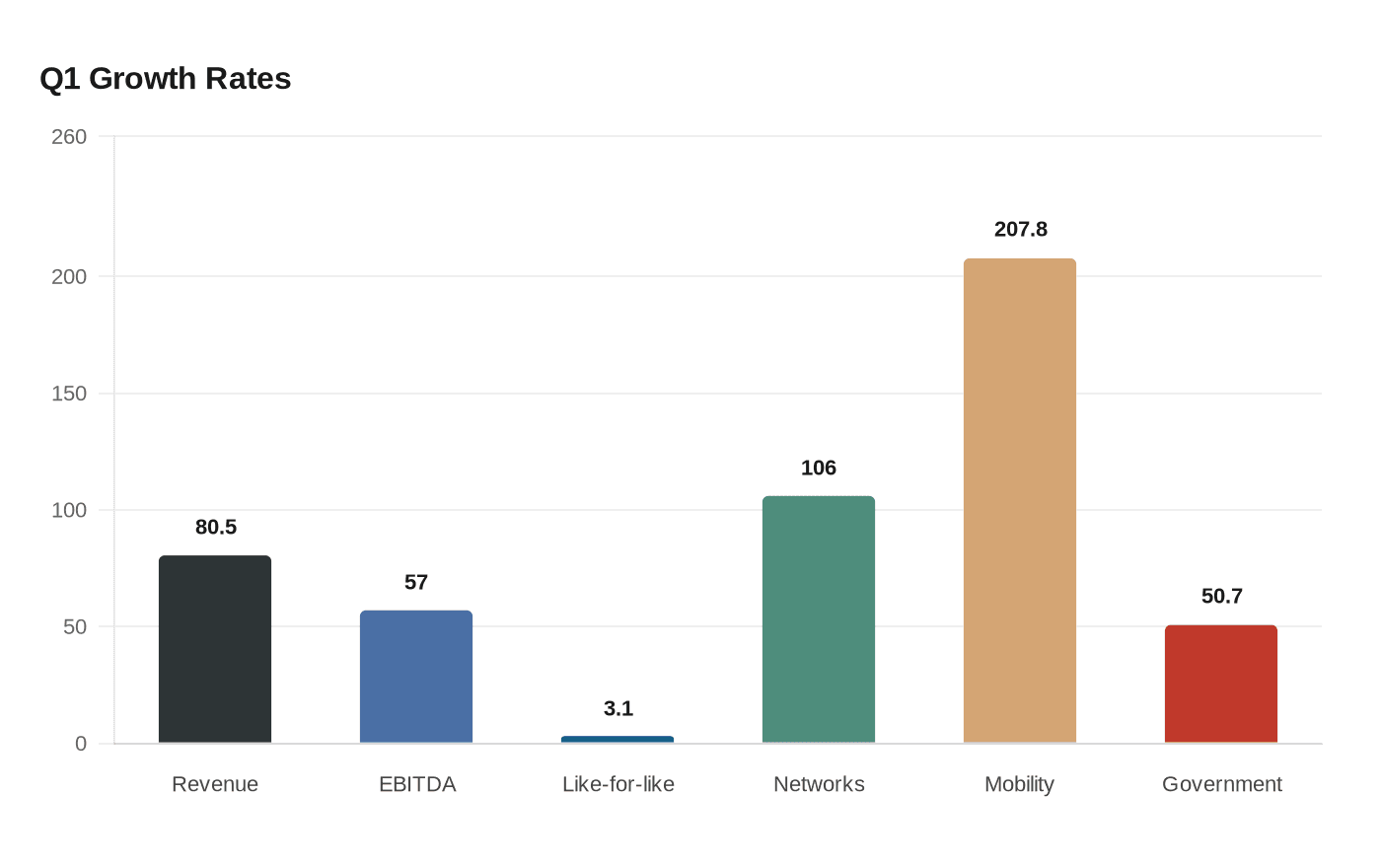
SES turned in a sharp first-quarter surge as airplane connectivity moved from a niche add-on to one of the company’s main growth engines. The Luxembourg-based satellite operator said revenue rose to 847 million euros, up 80.5% from a year earlier on a reported basis, while adjusted EBITDA climbed 57% to 404 million euros. On a like-for-like constant-currency basis, revenue was up 3.1%, and SES reiterated full-year 2026 guidance for revenue and adjusted EBITDA to be stable year on year.
The strongest momentum came from SES’s Networks business, which generated 556 million euros in revenue, up 106.0% from the same quarter a year earlier. Mobility revenue jumped 207.8%, helped by an 81 million euro contract restructuring in Aviation, and Government revenue rose 50.7%. SES said nearly 600 aircraft were flying with its multi-orbit inflight connectivity system, a sign that airlines are beginning to treat broadband service as part of the core passenger experience and operational toolkit rather than a premium extra.
That shift matters because in-flight connectivity is becoming a battleground for satellite operators trying to defend market share against newer networks and alternative broadband technologies. SES said it signed 306 million euros of new business and contract renewals in the quarter, and chief executive Adel Al-Saleh said the company was benefiting from continued momentum in Mobility and Government. The message from the quarter was that airline demand is no longer experimental: it is starting to look like a repeatable revenue stream, especially as more carriers upgrade long-haul fleets and seek higher-capacity links over oceans and remote routes.
SES is pairing that demand with a broader multi-orbit strategy. The company ended the quarter with net leverage of 4.1 times and 874 million euros of cash and cash equivalents, after raising 650 million euros in March through its SPACE hybrid securities issue, which was 5 times oversubscribed. It also completed its acquisition of Intelsat on 17 July 2025, expanding to a fleet of 120 satellites across two orbits. Beyond aviation, SES and the European Union Agency for the Space Programme extended the EGNOS GEO-1 service agreement through 2030, with an option to 2032, while the European Commission’s IRIS² program points to a 290-satellite secure connectivity constellation with first launch envisioned in 2029. SES’s Q1 numbers suggest the economics of connected travel are no longer just about passenger convenience; they are becoming central to the next phase of the satellite industry’s growth.
This article was produced by Prism’s automated news system from verified source data, official records, and press releases, then run through automated quality and moderation checks before publishing. The system is built and supervised by the people who set the standards it runs under. Read our full AI policy.
Did this article answer your question?

%3Amax_bytes(150000)%3Astrip_icc()%2FCertificate-of-deposit-2301f2164ceb4e91b100cb92aa6f868a.jpg&w=1920&q=75)
