SFMTA Warns Major Muni Service Cuts Possible After Pandemic Aid Ends mid-2026
SFMTA staff told the Board that Muni faces "a substantial operating shortfall when one-time federal/state pandemic relief ends in mid-2026," risking major service cuts without new funding.

At an SFMTA Board workshop on Feb. 3, 2026, agency staff presented budget projections and contingency options that the materials say show "a substantial operating shortfall when one-time federal/state pandemic relief ends in mid-2026." The presentation referenced a "worst-case" package that the excerpted materials stop short of listing in full, leaving the specific routes, timelines, and savings unspelled.
The warning brings a familiar set of fiscal pressures back into view for San Francisco transit riders. SFMTA’s earlier board materials from 2020 framed similar risks under the header "Growing Service Demand Structural Imbalance Capital Funds Declining Infrastructure Needs Potential for Downturn Financial Challenges." Those slides outlined a Downturn/Recession Scenario that "Assumes decrease in General Fund baselines and parking tax based on Controller scenario" and a "Decline in traffic fines, fees & permits and operating grants based on SFMTA revenue history during last recession." The 2020 deck also noted "No change in fares– based on SFMTA history during last recession."
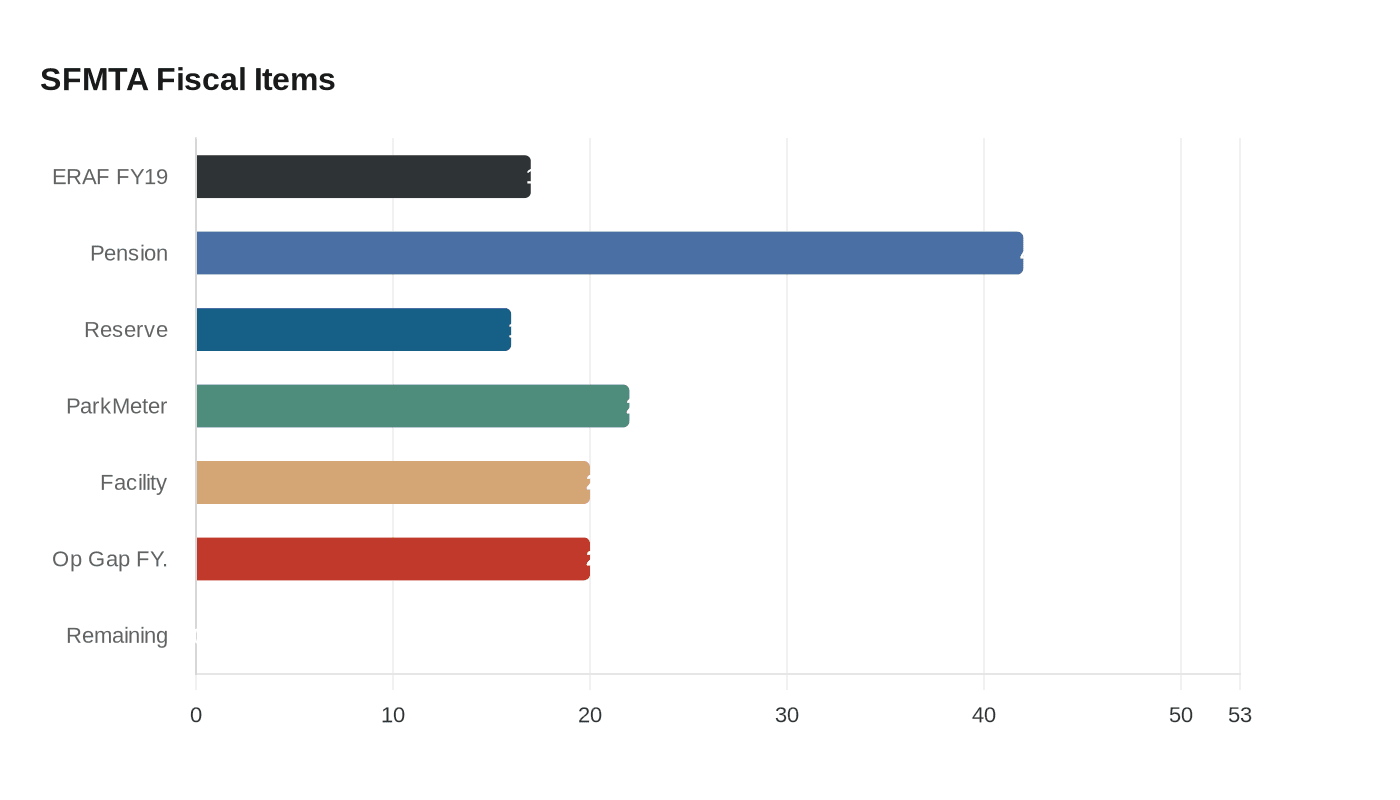
The 2020 slides contain concrete fiscal markers that provide context for the current warning. They record that FY19-20 "includes $17M one-time ERAF" and flag a possible pension-related pressure: "Note: an additional pressure on SFMTA budget would be likely increase in required pension contributions to make up for assumed investment losses ~$42M based on Controller scenario." A chart axis in that deck spans "($M) 1,000 1,050 1,100 1,150 1,200 1,250 1,300 1,350 FY18-19 FY19-20 FY20-21 FY21-22 FY22-23 FY23-24 FY24-25 No [...]," and line-item labels include "Reserve/Contingency (16)," "Parking Meter Replacement Project (22)," "Facility Renewal Program/SGR (20)," "FY 2021 Operating Budget Gap (20)" and "Remaining Balance 0."
Those historical slides also cataloged policy options under the heading "Some possibilities:" and listed potential revenue or policy levers such as "Congestion Management Fees," "Employer-Based Taxes: could be sized to allow it to cover passes for all employees of those employers paying the tax," "Apply new fees or taxes to free parking lots that do not currently pay any parking taxes," "Rethink Residential Parking Permit Program," and "Revitalized federal/state assistance for major capital investments of regional importance."
For San Franciscans, the stakes are practical: any reduction in Muni frequency or coverage would lengthen commutes, strain connections to BART and Caltrain, and disproportionately affect transit-dependent neighborhoods and riders without reliable car access. The Feb. 3 presentation did not include a dollar figure for the projected shortfall in the excerpt provided, nor did it list the detailed items in the "worst-case" package.
Next steps for officials and riders include obtaining the full Feb. 3, 2026 slide deck and supporting spreadsheets, and for the Board to identify near-term revenue options or targeted protections for core routes. City leaders must weigh the 2020-era revenue ideas against legal, equity and implementation timelines if federal and state pandemic aid truly ends in mid-2026. The immediate question for riders is whether SFMTA will release the full contingency plan and how quickly the Board will move from warning to a concrete strategy.
Sources:
Know something we missed? Have a correction or additional information?
Submit a Tip