SHEIN investigations, eBay buys Depop, climate threats reshape sustainable fashion and beauty
SHEIN must prove its net‑zero claims, eBay has bought Depop, and new EU rules plus climate risk and tech shifts mean sustainable fashion is finally being forced from slogan to statute — textiles make 4–10% of global emissions.
Good On You’s March roundup: why this one matters Good On You’s monthly roundup by Amy Miles pulls together an immediate, actionable brief: regulatory pressure on fast fashion, a major re‑commerce acquisition, and clear climate risk for supply chains. The piece sits under Journal > “ocean from above” and is framed as a practical digest of “the most actionable and newsworthy developments across sustainability and fashion for March 2026.” Good On You’s editorial mission is explicit: “We're creating a world where it’s easy for anyone, anywhere to buy better.”
How the platform outfits its coverage The roundup is nested inside a busy editorial architecture that signals practical utility: “All Brand Ratings,” “How We Rate,” and a prompt to “Download the App” sit alongside product category navigation — Tops, Dresses & Playsuits, Face Makeup, Skincare, Bottoms, Basics & Intimates, Eye Makeup, Suncare & Tanning, Shoes, Denim, Lip Makeup, Haircare, Accessories, Outerwear, Nails, Bath & Body, See all fashion >>, See all beauty >>. That scaffolding matters: this is a site built to convert awareness into purchases and swaps, and the navigation names the categories readers actually shop.
SHEIN faces regulator heat: net‑zero claims on trial The clearest regulatory flashpoint in the roundup is bluntly titled: “German Watchdog Says SHEIN Must Substantiate or Remove Net‑Zero Claims (Business of Fashion).” That phrasing points to a legal moment with immediate consumer impact — brands that market net‑zero now risk regulatory takedown if they cannot show the evidence. For shoppers, that means green marketing on ultra‑fast retailers is suddenly less a trust exercise and more a verifiable claim.
Wider investigations into SHEIN’s practices Good On You also flags “more investigations into SHEIN’s alleged shady practices,” signalling this is not an isolated tick box but part of a mounting scrutiny pattern. For anyone who has bought snap‑trendy, disposable pieces at bargain prices, this doubles as a prompt to ask not only about materials and fit but about how claims are audited and enforced.
eBay buys Depop: re‑commerce goes corporate “big news in re‑commerce as eBay buys Depop” is listed as a headline item — a sentence that compresses seismic retail logic. Re‑commerce moves from grassroots to boardroom when legacy players acquire fast‑growing resale platforms, and that transaction-level change reshapes fees, discovery, and who captures resale value. For sellers and vintage hunters, expect platform policy shifts and a recalibration of where second‑hand liquidity lives.
Second‑hand is mainstream, not niche MudJeans’ bullish line is plain: “Second‑hand clothes will be here to stay in 2025. Second‑hand (online) shops are booming. Preloved items no longer belong to sustainable fashion advocates only; they have become a conscious choice.” That shift changes buying behaviour: preloved becomes a style strategy rather than a niche virtue signal, and wardrobes get curated for longevity and uniqueness rather than constant churn.
How eBay–Depop fits the resale surge Taken together, eBay’s acquisition and MudJeans’ forecast mean resale is scaling up and consolidating. Bigger platforms bring better search and payments but also the risk of fee flattening and algorithmic curation that privileges volume sellers. The practical upshot for consumers: more inventory and easier discovery, but keep an eye on seller protections and the premium for authenticated, high‑quality pieces.
EU textiles law: a statutory turn “It is finally here: sustainable fashion legislation is making progress,” MudJeans declares, and they point to the EU Strategy for Sustainable and Circular Textiles: “By 2030, for example, all textile products in the EU must be sustainable, repairable, and recyclable.” That’s not aspirational language — it’s a timeline that will force designers, brands, and suppliers to change product architecture, labelling and end‑of‑life planning within a single design cycle.
Regenerative agriculture on the agenda MudJeans lists “Regenerative agriculture” as a headline trend, acknowledging a shift beyond fibres to feedstock systems. Regenerative practices in cotton, hemp, and other natural fibres mean upstream farmers become climate partners, not just raw‑material suppliers — an important pivot for brands that market provenance and soil health as part of garment value.
Technical innovations remaking design and production MudJeans’ tech brief is concrete: “Take the 3D printer, making customising garments without excess material possible. Or AI software that analyses trends and optimises designs. These innovations are making the fashion industry more efficient, sustainable and customer‑oriented.” The sensory reality is new: 3D printed trims, on‑demand patterning and AI‑trimmed assortments cut markdowns and reduce deadstock — small technical shifts with large commercial consequences.
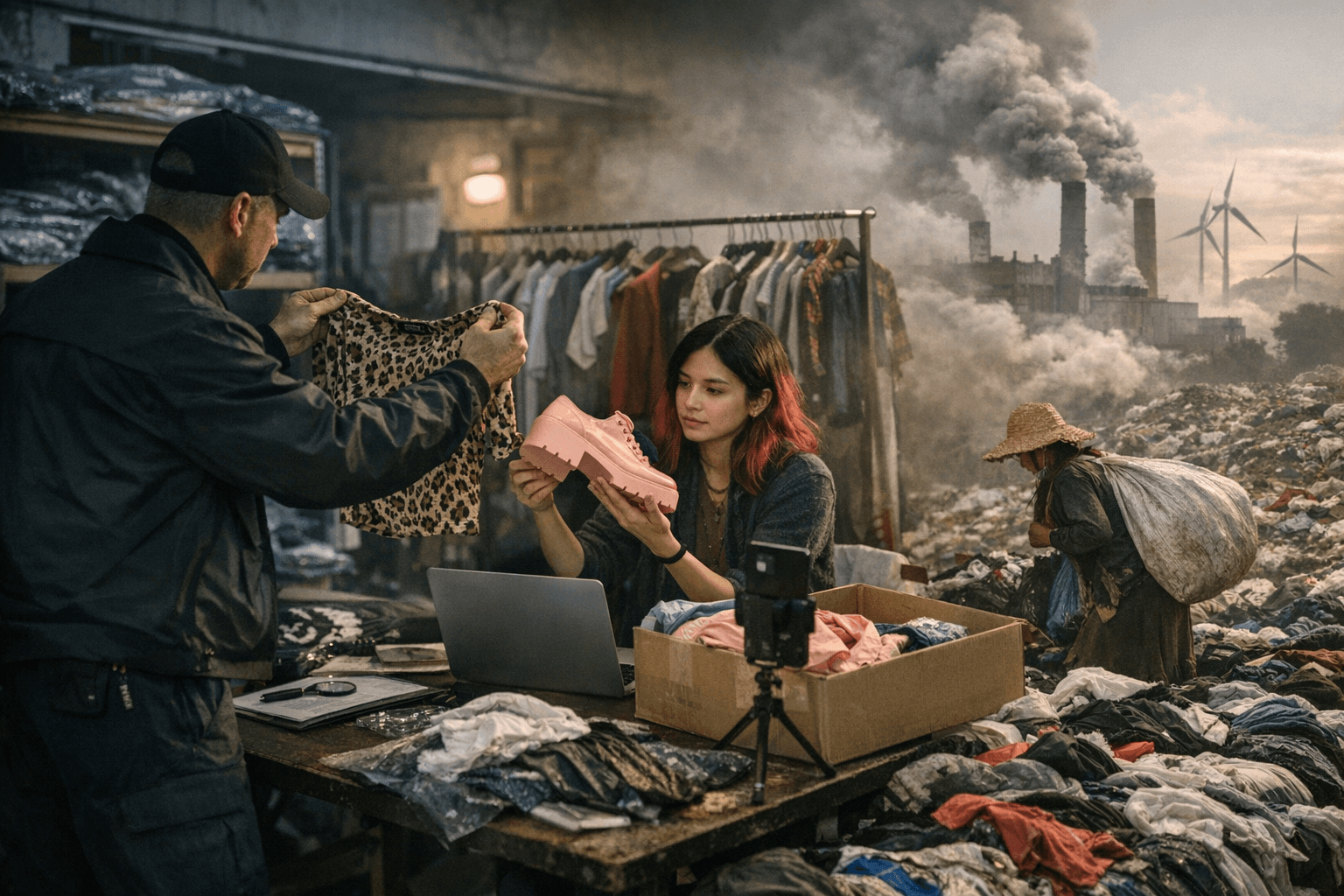
Climate breakdown: supply chains and profit risk Good On You highlights “details about how the climate breakdown will affect supply chains and fashion industry profits.” Climate impacts aren’t abstract — they threaten raw‑material yields, dyehouse operations, shipping routes and labour stability, which in turn create margin pressure and inventory volatility. Brands will increasingly need climate‑scenario planning as much as trend forecasting.
The industry’s scale: greenhouse gas reality British Vogue’s stark framing is worth repeating verbatim: the industry is responsible for “a shocking four to 10 per cent of global greenhouse gas emissions every year.” That statistic is a share‑of‑planet figure that reframes wardrobe choices as climate policy, and it’s the hard number that underpins why regulators and investors are shifting from gentle nudges to enforceable rules.
Why materials matter: polyester’s dominance British Vogue warns to “avoid virgin synthetics, such as polyester – which makes up 55 per cent of clothes globally – as these are derived from fossil fuels and take years to break down.” The tactile insight is immediate: a poly‑heavy wardrobe is light on care needs but heavy on planetary cost; swapping one or two synthetics for natural or recycled fibres can materially change a wardrobe’s lifecycle footprint.
Water counts: the astonishing textile footprint Another British Vogue statistic cuts through greenwashing: “the production of textiles uses an astonishing 93 billion cubic metres of water annually – the equivalent to 37 million Olympic swimming pools.” That figure reframes laundering and fibre choices as water policy; when a brand speaks of “low‑impact” viscose or certified cotton, these are the metrics you should be demanding.
Practical consumer guidance from Vogue’s brief British Vogue’s headings — “Know your materials”, “Reduce your water footprint”, “Take care of your clothes” — are not platitudes; they’re actions. Knowing fibre content, washing less and repairing sooner are the everyday gestures that scale when millions adopt them; collectively they reduce emissions, demand for virgin synthetics and pressure on water systems.
Good On You’s visual and social framing The roundup’s page uses evocative alt text and adjacent features — “ocean from above”, “Person in red jacket”, “person wearing modest clothing - long coat from bastet noir” — and social prompts such as “Share for change.” That visual language and the presence of social share links signal that Good On You wants readers to move from scroll to action: to use ratings, download the app, and let their buying choices reflect new rules and risks.
What this all adds up to Taken together, these fifteen threads — regulatory pressure on green claims, acquisition of resale platforms, EU 2030 targets, regenerative supply thinking, tech like 3D printing and AI, and hard environmental statistics — paint a market that is rapidly professionalising its sustainability rhetoric into enforceable practice. For shoppers, the expectations shift: demand evidence for net‑zero claims, expect resale platforms to change under new ownership, and favour garments built to be repaired, recycled or traced from regenerative farms.
A forward close Sustainable fashion is no longer a boutique beat or a set of good intentions; it’s a regulatory, technical and market transformation touching materials, supply chains and how garments circulate. The numbers are uncompromising — from 4–10% of global emissions to 93 billion cubic metres of water — and they explain why brands, platforms, and legislators are finally moving from talk into rules and acquisitions with real consequence.
Know something we missed? Have a correction or additional information?
Submit a Tip