Silicon quantum chips gain mobile qubits for scalable connectivity
Silicon qubits are no longer just manufacturable; now they are mobile, linked and accurate enough to challenge the scaling bottleneck.
The bottleneck is no longer only making qubits
The big question in silicon quantum computing has shifted from whether qubits can be built in a semiconductor factory to whether they can be moved and connected without destroying their quantum state. That matters because scale is not just a matter of adding more qubits. It depends on routing information across a chip, controlling errors and turning one-off lab devices into repeatable production.
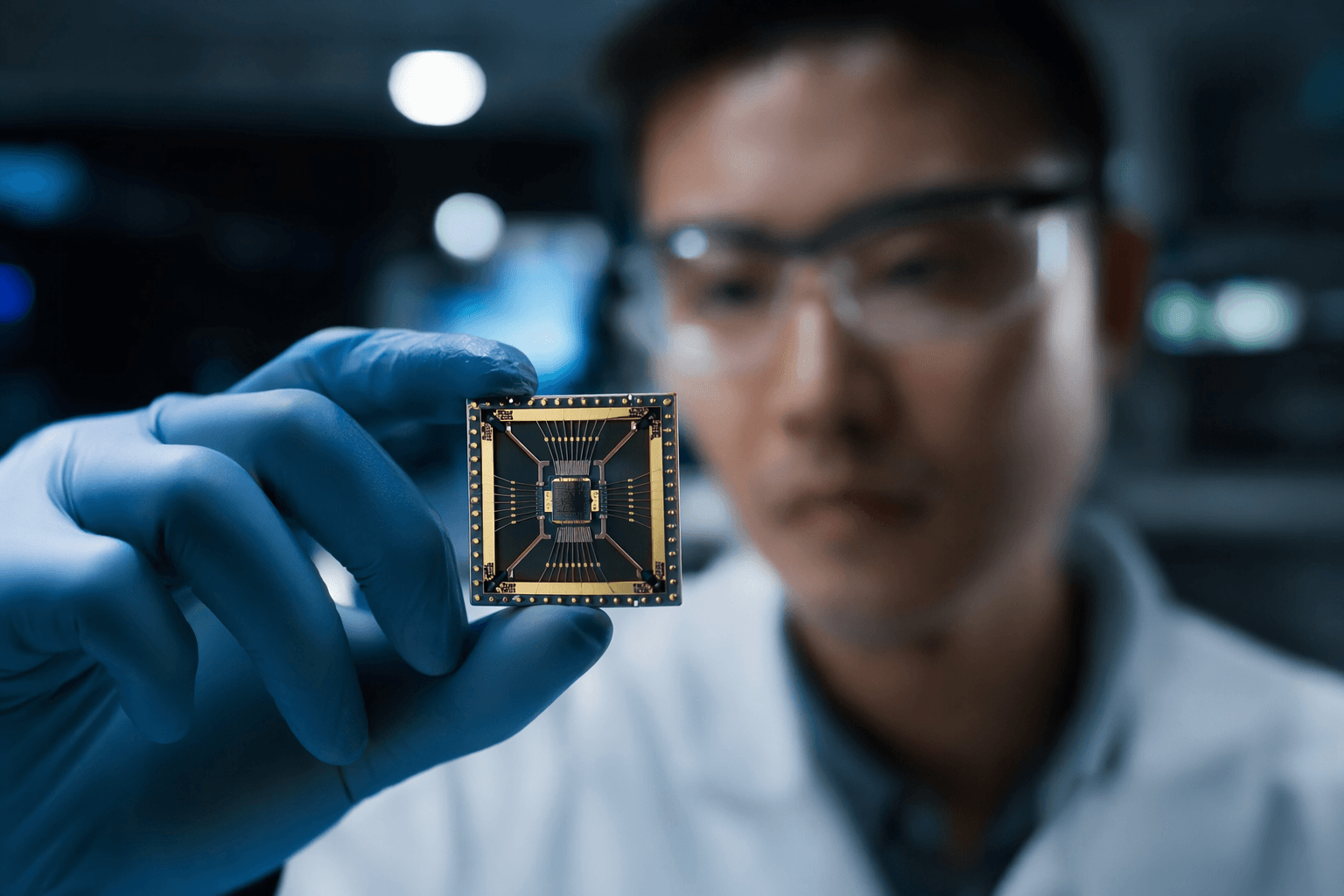
A series of recent results suggests the field is starting to address that manufacturing bottleneck directly. Researchers have now shown silicon-based mobile qubits that can be shuttled, linked and operated with two-qubit fidelity of about 99%, while also demonstrating teleportation between qubits separated by 320 nm. Those are the kinds of numbers that move the conversation from physics demonstration to architecture.
Why mobility changes the scaling problem
Quantum computing has long faced a geometry problem. Qubits are delicate, and the more wiring, gates and physical couplings a chip needs, the harder it becomes to preserve coherence and maintain high accuracy. Movable qubits offer a different answer: instead of forcing every interaction to happen through a dense fixed network, the chip can physically transport spin states to where they are needed.
That routing flexibility is more than an elegant idea. In the 2024 Nature Communications paper on coherent spin qubit shuttling through germanium quantum dots, researchers reported transport of spin basis states over effective lengths beyond 300 microns. They also reported coherent shuttling of superposition states over effective lengths corresponding to 9 microns, extended to 49 microns with dynamical decoupling. The authors argued that shuttling could provide flexible qubit routing and local addressability, while also reducing the number of gates needed to run algorithms.
That last point is important for commercialization. Fewer gates usually means fewer opportunities for error, less control overhead and a clearer path toward fault-tolerant operation. In other words, mobility is not just a scientific trick. It is a possible way to simplify the chip-level mechanics that have kept quantum devices from scaling cleanly.
Silicon is becoming the industrial test bed
Silicon remains attractive because it fits into the same manufacturing culture that built modern electronics. A 2022 Nature Electronics article said silicon spin qubits can be fabricated in a 300 mm semiconductor manufacturing facility using all-optical lithography and fully industrial processing. That is a crucial advantage over platforms that rely more heavily on bespoke lab-scale fabrication.
The industrial case strengthened further in 2025, when a Nature paper reported two-qubit operations exceeding 99% fidelity in silicon devices made with standard semiconductor tooling in a 300-mm foundry environment. Intel has also said its 300-mm cryogenic probing process is meant to collect high-volume data across whole wafers and support scaling and commercialization of silicon spin qubits. Intel’s 2022 Tunnel Falls chip, fabricated on 300-millimeter wafers using advanced transistor fabrication methods such as extreme ultraviolet lithography, underscored that the company is already treating quantum hardware as a semiconductor manufacturing problem, not just a lab experiment.
That industrial compatibility matters because quantum computing has been stuck in a transition zone for years. Many platforms can demonstrate a few impressive qubits. Far fewer can show that those qubits can be produced on wafer-scale tools, characterized at scale and kept within the tight tolerances needed for repeatable device performance.
From shuttling in germanium to mobile qubits in silicon
The latest advance closes another gap. In June 2025, Nature Nanotechnology highlighted near-perfect shuttling of silicon spin qubits, saying it closed a gap versus rival systems. Then on 6 May 2026, Nature reported that a silicon-based mobile-qubit architecture had achieved about 99% two-qubit gate fidelity and quantum-state teleportation between qubits separated by 320 nm.
Taken together, these results mark a progression. Germanium quantum dots showed that coherent spin transport could work over meaningful distances. Silicon experiments then pushed the idea into the material system most closely tied to mainstream chip fabrication. The newest work goes a step further by combining mobility with two-qubit logic and teleportation, which is the critical test for whether moving qubits can support real computational operations rather than merely preserve quantum states during transport.
That distinction matters to engineers. A chip architecture that can move qubits but cannot reliably entangle them or preserve fidelity during logic still falls short of the requirements for useful systems. The 99% figure is notable because it suggests mobile qubits may now be entering the range where error-correction strategies and scalable device design start to look plausible rather than speculative.
Why the roadmap is changing
Semiconductor spin-qubit roadmaps now increasingly emphasize that scaling to larger devices likely requires changes in architecture, not just more qubits packed onto a wafer. The emerging model points to short-range and mid-range quantum links as part of the design, rather than a purely static grid of fixed interactions.
That shift reflects a deeper commercialization reality. A scalable product needs not only a higher qubit count but a manufacturable way to connect distant regions of the chip, control error rates and keep fabrication compatible with industrial process flows. Mobile qubits help by introducing flexibility at the chip level: a qubit can be routed to an interaction zone, used for logic or teleportation, then moved again. If that process can be repeated with high fidelity, it reduces the burden on the wiring and gate layout that has constrained earlier designs.
The significance is especially clear in the context of the organizations driving this work. The University of Oxford, the University of New South Wales, QuTech, imec, KU Leuven, Quantum Motion, Intel and researchers including Christian W. Binder, Simon C. Benjamin, Floor van Riggelen-Doelman, Chien-An Wang, Sander L. de Snoo, William I. L. Lawrie, Nico W. Hendrickx, Maximilian Rimbach-Russ, Amir Sammak, Giordano Scappucci, Corentin Déprez, Menno Veldhorst, Y. Matsumoto, M. De Smet, L. M. K. Vandersypen and Andrew S. Dzurak all sit within an ecosystem trying to translate quantum science into semiconductor practice.
The real test is repeatable production
The story now is not whether movable qubits are clever. It is whether they solve the manufacturing problem that has kept quantum computing from scaling. Silicon’s advantage has always been that it can live inside the logic of semiconductor production, including 300-mm wafers, foundry tools and standard transistor methods. What is new is the evidence that those same platforms can also support mobility, coherence and near-99% two-qubit performance.
That combination changes the commercial outlook. A quantum processor built from mobile silicon qubits is no longer only a prototype of exotic physics. It is increasingly a candidate for a production-minded architecture, one that could align chip fabrication, error control and connectivity in a way the field has been missing. If the next wave of results keeps holding fidelity while extending routing distance and improving control, silicon quantum computing may finally be moving from proof of concept toward a repeatable manufacturing model.
This article was produced by Prism’s automated news system from verified source data, official records, and press releases, then run through automated quality and moderation checks before publishing. The system is built and supervised by the people who set the standards it runs under. Read our full AI policy.
Did this article answer your question?