Six New Coffee Diterpenes Identified That Inhibit Blood‑Sugar Enzyme
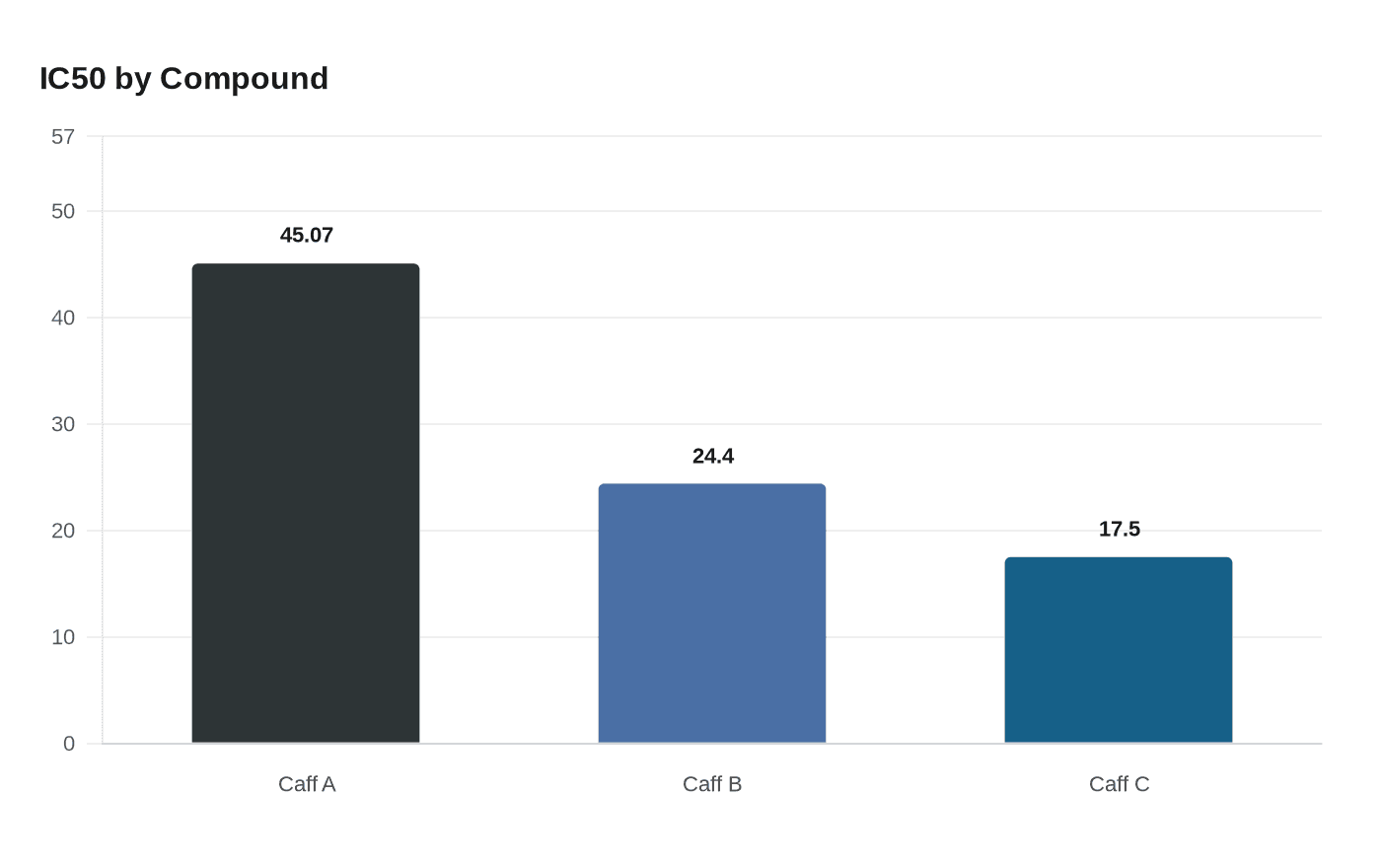
Minghua Qiu’s team found six previously unknown diterpene esters in roasted Arabica that inhibit α-glucosidase in vitro, isolating caffaldehydes A–C with IC50s of 45.07, 24.40 and 17.50 μM.

Minghua Qiu’s group at the Kunming Institute of Botany reported isolating six previously undescribed diterpene esters from roasted Coffea arabica that inhibit the carbohydrate‑digesting enzyme α-glucosidase in vitro. The paper in Beverage Plant Research names the three isolated compounds caffaldehydes A, B and C (compounds 1–3) and lists IC50 values of 45.07 μM, 24.40 μM and 17.50 μM respectively; the authors state those values are more potent than the control drug acarbose under the assay conditions reported.
The team used an explicit three-step, activity‑oriented strategy to find both abundant and trace bioactives. A crude diterpene extract was split into 19 fractions by silica gel chromatography, each fraction was profiled by 1H NMR and screened for α-glucosidase inhibition, and a cluster heatmap of 1H NMR data highlighted Fr.9–Fr.13 as the most bioactive group. Follow‑up 13C‑DEPT NMR of Fr.9 revealed an aldehyde signal; semi‑preparative HPLC on Fr.9 yielded the three new caffaldehydes, whose structures were confirmed by 1D/2D NMR and high‑resolution electrospray ionization mass spectrometry. NMR data were collected on Bruker DRX‑600 instruments, the paper notes.
To capture trace congeners the authors pooled fraction groups for LC‑MS/MS and built a molecular network using GNPS, visualized in Cytoscape. That network revealed three additional novel diterpene esters (compounds 4–6) that share common fragment ions with caffaldehydes A–C but carry different fatty‑acid moieties reported as magaric, octadecenoic and nonadecanoic acids. The study reports these trace compounds were “directly identified without enrichment with the aid of an LC‑MS/MS-based molecular network,” and searches of compound databases returned no matches, supporting their novelty.
The enzyme target is relevant to blood‑sugar control because α‑glucosidase breaks carbohydrates into absorbable sugars; inhibitors of the enzyme are used to blunt postprandial glucose spikes and are of interest for type 2 diabetes research. The authors include the precaution: “To be clear, this was not a human study. Thus, the practical effect these new coffee compounds may have on the body remains unknown, according to the authors.” The reported IC50s are from in vitro enzyme assays; the paper does not provide clinical or in vivo efficacy data in the summaries available.
Methodologically the team frames the work as a proof of concept for an “activity‑oriented strategy” that speeds discovery in complex food matrices while reducing solvent use. Maxapress’ materials and methods further state the targeted separations for 1–3 were achieved using “very small amounts of organic solvent,” and the authors write that “The proof‑of‑principle of the strategy was successfully achieved in the diterpene extract of Coffea arabica.” The next steps the paper implies are in vivo testing, pharmacokinetics and full spectroscopic disclosure (m/z values, NMR tables and yields) to validate bioavailability and safety before any translational claims can be made.
Know something we missed? Have a correction or additional information?
Submit a Tip