Sizing and Aspect Ratio Tradeoffs for Surf, Downwind, and Pump Foil Wings
Choosing foil wings comes down to balancing aspect ratio and surface area for the discipline, weight and conditions — the right combo buys glide, lift or pumpability.

Front wings define how a foil rides, and the community is sharpening its playbook around aspect ratio and area to match surf, downwind, and pump disciplines. Manufacturers and team riders offer concrete model choices tied to AR numbers and surface-area logic so you can match gear to wind, swell and weight.
F-ONE lays out the spectrum bluntly: "Our range starts at an AR of 5.0 with the GRAVITY and goes all the way to 12.0 with the EAGLE X." That span explains the performance split riders already feel on the water. Lower-AR, larger-chord wings like the GRAVITY (AR 5.0) prioritize lift and stability; F-ONE describes GRAVITY as "the foil you should have if you want to learn how to use both a wing and a foil. Accessible and straightforward, the GRAVITY foils have great lift and stability." At the other end, the EAGLE X family chases glide and top-end speed: Brand manager Julien Salles praises the EAGLE X 900 for its "stunning glide, high speed potential and comfort in the air" and recommends it "a perfect foil to downwind in more than 25 knots, and to wing foil in choppy waters."
Coaching and community voices converge on a clear principle: glide and low stall speed usually favor higher aspect ratios. "No matter your discipline, you’ll want something with plenty of glide and a low stall speed. That usually means a high-aspect design (7 aspect ratio or higher)," reads one practical guideline. That advice sits beside product-led nuance: F-ONE’s SEVEN SEAS at AR 8.0 and the SEVEN SEAS 1300 are positioned as do-it-all performers for small chops and light winds because "Having a bigger surface area is essential for low-winds conditions, and the thin profile is great to maintain a good speed."
Practical tradeoffs are the real story. Larger wings in the 1300–2400 cm2 neighborhood make pumping and early lift easier — ENSIS recommends INFINITY 1800 for beginners and the PACER 2400 for riders up to 120kg — but larger area can be slower relative to swell so you must learn to link bumps. Smaller, higher-AR wings give long glides and speed for true downwind runs, yet they demand cleaner technique and can be less forgiving in tight surfing maneuvers.
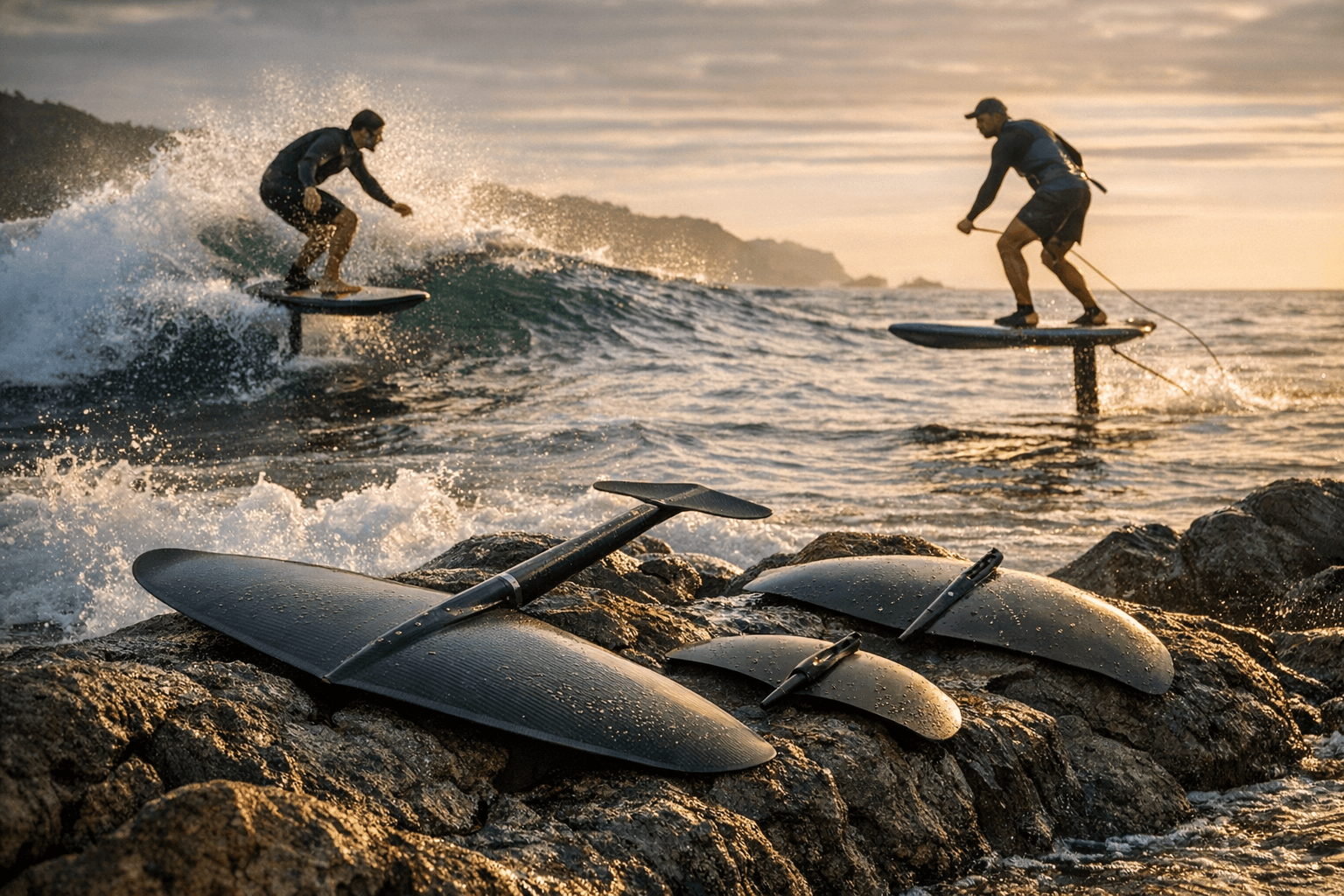
Pump foiling has its own house rules. Several makers offer pump-tuned wings: F-ONE markets the JAM at AR 10 for dock starts and pumping, while a YouTube fragment advises Takoon Pump 1700 or 1900 for beginners and notes, "If you weigh more than 70 kg, I would go straight for the 1900; it will be a little harder to control the turns, but it will last longer." Once balance is consistent, riders can reduce stabilizer size to cut drag and extend glide.
Skills matter as much as numbers. "The two skills that unlocking longer downwind rides are Bump Reading and Pumping The Foil," is a short checklist that matches forum experience: "The most important thing to learn is the rhythm of bumps." Expect a steep curve for SUP downwind; one rider notes a year of dedicated practice to feel competent.
Build your quiver according to your skill set, the conditions, your weight, and what kind of riding you intend to do. Test larger wings for early lift, move toward AR 7+ plates for longer glides, and treat stabilizer swaps as a tuner's lever. With clear AR ranges and model examples now baked into the conversation, readers can make targeted choices that translate to longer sessions, fewer swims and better lines down the bumps.
Know something we missed? Have a correction or additional information?
Submit a Tip