SK Hynix posts record profit as AI memory chip demand surges
SK hynix’s profit surged as AI memory demand outran supply, showing that HBM has become as critical a bottleneck as GPUs in the data-center race.
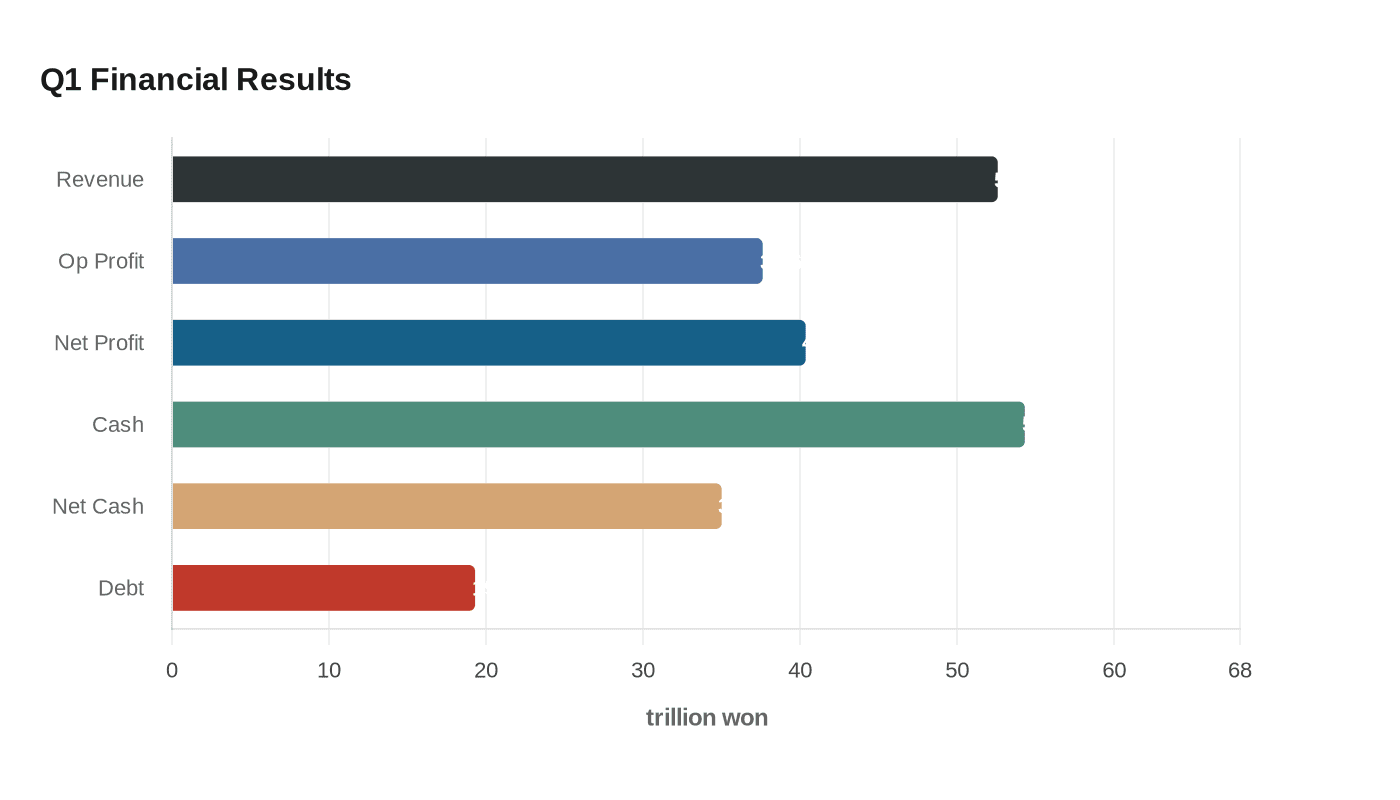
SK hynix posted a record quarter as the AI buildout drove demand for memory chips beyond available supply, delivering a reminder that the bottleneck in artificial intelligence is no longer only graphics processors. The South Korean chipmaker reported first-quarter revenue of 52.5763 trillion won, operating profit of 37.6103 trillion won and net profit of 40.3459 trillion won, with an operating margin of 72%.
Revenue topped 50 trillion won for the first time in a quarter, and the company said cash and cash equivalents climbed to 54.3 trillion won, up 19.4 trillion won from the previous quarter. SK hynix moved to a net cash position of 35 trillion won, with interest-bearing debt at 19.3 trillion won, a balance sheet that reflects how tightly advanced memory supply is being absorbed by AI customers.
The company said the results were driven by expanded investment in AI infrastructure and stronger sales of high-bandwidth memory, high-capacity server DRAM modules and eSSDs. SK hynix, the world’s leading supplier of HBM, sits at the center of Nvidia’s AI chip ecosystem, and its latest outlook showed that customers are still pushing to secure supply even as prices stay elevated. An executive said buyers are prioritizing procurement over price because demand is outstripping capacity.
That matters far beyond one Korean manufacturer. HBM is a core component in the systems used to train large models and run them in production, and SK hynix said demand is still widening as AI shifts from large-model training toward agentic AI and real-time inference. For U.S. cloud operators and AI developers, that means memory, not just GPU availability, can determine how quickly new data-center racks come online and how much those systems cost to equip.
The company also said favorable pricing conditions should continue for both DRAM and NAND flash, suggesting the memory market remains tight rather than normalizing. Counterpoint Research said the DRAM market had posted 30% quarter-over-quarter growth for two straight periods, driven by higher prices, underscoring how constrained supply is supporting margins across the sector.
SK hynix has been preparing for that squeeze. It said in September 2025 that it completed development of HBM4 and was getting ready for mass production. It also plans to invest about 19 trillion won, or roughly $12.85 billion, in a new South Korea plant for advanced packaging, with construction set to begin in April 2026. Shares rose 0.16% in Seoul trading after the results, while Samsung Electronics climbed 3.22%, a sign that investors still see an intense race for the memory capacity behind the AI boom.
This article was produced by Prism’s automated news system from verified source data, official records, and press releases, then run through automated quality and moderation checks before publishing. The system is built and supervised by the people who set the standards it runs under. Read our full AI policy.
Did this article answer your question?

