Small Bakeries Scale Sourdough Production Using Scheduling and Capacity Planning
Small bakeries move from farmers‑market chaos to predictable daily retail by scheduling ferment windows, matching oven and rack capacity, and planning staff shifts around cold retards.

When a two‑person stall turns into a seven‑day storefront, the gap you’re really facing isn’t flavor but timing: the clock on your starter and the limits of your oven will decide whether you make money or make excuses. Scaling sourdough from weekend batches to reliable daily retail requires translating wild fermentation into a repeatable schedule and building capacity assumptions around racks, trays, and people so artisan quality survives higher volume.
Why scheduling is the operational lede Scheduling is not a checklist; it’s the backbone of quality control. If you stagger feedings, mix times, bulk ferment and proof windows on paper first, you convert unpredictable fermentation into predictable outcomes that bakers and front‑of‑house staff can rely on. That predictability also creates teachable moments—documented workflows that are far more likely to be shared within the community, and useful given that 97.4% of readers typically consume without sharing and only 2.6% of pieces get passed on; make your processes repeatable and you increase the odds your system becomes the one people copy.
Map your current production footprint Start by inventorying what you actually have: number of ovens and their usable deck area, number of proofing racks and trays per rack, steady starter volume, and trained staff hours per day. Translate those into hard capacities: how many 1‑kg loaves fit per oven load; how many trays fit per rack and how many hours those trays need to be in proof before bake. Write these numbers down; a capacity map (rack × trays × proof time × bakes per day) is the single most useful artifact when you begin to schedule.
Turn recipes into capacity math Convert every recipe into dough yield and dough pieces, then express those as throughput per bake cycle. Use baker’s percentages to scale cleanly: once you know hydration and flour weight, you can scale ingredients to match a target dough yield without rebalancing water or salt on the fly. Calculate how many loaves a single mix produces, how many mixes you can run in an eight‑hour window, and how many oven loads that translates to. Those calculations tell you whether demand requires more shifts, a second oven, or smarter use of cold retardation to spread work.
Build a weekly production schedule (sequential process) 1. Forecast demand for each sale day using historical sales or farmers’ market counts. 2. Back‑calculate required bakes and then required mixes and proof windows. 3. Slot mixes, bulks, proof retards, and bake slots into a repeating schedule that aligns with staff shifts and opening hours.
Treat that schedule as living: update the forecast weekly and lock the mix timetable 48–72 hours before each major sale day so staff and ingredient orders can adjust.
Use fermentation windows as a scheduling lever One of the most powerful levers for small bakeries is cold retardation. Moving proofing into the refrigerator spreads workload across time: you can mix in the afternoon, cold retard overnight, and bake the next morning to meet retail demand. Likewise, prefer predictable bulk fermentation (set target rise percentages or timed windows) instead of visual cues alone; time‑based targets make staffing and oven planning reliable. When you need to deviate—overproof one day, underproof the next—document the impacts so the team learns the tradeoffs between texture and throughput.
Staffing, roles, and cross‑training Schedule bakers and front‑of‑house around production peaks and proofing valleys. Identify roles: starter custody (feeds and health), mixer operator, floor baker (shaping and scoring), and front‑of‑house for sales. Cross‑train so any employee can take over basic scoring or loading an oven when someone calls out. Track labor in hours per loaf during a normal week; that metric will show when hiring a part‑timer actually reduces costs by increasing throughput.
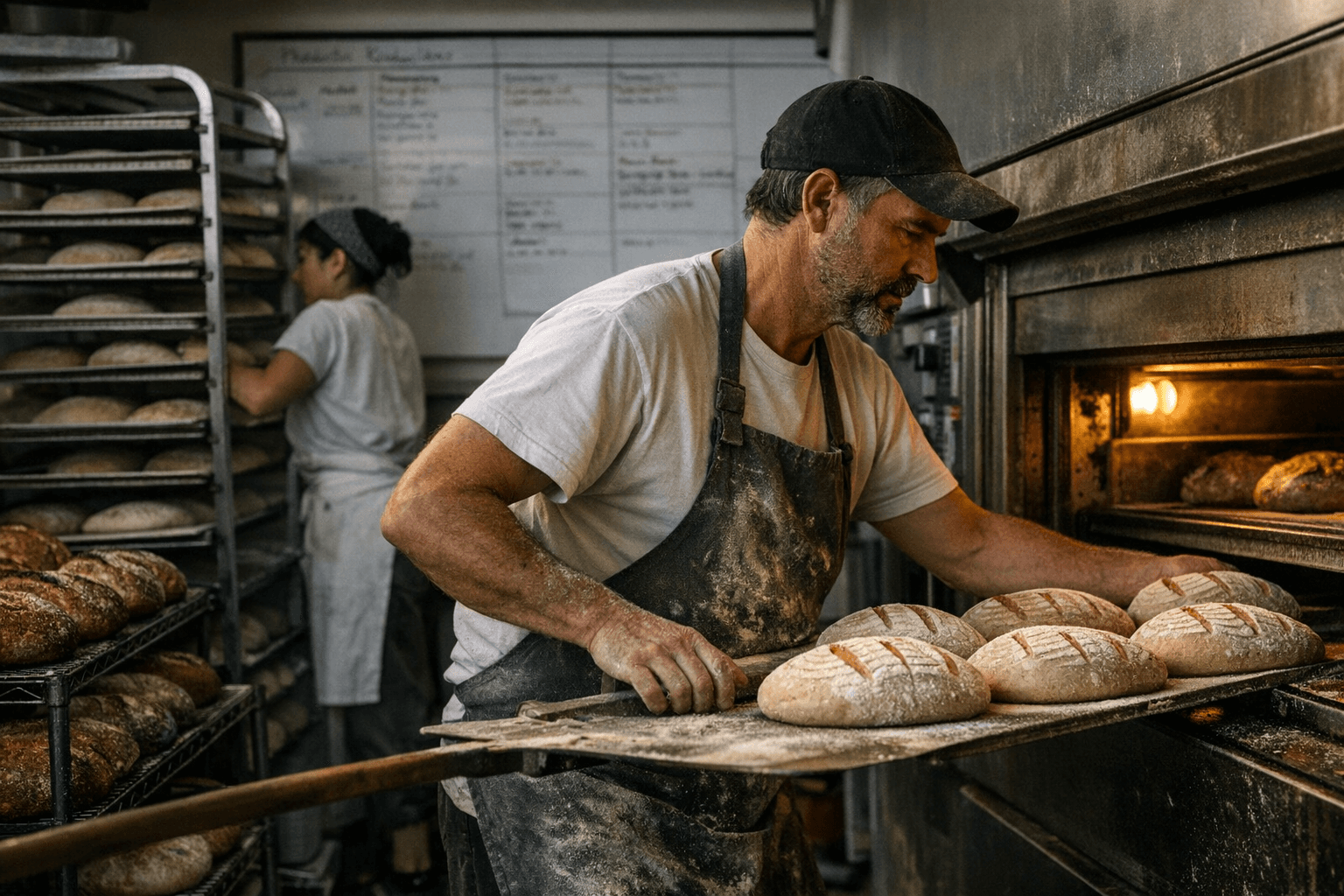
Equipment tweaks that unlock capacity Small changes often yield outsized gains. More proofing trays and a modest proof cabinet reduce idle time between batches; investing in one extra rack or a second small deck oven can double morning capacity without changing recipes. Also consider staging space for pre‑shaped dough, rolling carts for quick oven loading, and consistent tray sizes so you can predict dough weight per tray. Those predictable volumes simplify scheduling and reduce time wasted shifting odd tray configurations.
Short‑term forecasting and buffer management Use a two‑tier forecast: a rolling 7‑day operational forecast for scheduling and a 30‑day demand forecast for ingredient and labor planning. Always add a buffer to your raw calculations: a 10–15% production buffer handles variability from starter vigor, staff illness, or a sudden wholesale order. Track fill rate (percent of demand met on schedule) and aim to push it above 95%; in small retail, missing a sell day hurts customer trust more than a slightly stale technique.
Quality control without sacrificing throughput Maintain a simple QC checklist tied to schedule slots: starter specific gravity or rise time, dough temperature targets at mix, bulk fermentation duration, proof timing, and oven spring observations. Put one QC check at each schedule milestone so an apprentice can validate the batch before it moves to the next step. These checkpoints keep artisan quality consistent as volumes climb.
Metrics that tell you when to invest Measure throughput (loaves/day), oven utilization (percent of available bake-hours used), labor per loaf (hours/loaf), and waste rate (percent of dough discarded). When oven utilization regularly exceeds 80% during peak windows, consider incremental capacity—another small oven, extra rack, or split shifts. If labor per loaf is climbing, look at bottlenecks in shaping or scoring and address them before hiring.
Packaging, distribution, and retail cadence Match your bake cadence to how you sell: if your storefront sells all morning, concentrate your best bakes to that window and use par‑bakes or chilled retards to supply later demand. For wholesale, consolidate loads into predictable pick‑up slots; that lets you batch packaging and reduces handling time. Packaging decisions should be included in your schedule as an hourly task—packing 200 loaves will take significantly more time than packing 20.
Conclusion: shift from ad‑hoc artistry to deliberate production Scaling sourdough is less about losing craft and more about structuring it. By mapping equipment and human capacity, converting recipes into throughput math, using cold retardation and proof windows intentionally, and tracking a small set of KPIs, you move from firefighting to a defensible schedule that keeps crumb and crust consistent. As trends in our community show, stories that spell out operational change and opportunity get attention; build your schedule with that same clarity, and your bakery will reliably deliver the artisan quality customers expect as you grow. As of March 5, 2026, start by writing down your rack × tray × proof × bake numbers—those four figures will change how you plan everything else.
Know something we missed? Have a correction or additional information?
Submit a Tip