South Korea president warns democracy still fragile after failed martial law
President Lee Jae Myung said cleanup after last year’s abrupt martial law declaration remains unfinished, as trials and investigations continue into senior officials and military figures. His proposal to make December third a public holiday and his vow to pursue those responsible come amid deep political divisions and economic concerns for the export dependent economy.
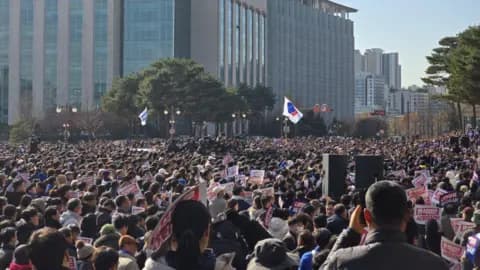
President Lee Jae Myung used a high profile address on December third to mark the first anniversary of the failed martial law declaration by former president Yoon Suk Yeol, saying the task of addressing the political and institutional fallout is not yet complete. Lee framed the episode as a major threat to constitutional democracy and outlined a series of steps he said were needed to close the crisis and prevent a recurrence.
Lee proposed designating December third as a public holiday to honor the role of citizens who resisted the move, and said the government would continue investigations of senior officials, military officers and associates linked to the attempted seizure of power. The prosecutions already under way include cases brought against military personnel and civilian associates, and Yoon himself faces trial on insurrection related charges. Judicial proceedings have stretched through the year, underscoring the depth of the crisis and the political polarisation it left behind.
The president tied institutional reform to national memory, arguing that public recognition of those who defended democratic order was part of healing. He described reforms as painful but necessary, and said that the political system must be strengthened to restore public trust. Lee suggested that those who helped preserve constitutional rule merit not only domestic acknowledgment but international recognition as well.
The address comes as South Korea navigates a difficult external environment. The country’s export oriented economy, where exports equal roughly 40 percent of gross domestic product, remains sensitive to diplomatic and trade frictions. Recent tensions with key partners have complicated supply chains for semiconductors and other advanced manufactured goods, areas that drive both growth and national income. Business leaders and foreign investors are watching how political uncertainty and judicial outcomes affect policy continuity and trade relations.

Market reaction to the anniversary was muted on the day as investors absorbed the long running legal saga and shifts in political risk. Analysts say that prolonged uncertainty can weigh on investment decisions, particularly in sectors requiring long term commitments, and can complicate negotiations on trade and technology cooperation that are crucial for South Korea’s export performance.
The legacy of December third is likely to shape politics and policy for months if not years. Lawmakers and prosecutors now face a choice between broad institutional reform and a narrower accountability process. International partners may also adjust their engagement depending on perceptions of stability and the rule of law.
For now the immediate horizon is legal. The courts will determine accountability for the events that unfolded a year ago, and the outcome will be a key test of South Korea’s institutions. Lee’s call to memorialize the public resistance and to press ahead with reform signals a government seeking to turn a constitutional crisis into a longer term strengthening of democratic safeguards, even as political fissures and economic pressures persist.
This article was produced by Prism’s automated news system from verified source data, official records, and press releases, then run through automated quality and moderation checks before publishing. The system is built and supervised by the people who set the standards it runs under. Read our full AI policy.
Did this article answer your question?


