Southeast Asia’s fisheries face depletion, illegal fishing, and rising economic losses
Southeast Asia feeds the world’s seafood trade, but its own waters are being exhausted. Overfishing now threatens food security, jobs, and billions in lost value.
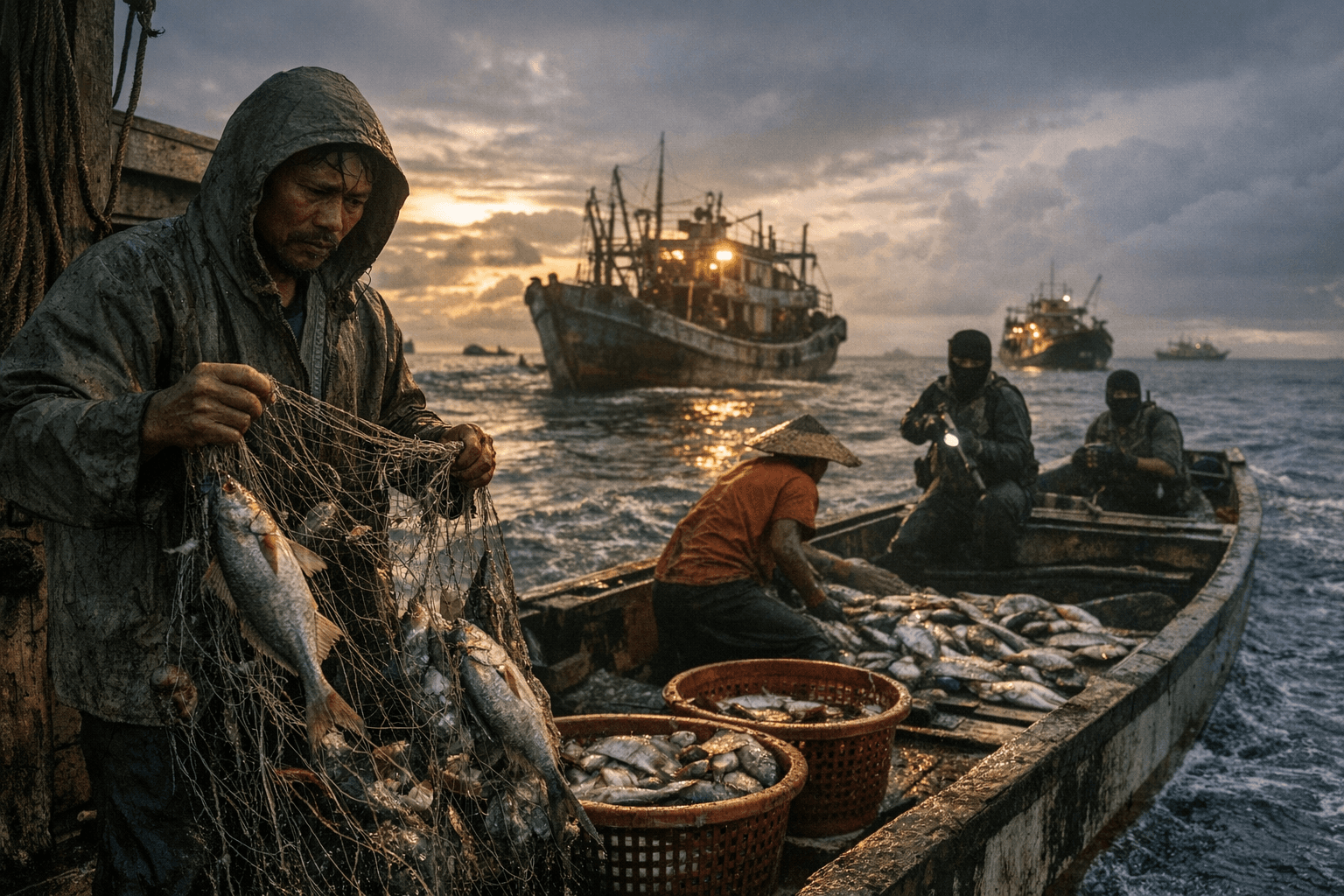
The supply-chain paradox
Southeast Asia produces more than half of the world’s fish, yet its coastal waters are among the most depleted and contested on earth. That contradiction sits at the center of the region’s fisheries crisis: the same waters that keep seafood moving through global markets are being strained to the point where local communities feel the losses first and most sharply.
The scale of the economic risk is larger than conservation alone. The World Bank estimates that global marine fisheries lose about US$83 billion a year in economic benefits because of overfishing, a figure that captures the cost to jobs, trade, and national economies when fish stocks are pushed beyond recovery.
Who depends on the catch
UNEP says the coastal waters of Southeast Asia support nearly 4 million people, which means the health of fisheries is tightly bound to daily survival in coastal towns and island communities. A 2001 U.N. report found that roughly 80% of fishers in the region were small-scale or artisanal, a sign of how heavily the region has long relied on nearshore fishing and how quickly falling catches can become a household crisis.
That dependence also has a labor dimension. IOM says Southeast Asia accounts for about 20% of the world’s fish supply and employs millions of migrant fishers, tying the region’s seafood economy to a workforce that is often mobile, vulnerable, and far from home. When stocks decline, it is not only reefs and breeding grounds that suffer; wage insecurity, debt, and unsafe working conditions tend to rise alongside them.
Illegal fishing deepens the damage
Illegal, unreported and unregulated fishing remains one of the region’s most stubborn governance failures. A 2025 Stimson Center policy roadmap says Southeast Asia still faces serious gaps in combating IUU fishing, and UNEP has highlighted destructive practices such as blast fishing in Sabah, Malaysia, as part of the broader ecological damage.
Blast fishing is especially devastating because it destroys habitat as well as catch. Reefs and nursery grounds are flattened in moments, leaving fewer places for marine life to recover and fewer future harvests for legal fishers who depend on those ecosystems. Regional efforts, including Sabah-based Stop Fish Bombing! and advocacy from Greenpeace Southeast Asia, show how much local pressure has been needed to keep the issue visible.
A crisis decades in the making
Warnings about overfishing in Southeast Asia are not new. Mongabay has reported that concerns about coastal depletion in the region date back to the 1970s, when overcapacity, rising demand, and population growth began to collide with the limits of marine ecosystems.
Those pressures have only intensified as seafood became more central to both domestic diets and export earnings. The result is a regional system in which more boats, more gear, and more market demand have not translated into more stability. Instead, the competition for fewer fish has made the waters from Indonesia to Vietnam, Thailand, and across the Mekong region more contested and more fragile.
Why management still matters
FAO’s 2024 State of World Fisheries and Aquaculture report, the organization’s flagship biennial review, places fisheries, aquaculture, seafood trade, and IUU fishing within a broader Blue Transformation agenda. That framework is meant to improve food security and sustainability at the same time, while also supporting community involvement rather than treating fishers as bystanders in policy design.
The FAO’s 2025 global fish-stock assessment offers an important comparison for Southeast Asia: well-managed fisheries can remain highly sustainable, while weaker management leaves stocks under continuing pressure. That is a reminder that depletion is not an unavoidable fate, but the result of choices about enforcement, access, limits, and accountability.
The policy lesson for Southeast Asia is clear. If governments want to protect food security, preserve livelihoods, and reduce losses in one of the world’s most important seafood regions, they have to treat overfishing, illegal fishing, labor precarity, and market discipline as one linked problem. Without that shift, the region will keep exporting fish while importing ecological decline and economic loss.
This article was produced by Prism’s automated news system from verified source data, official records, and press releases, then run through automated quality and moderation checks before publishing. The system is built and supervised by the people who set the standards it runs under. Read our full AI policy.
Did this article answer your question?


