Space Development Agency Awards 3.5 Billion for 72 Tracking Satellites
The U.S. Space Development Agency awarded roughly 3.5 billion to four companies to build and operate 72 missile warning and tracking satellites, a major expansion of its proliferated low Earth orbit architecture. The move accelerates the Defense Department's push for faster, more resilient missile warning and targeting data, with first launches expected in late fiscal 2029.
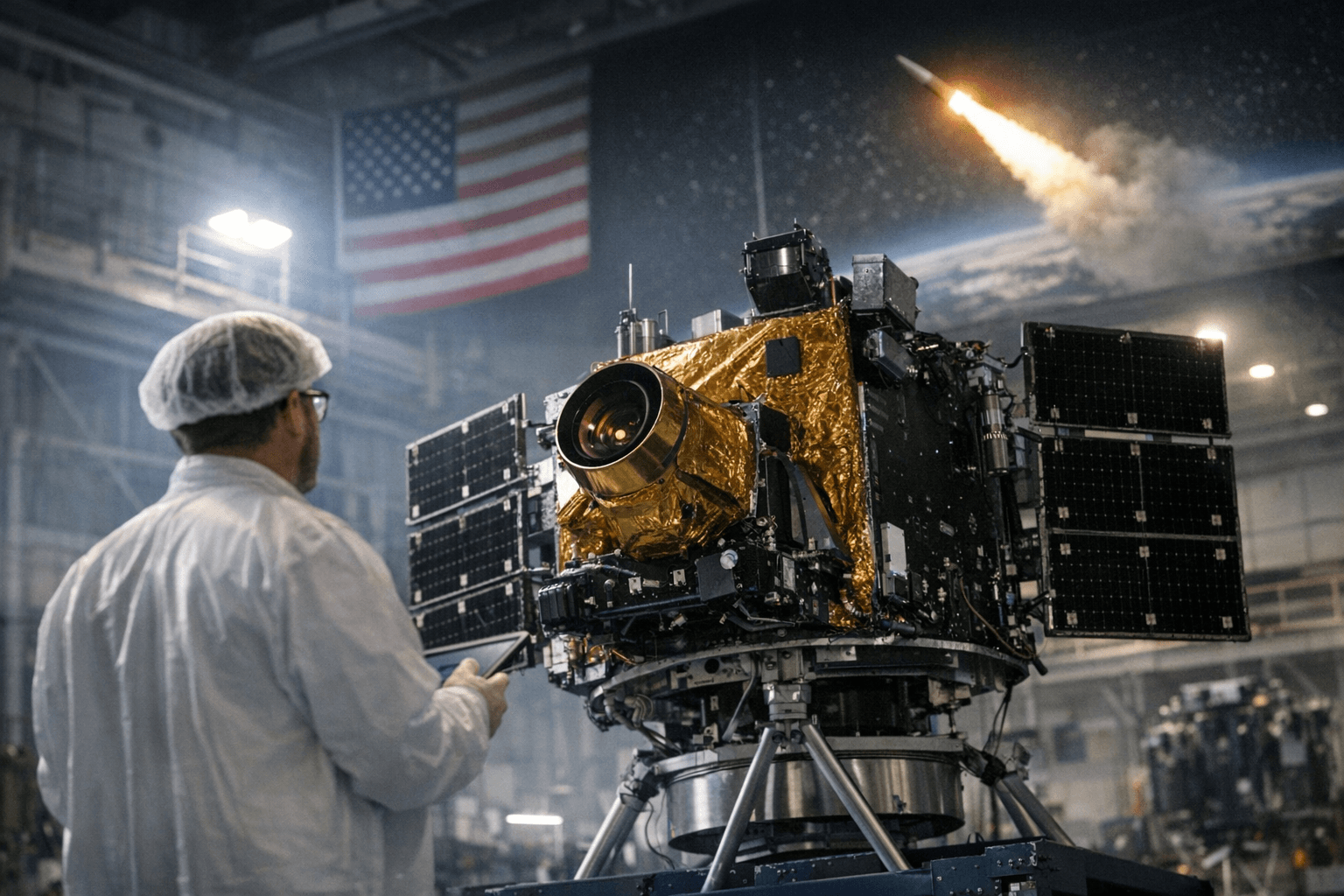
The U.S. Space Development Agency on December 19 and December 20 announced agreements totaling about 3.5 billion to four firms to design, deliver and operate 72 missile warning and missile tracking satellites as part of Tracking Layer Tranche 3 of the Proliferated Warfighter Space Architecture. L3Harris Technologies, Lockheed Martin, Northrop Grumman and Rocket Lab USA each received work to supply and operate 18 space vehicles, marking the largest single set of Tracking Layer awards to date.
The Tranche 3 satellites will carry infrared missile warning and missile tracking sensors as well as integrated missile warning, tracking and defense sensors. SDA materials describe the Tracking Layer as intended to produce fire control quality tracks and to feed mission data through the Transport Layer mesh communications network to tactical data links and downstream shooters. The agency frames the PWSA as a cadence driven program, with generations of satellites refreshed roughly every two years to add capacity and new capabilities.
Contracts were described in public materials variously as firm fixed price agreements and as awards made under Other Transaction Authority. Lockheed Martin said its award has a potential value of more than 1 billion for the 18 space vehicles it will deliver and operate. The aggregate value emphasized by SDA and company releases was approximately 3.5 billion.
Procurement documents and the solicitation cited by the agency call for the first Tranche 3 launches in the fourth quarter of fiscal 2029, with teams delivering and operating their 18 satellites on a schedule tied to integration and qualification milestones. The Tranche 3 awards grew from an April 2025 solicitation that initially envisioned three awards for a total of 54 satellites, expanding to four winners and 72 satellites during the acquisition process.
Officials delayed the tranche awards slightly after the 2025 U.S. government shutdown and a temporary Pentagon decision to reallocate some program funds to cover troop salaries during the funding lapse. Those adjustments altered the planned release cadence but did not change the announced winners or the overall value of the agreements.
Tranche 3 follows earlier Tracking Layer efforts. Tranche 1 awards in July 2022 went to Northrop Grumman and L3Harris for 28 satellites. Tranche 2 awards in January 2024 were made to L3Harris, Lockheed Martin and Sierra Space for 54 satellites. SDA officials have emphasized resilience through proliferation, arguing that spreading capability across many small, regularly refreshed satellites makes missile warning and tracking systems harder to degrade.
Industry executives and defense planners will now move into production, integration and ground segment planning under the awarded agreements. Integration testing, qualification milestones and coordination with the Transport Layer and tactical users are expected to occupy contractors and the agency over the next several years before the first Tranche 3 launches in late fiscal 2029.
The awards underscore a broader shift in U.S. military space strategy toward distributed, quickly replaceable constellations intended to deliver low latency targeting and warning data in contested environments. As the program scales up, it will test the ability of industry and defense systems to integrate new sensor architectures, manage satellite traffic in low Earth orbit and sustain a continuous refresh cycle while controlling costs.
This article was produced by Prism’s automated news system from verified source data, official records, and press releases, then run through automated quality and moderation checks before publishing. The system is built and supervised by the people who set the standards it runs under. Read our full AI policy.
Did this article answer your question?