SpaceX IPO could land in millions of Americans’ 401(k)s
SpaceX’s market debut could flow into 401(k)s automatically, because index funds and target-date funds would buy it for millions of savers who never chose the stock.
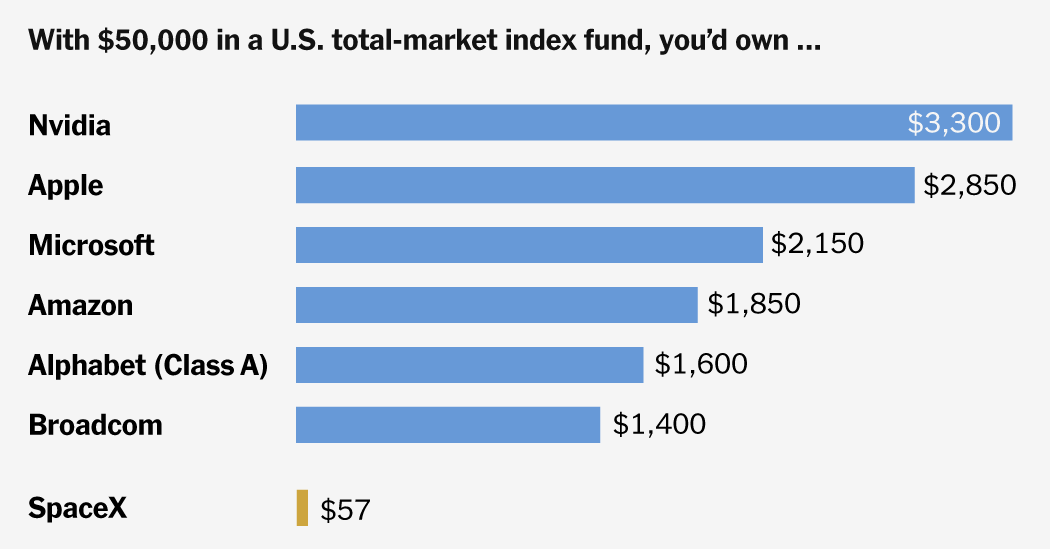
A SpaceX listing would not stay confined to traders and the company’s earliest backers. Once the stock enters major benchmarks, retirement savers who never buy a share directly could still own it through 401(k)s, target-date funds, ETFs and total-market funds that track those indexes.
SpaceX went public at a valuation of about $1.96 trillion, and a Securities and Exchange Commission filing showed the company raised $75 billion by selling 555.6 million shares at $135 each, implying a valuation of about $1.77 trillion in that filing. The key issue for ordinary savers is not just the size of the offering, but how quickly passive funds can be pulled into it once index providers add the company to their benchmarks.

Nasdaq changed that pipeline on May 1, 2026, after a public consultation that updated the Nasdaq-100 methodology. The exchange said the changes were meant to speed the inclusion of the largest companies while preserving replicability for passive managers. That matters because the Nasdaq-100 is tracked by more than 200 investment products with over $800 billion in assets under management globally, so a new entrant can reach millions of retirement accounts almost automatically.
The same dynamic applies beyond a single index. CRSP says its U.S. Total Market Index is designed to represent the full investable U.S. equity market, using float-adjusted screens for size and liquidity across listed U.S. exchanges. In practice, that means a company like SpaceX would likely show up in broad market funds once it becomes eligible, giving 401(k)s and other retirement products exposure even if the underlying investors never made an active decision to own the stock.
The policy backdrop has also shifted in Washington. President Donald Trump signed an executive order on August 7, 2025, directing agencies to make it easier for retirement plans to offer alternative assets. On March 30, 2026, the Labor Department proposed a rule to open 401(k)s more easily to private equity, real estate and cryptocurrencies, saying it could affect more than 90 million Americans. The department has since received nearly 40,000 comments on the proposal, underscoring how much is at stake as retirement plans expand beyond plain-vanilla stock and bond funds.
For savers, the result is a sharp tradeoff. Passive investing still delivers the broad diversification that made index funds popular in the first place, but a mega-cap IPO like SpaceX also shows how much concentrated hype can be routed straight into ordinary retirement portfolios. In a system built to track the market automatically, investor choice can disappear just as quickly as a stock becomes too big to ignore.
This article was produced by Prism’s automated news system from verified source data, official records, and press releases, then run through automated quality and moderation checks before publishing. The system is built and supervised by the people who set the standards it runs under. Read our full AI policy.
Know something we missed? Have a correction or additional information?
Submit a Tip