Stanford Uses 3D-Printed Uniform Capsules to Boost ICF Fusion Yields
Stanford lab filed a Feb 2026 patent for 3D-printed fuel capsules with identical pore structures to reduce variability and boost ICF compression and yields.
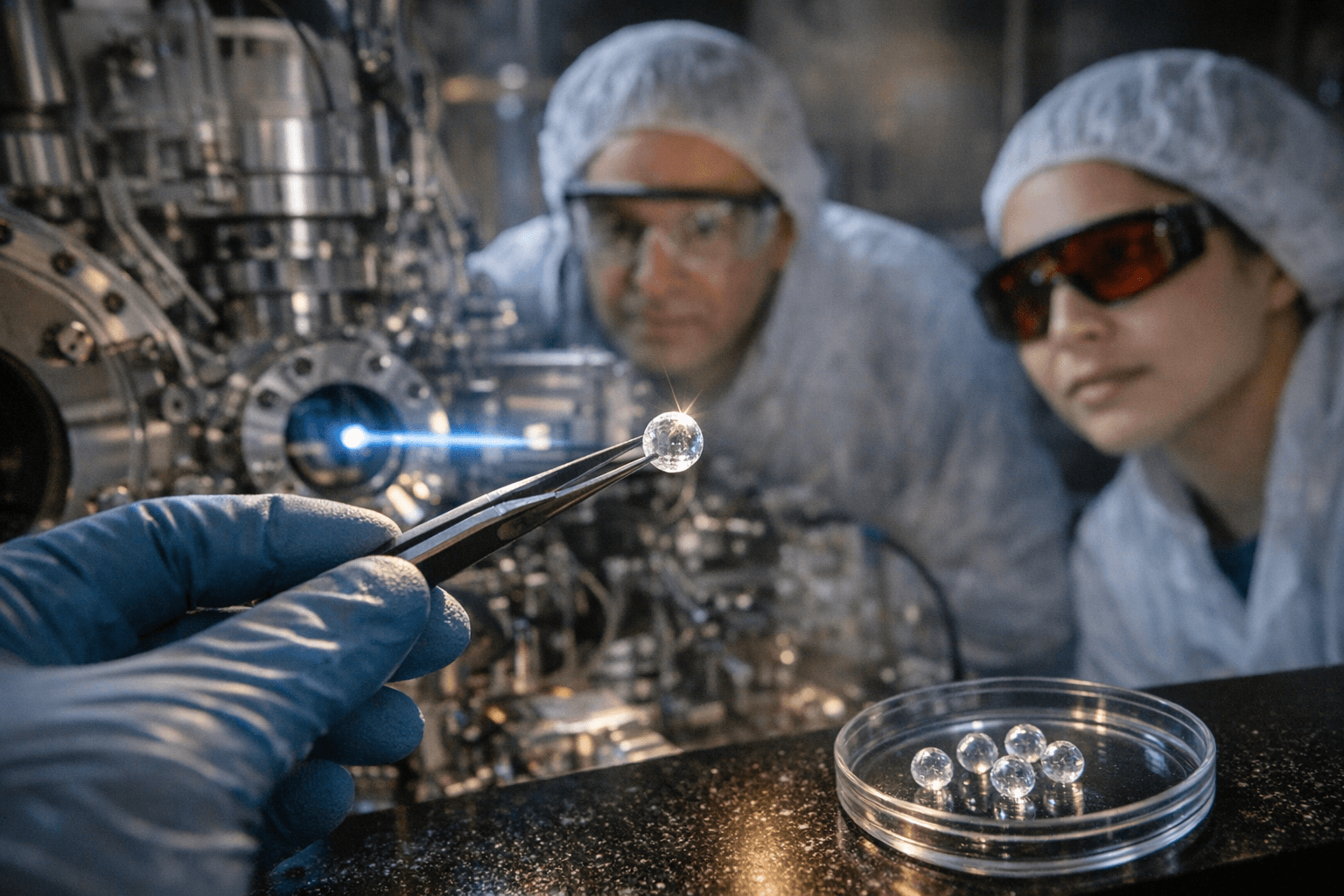
Stanford chemist Joseph DeSimone’s lab has built digitally designed, high-resolution 3D-printed fuel capsules with uniform pore architectures and filed a patent in February 2026 to cover fusion and fission applications, a move that aims to eliminate the capsule-to-capsule variability that undermines inertial confinement fusion compression symmetry and reaction yield. The lab says the digitally produced parts are identical every print, a practical change intended to make laser-driven implosions more predictable when capsules are struck precisely by reactor optics.
DeSimone frames the contrast with current porous materials bluntly: “We don’t make snowflakes. We make precision particles.” He added that “because the lasers in an ICF reactor are positioned to hit the capsules precisely, any structural flaw in a capsule material can affect the uniformity of fuel compression and energy output.” The lab’s printed spheres, described as about the size of a black peppercorn, are produced on a high-resolution polymer 3D printer and shown in hand-held images and white polymer prints credited to Jacob Dobson and Katie Jewett.
Lawrence Livermore National Laboratory has already run the first four NIF experiments with fully 3D-printed ICF capsules, demonstrating ultrathin, leak-tight walls measured at just a few micrometers and internal linings of extremely low-density foam that wick and suspend liquid fuel, features enabled by two-photon polymerization printing. LLNL staff warn that “for a power plant or a facility with a high-repetition shot rate, the traditional capsule fabrication approach probably isn’t going to work,” underscoring the operational pressure to find faster, cheaper manufacturing routes.
That pressure is clear in the scale math: LLNL estimates an inertial fusion energy power plant would need about 800,000 capsules per day produced at less than $0.50 each, while one industry writeup describes the requirement as “nearly a million of these capsules per day.” Current manufacturing timelines are slow — producing a near-perfect solid DT ice layer can take up to a week and some capsules currently take months to manufacture — which is why printed foams that can suspend liquid DT are attracting attention as an easier-to-handle alternative.
SLAC National Accelerator Laboratory has been imaging and shock-testing two-photon polymerization foams at the LCLS using the MEC instrument and ultrashort X-ray pulses, producing four studies published in Physics of Plasmas that compare TPP foams to conventional aerogels. “At SLAC, we’re inventing new ways to study these fusion fuel targets and their potential behavior under the extreme conditions of a fusion power plant,” said Arianna Gleason, while lead author Claudia Parisuaña Barranca emphasized that real-world imaging will “help us validate simulation models, which help us predict how different targets will perform.”
Oak Ridge National Laboratory is testing a different AM angle for reactor hardware, printing 316H stainless steel irradiation capsules on a laser powder-bed system in the MDF, qualifying and inserting them into HFIR for a month-long irradiation, and removing them intact. Ryan Dehoff, director of ORNL’s MDF, said as reliability is demonstrated “we’re looking at a future where additive manufacturing might become standard practice in producing other critical reactor parts.” Images in ORNL releases show a singular capsule labeled R2-29 and boards holding 40 printed capsules.
Taken together, the Stanford patent filing in February 2026 and cross-lab demonstrations from LLNL, SLAC and ORNL move additive manufacturing from proof-of-concept toward operational testing, but the hard benchmarks remain throughput and cost: meeting an 800,000 to nearly one-million capsule-per-day production rate at under $0.50 each while preserving micrometer-scale wall integrity and perfect sphericity. Labs are now shifting from imaging and single-shot experiments to the validation and qualification steps that would be required before these printed capsules could support routine high-repetition ICF or IFE operations.
Know something we missed? Have a correction or additional information?
Submit a Tip