Study Finds Anglerfish Lures Evolved for Mating, Not Just Hunting
Anglerfish lures began as hunting tools 72 million years ago, then some became glowing mating signals in the dark open ocean.
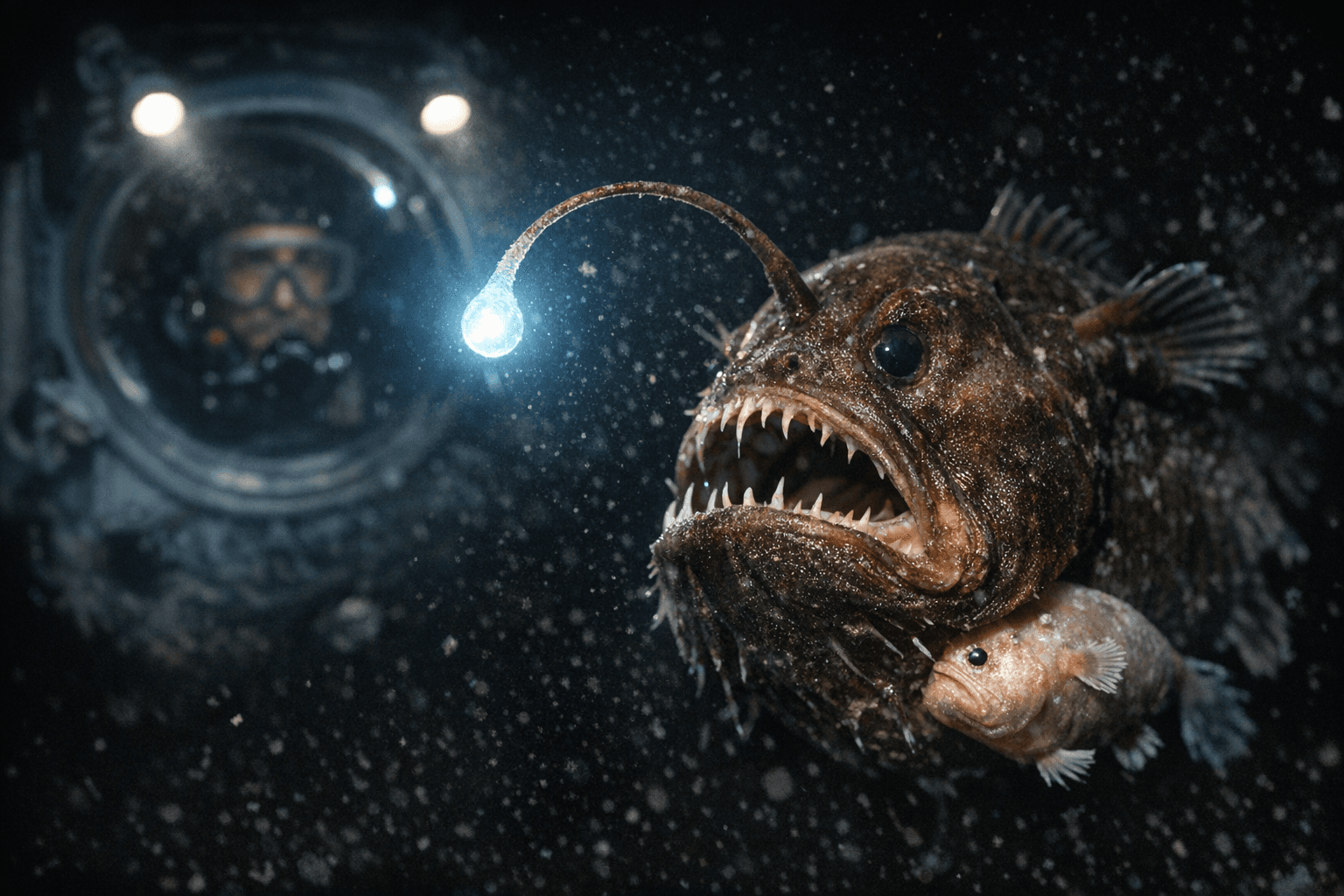
A single lure may have helped anglerfish solve two of the deep sea’s hardest problems at once: finding food and finding a mate. A new study finds that the famed fishing-rod appendage evolved first as a hunting tool, then in some lineages became a glowing signal that may also advertise sex and reproduction in a world where darkness is the rule.
The analysis, published in Ichthyology & Herpetology, traced the evolution of lures across anglerfishes and their allies using a total-evidence phylogeny built from ultraconserved elements, mitochondrial data and morphological characters. It places the original lure in the common ancestors of today’s anglerfishes at about 72 million years ago, in the Late Cretaceous, long before modern deep-sea ceratioids spread through the world’s oceans below 300 meters.
The study found that mechanical lures evolved early in the common ancestor of the Lophioidei. Chemical luring appeared separately at least twice, once in batfishes during the Eocene and once in the frogfish Antennarius striatus. Bioluminescent lures, by contrast, arose only once, within a derived deep-sea ceratioid lineage during the Oligocene. In that branch, the glow was linked to major moves into pelagic deep-sea habitats and to higher diversification rates, suggesting the trait helped anglerfish open new ecological territory.
That matters because the deep sea is one of Earth’s most expansive ecosystems and one of its most difficult places to survive. Food is scarce, visibility is near zero and mates are even harder to find. In that setting, a lure that draws prey can also serve as a visible or chemical cue for reproduction. The paper points to anatomical innovations such as the escal pore and elaborate escae, structures that may be involved in both prey attraction and sexual signaling. Some lures glow because symbiotic bacteria, including Photobacterium, live in the esca.
The findings also fit what is already known about ceratioid anglerfish, which are notorious for extreme sexual dimorphism. Males are tiny compared with females, and in some species they permanently fuse to females in a reproductive strategy called sexual parasitism. Yale researchers reported in 2024 that these fish moved from benthic habitats into the deep open ocean 50 to 35 million years ago, underscoring how life in extreme environments can reshape anatomy, behavior and even reproduction.
With about 413 species across 74 genera and 15 families, anglerfishes and their allies show how evolution can turn a single structure into a multipurpose survival tool. In the midnight zone, that kind of adaptation is not a curiosity. It is the difference between disappearance and diversification.
This article was produced by Prism’s automated news system from verified source data, official records, and press releases, then run through automated quality and moderation checks before publishing. The system is built and supervised by the people who set the standards it runs under. Read our full AI policy.
Did this article answer your question?