Study reveals sex-specific call roles in yellow‑naped Amazon duet structure
Researchers led by Dr. Christine R. Dahlin found yellow‑naped Amazons perform "warble" duets with 36 distinct call types, many 75–99% biased to one sex and some exclusive to males or females.
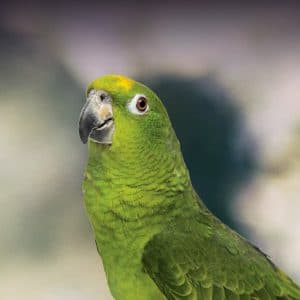
A detailed acoustic analysis of yellow‑naped Amazon duets finds a surprisingly large, sex‑structured lexicon and rule‑governed sequencing in pair vocalizations. Dr. Christine R. Dahlin of the University of Pittsburgh and colleagues report warble duets contain 36 distinct call types, with many call types used 75–99% of the time by one sex and some calls produced exclusively by males or females.
The team recorded duet exemplars from 16 pairs in 2002 and 2006 at Ahogados, Horizontes and Santa Rosa and used three playback treatments - full duets, male solos, and female solos - to test responses. Recordings were digitized by playing Hi‑8 tapes on a SONY GVD‑200, routing sound through an i‑Mic (Griffin Technology) into a Macintosh Power PC G5 and digitizing at 44 kHz and 16 bit in Raven, preserving fine temporal detail for syntactic analysis.
Behavioral patterns in the field were consistent across years. Dahlin and Wright analyses of recordings dating back to 1995 and 2002 show duet form is temporally stable, and earlier work finds males and females initiate duets at equal rates. Male and female solos do occur but are less common than complete duets, while calls produced outside of duets do not appear to be sex specific according to Dahlin and Wright unpublished data. Pairs sing year‑round with peak duet rates in January and February at the start of the nesting season, also reported as unpublished observations by the authors.
The study distinguishes two duet forms - standard and warble - with warble duets carrying a much larger lexicon and "language‑like" properties including syntactic rules. Spectrogram comparisons show Northern and Southern Costa Rica dialects differ in specific note types but retain similar overall duet structure, supporting cultural transmission across populations. The authors emphasize links between vocal learning in yellow‑naped amazons and broader imitation‑learning parallels in primates and humans.
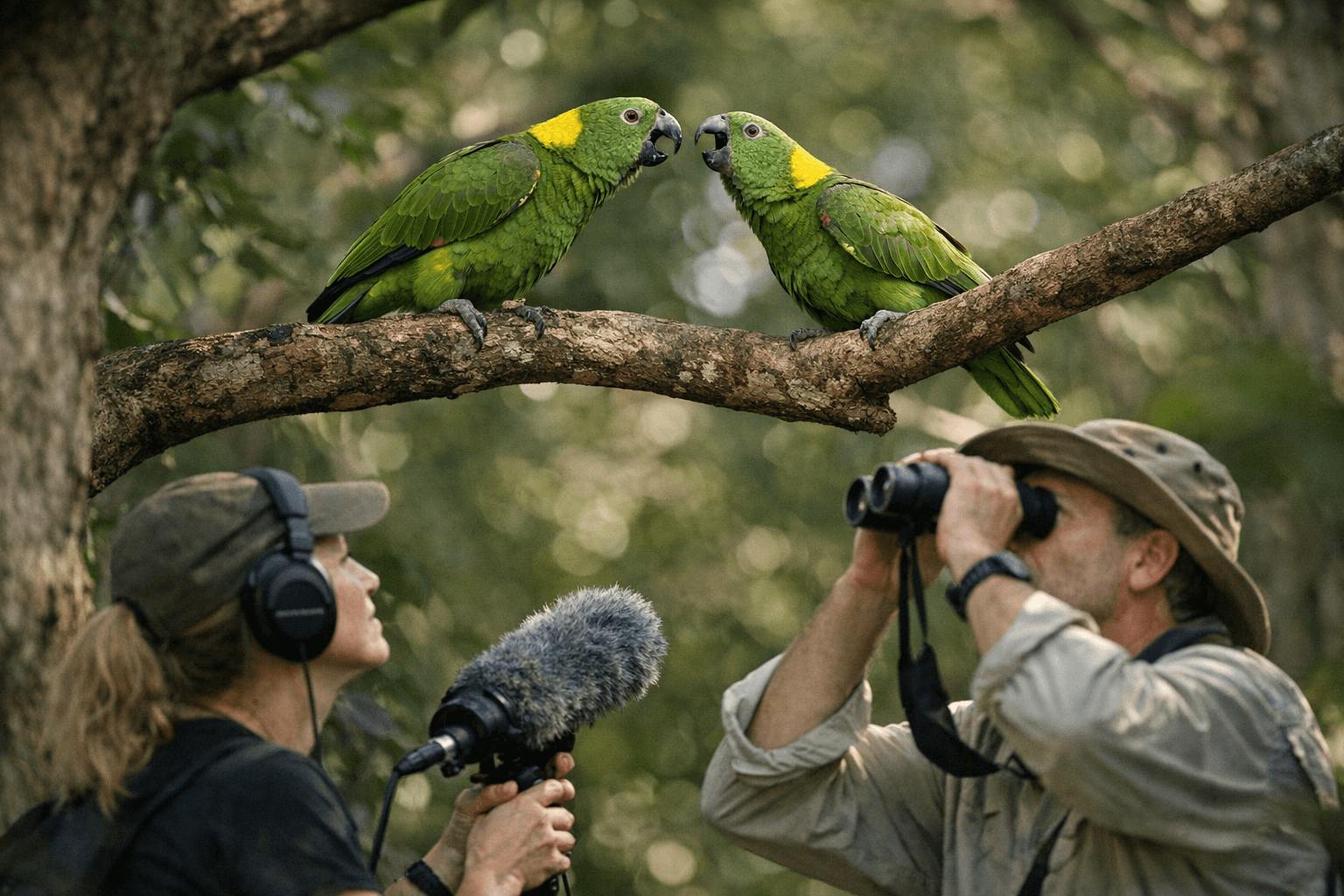
Conservation context threads through the work. The Dahlin lab describes yellow‑naped amazons as "a threatened species that is declining across their range," and notes a planned 2016 population survey to aid conservation. The research team adds a pragmatic call for sustained field effort, writing, "If we hope to eventually break the code of their vocal communication system, it will likely take a sustained mix of conservation efforts, field observations, and playback experimentation. Ultimately, our work demonstrates the value of research into vocal complexity and syntactic organization in wild animal populations, as natural pressures shape communication in ways that cannot be replicated in captivity."
Caveats remain: several behavioral statements are cited as Dahlin and Wright unpublished data, and a fragmentary statistical table in the materials lacks column headers and full caption information. The 36‑call repertoire count and the 75–99% sex‑bias figures are reported in the authors' summary materials and warrant confirmation in the full manuscript and supplementary tables before being treated as final. Still, these findings mark a clear shift in how parrot duet structure and sex‑specific roles are understood and point directly to targeted playback and conservation work as next steps.
Know something we missed? Have a correction or additional information?
Submit a Tip