Stutsman County Explores Tech Changes to Prevent Ruth Eckholm-Style Disappearances
Stutsman County officials are weighing drones, ROVs, Marsh master and NCIC improvements after officials say those tools would likely change searches for 85-year-old Ruth Eckholm, who vanished from Twig in 1991.

Stutsman County and Jamestown-area discussions are centering on modern search tools after local reporting highlighted the 1991 disappearance of an 85-year-old Alzheimer’s patient identified in several accounts as Ruth Eckholm, who vanished from her residence in Twig, Minnesota, and was never found. Grand Forks Herald identified the woman as an 85-year-old Alzheimer’s patient who disappeared in 1991; an excerpt in St. Cloud Live includes a fragment referencing Nov. 5, 1991 and uses the spelling Eckstrom in one line.
St. Louis County Sheriff’s Office Sgt. Eric Sathers described the exact technologies county search teams now deploy: “Search and Rescue has advanced considerably with drone technology, better underwater search capabilities (ROV, sonar), better back-country search tools (Marsh master, SHERP), better GPS search devices, etc.,” Sathers said. St. Cloud Live also summarized investigative gains: “Investigators' abilities have also improved with advances in DNA technology and computer tools that can assist with age progression. Individuals are also more likely to carry cellphones and other electronic devices, which can be tracked and located.”
Database and procedural changes would also alter how a vulnerable-adult disappearance is handled compared with 1991. St. Cloud Live observed: “Eckstrom's case would today be entered into the National Crime Information Center, which existed at the time but has gone through major upgrades. As a vulnerable adult, her information would have been entered so that any agency across the country would receive a notification if they search her name.” Local reporting also points to a post-2000s legal shift: “The development of Brandon's Law in 2009 requires law enforcement to investigate, without delay, any disappearance of anyone over the age of 18.”
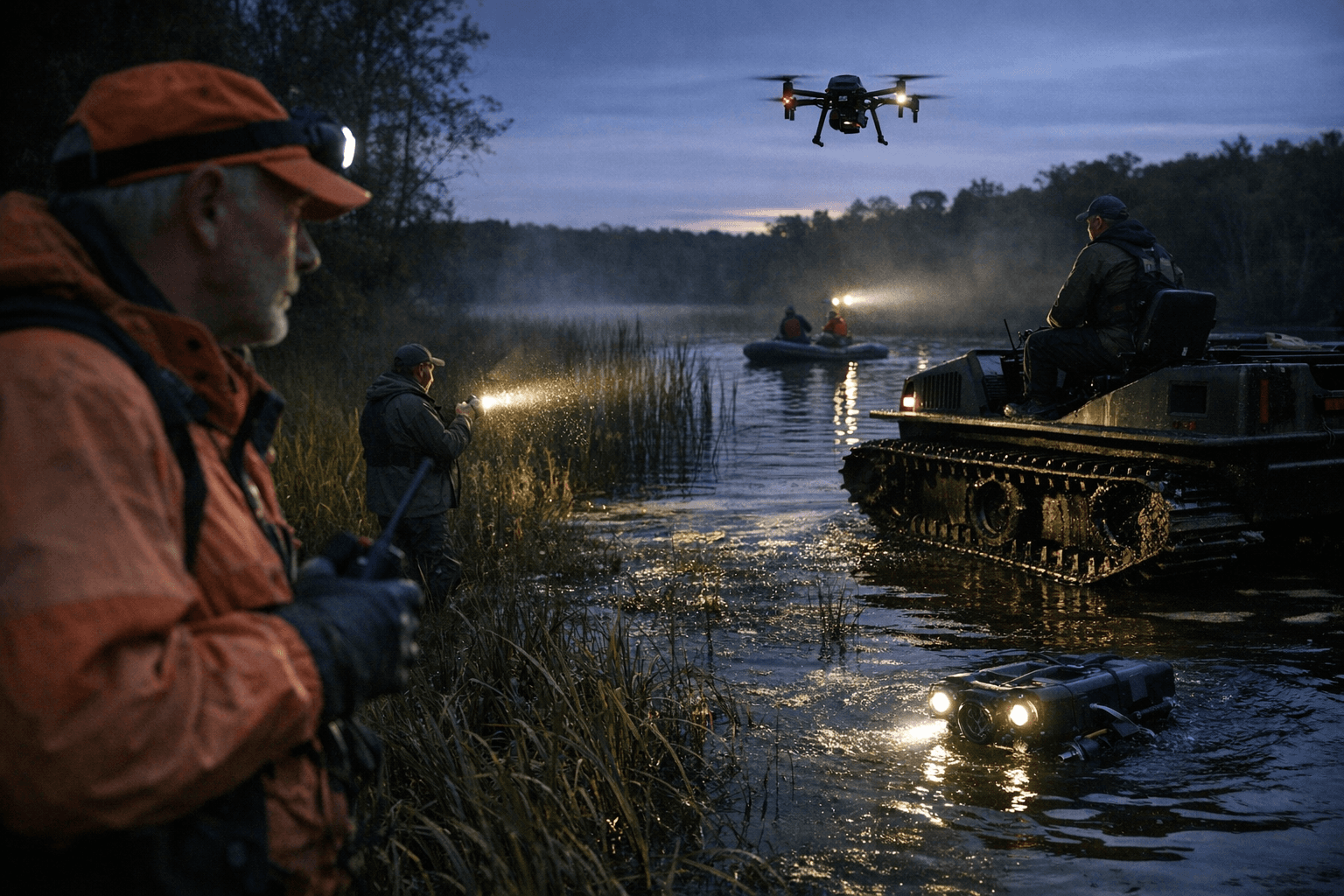
Those tools and rules do not remove operational realities in rural Minnesota. Sgt. Sathers warned plainly: “But even with all this technology at our disposal, we still see people go missing without a trace.” He added specific environmental limits that matter to Stutsman County searches: “In this part of the country, especially, those that go missing in heavily wooded areas, they are more vulnerable due to weather hazards, terrain hazards, and wildlife hazards. In addition, if someone dies in the wilderness, we have a very short amount of time to locate the body before animal scavengers scatter and potentially obliterate the remains.”
County leaders in the Jamestown region are weighing whether and how to invest in drones, ROVs, Marsh master and SHERP vehicles, upgraded GPS search devices, and training that leverages DNA and age-progression tools, given the narrow time window Sathers described. The unresolved 1991 Twig disappearance, coupled with Brandon’s Law and NCIC upgrades, is driving those conversations about equipment procurement, interagency data sharing and faster investigative response across Stutsman County and neighboring jurisdictions.
Know something we missed? Have a correction or additional information?
Submit a Tip