Sudan Prime Minister Takes Homegrown Peace Plan to U.N. Council
Sudan’s transitional Prime Minister Kamil Idris brought a government authored peace initiative to the U.N. Security Council seeking an immediate end to nearly three years of fighting. The proposal ties a monitored ceasefire and disarmament of the Rapid Support Forces to a political pathway toward elections, making the Security Council a test of international willingness to back a domestically led settlement.
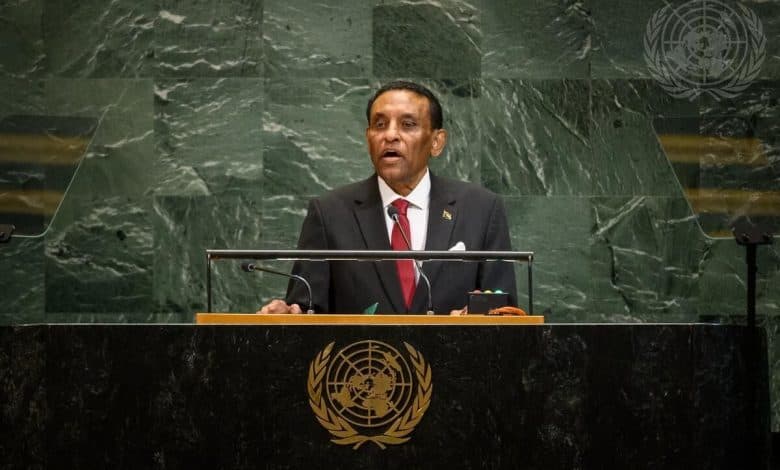
Prime Minister Kamil Idris asked U.N. Security Council members to back a comprehensive Sudanese government plan aimed at ending the conflict between the Sudanese Armed Forces and the Rapid Support Forces, presenting the initiative during Council meetings on Dec. 22 and Dec. 23, 2025. Idris framed the proposal as an internally crafted path to peace and appealed to Council members to "stand on the right side of history."
The plan calls first for an immediate ceasefire to be monitored jointly by the United Nations, the African Union and the Arab League. It would require RSF units to withdraw from occupied territories, surrender weapons, be contained in supervised camps and undergo disarmament under international oversight. The government also proposes a series of confidence building measures across political, economic, security and social sectors intended to create space for dialogue.
Idris proposed inter Sudanese dialogues among political actors as the next stage, to be followed by free and fair elections under international supervision. Humanitarian measures are central to the package, reflecting the government’s argument that mass displacement and the collapse of services demand an urgent and integrated response. Aid agencies say millions have been uprooted and humanitarian access remains severely constrained in many areas, contributing to what some observers call one of the most acute crises worldwide since the conflict began in April 2023.
Fighting continued in parts of the country as the plan was unveiled, with active combat reported in Kordofan and North Kordofan states. That reality underlined the immediate challenge for the Council and for mediators: stopping the violence on the ground while persuading an armed actor with territory and leverage to accept restrictions on its military capacity.
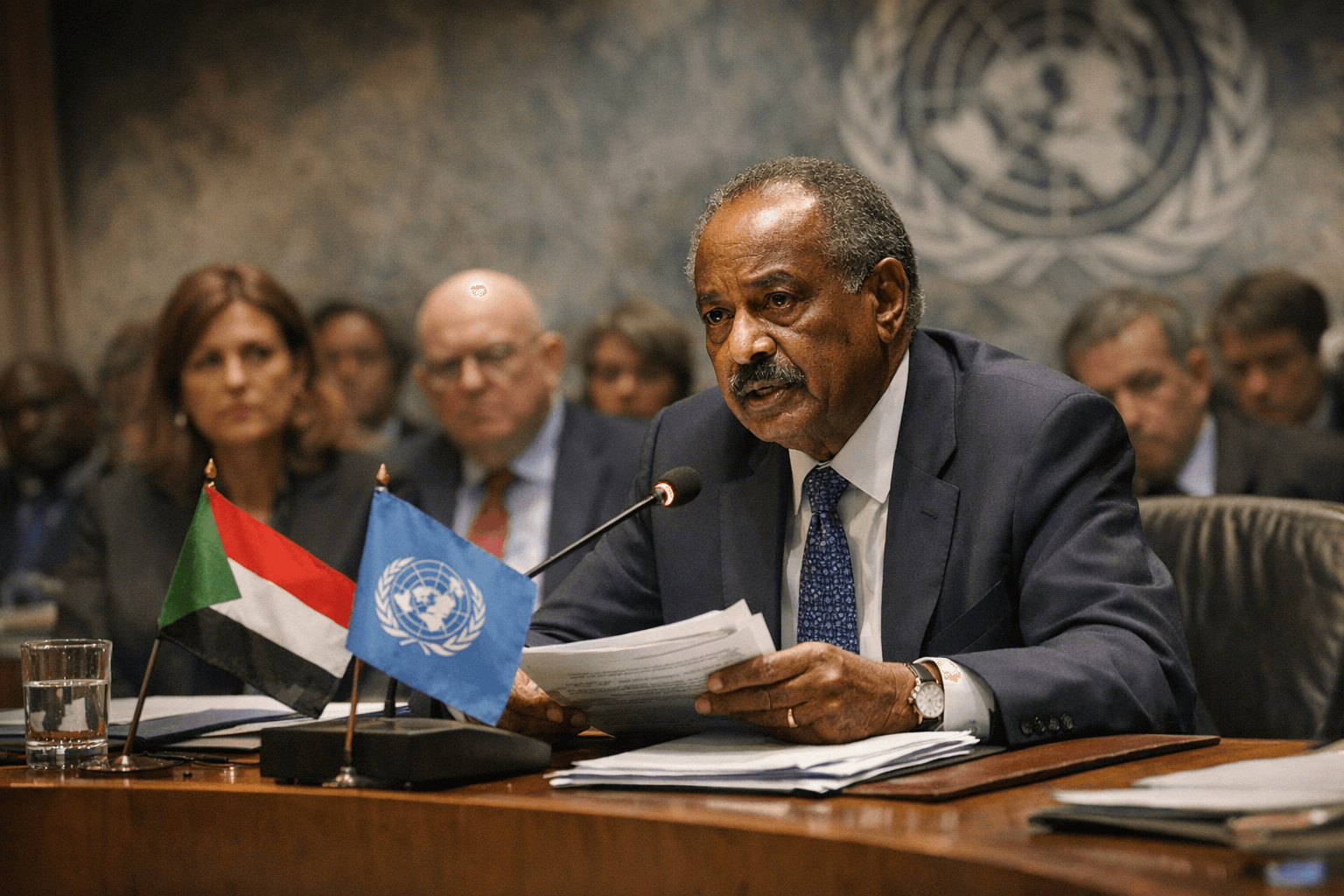
Idris positioned the plan in part as an alternative to externally brokered truce initiatives, referencing indirectly a separate ceasefire proposal supported by the United States and mediators Saudi Arabia, Egypt and the United Arab Emirates. He stressed that the government’s approach was domestically driven, seeking to bind international support to arrangements that preserve Sudanese ownership of the process.
Reception at the Security Council was cautious. Diplomats acknowledged the outline of common priorities, notably multinational monitoring of any ceasefire and urgent humanitarian relief, but analysts and officials flagged deep doubts about whether the RSF would accept terms that amount to confinement and disarmament. Observers noted that the plan would substantially curtail RSF military power, and that immediate buy in from the RSF therefore seemed unlikely.
The government’s proposal leaves unresolved operational details for handling RSF personnel who are not accused of war crimes, and public reporting has not produced a single, detailed text covering vetting, reintegration or prosecution mechanisms. That gap, along with ongoing battlefield dynamics, sets the scene for a protracted diplomatic effort. For the Security Council the test will be whether international actors can translate consensus on principles into credible enforcement and incentives that persuade combatants to lay down arms and commit to a political timetable.
This article was produced by Prism’s automated news system from verified source data, official records, and press releases, then run through automated quality and moderation checks before publishing. The system is built and supervised by the people who set the standards it runs under. Read our full AI policy.
Did this article answer your question?


