Sunday Morning Reflects on the Historical Events of This Day
The past keeps showing up: two decisions made on April 5, one in 1792 and one in 1986, still define the boundaries of presidential power today.
Where the Founding Blueprint Meets Living Debate
Every year, April 5 arrives on the calendar as a date that quietly carries more constitutional weight than most Americans realize. The events that cluster around this day, stretching from a tobacco field in colonial Virginia to a West Berlin nightclub, are not mere trivia. Two of them, separated by nearly two centuries, draw a direct line from the republic's earliest structural choices to arguments playing out right now over what a president can and cannot do.
The First "No" in American History: Washington's Veto of 1792
George Washington exercised the first presidential veto of a Congressional bill on April 5, 1792. The bill introduced a new plan for dividing seats in the House of Representatives that would have increased the number of seats for northern states. Washington, a Virginian, consulted his politically divided cabinet before acting. At the urging of Thomas Jefferson and other members of his cabinet, he vetoed the bill, becoming the first president ever to do so.
Washington made two objections in a letter to the House describing the reason for his veto. First, the apportionment had not been derived from a common divisor. Second, the bill would have given eight states more representatives than their proportional share of the population, which he considered unconstitutional. Congress could not muster the votes to override him, and a revised apportionment bill was signed into law nine days later, on April 14, 1792.
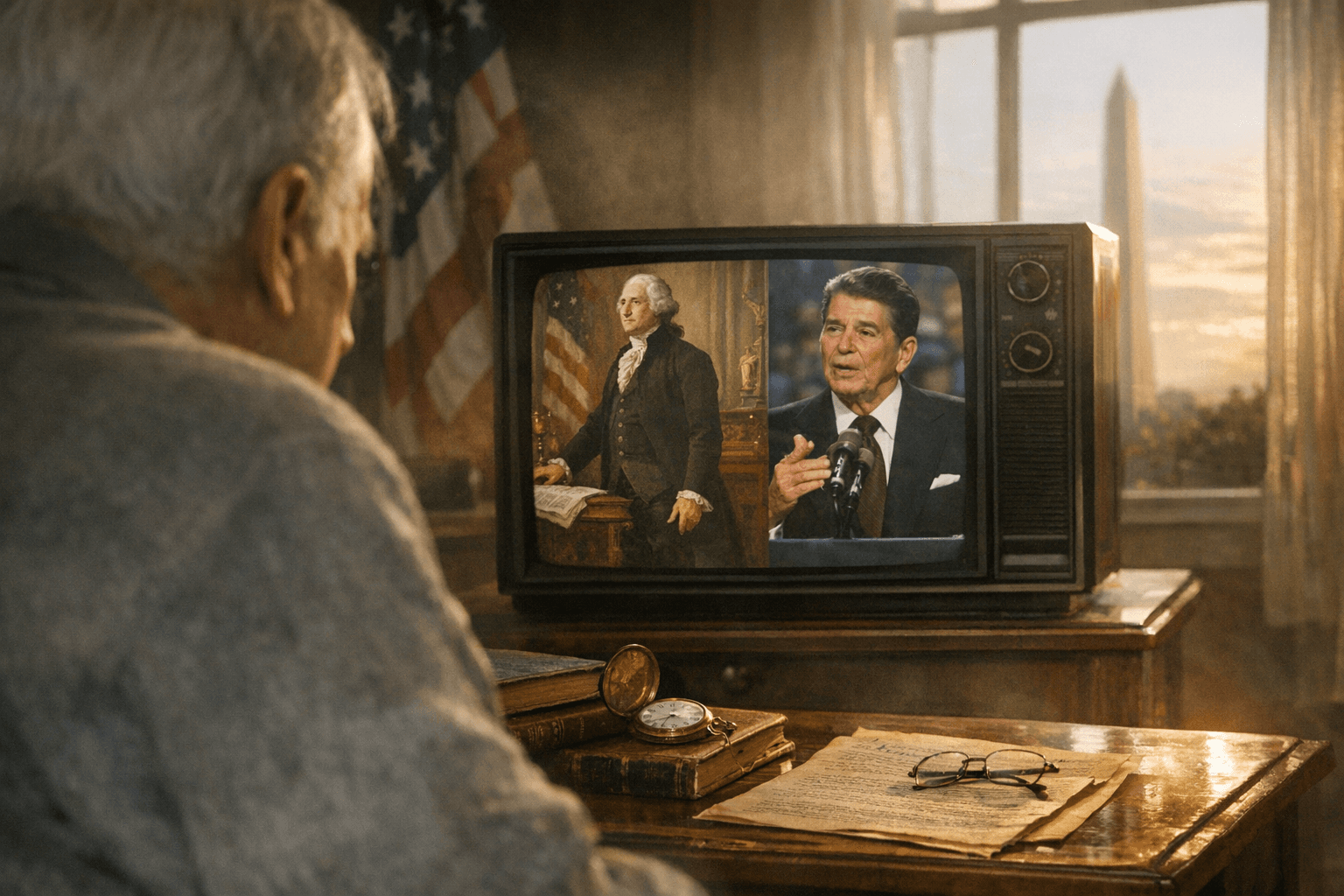
The then-versus-now relevance here is sharp. Washington's veto was the first formal assertion that the executive branch would not simply ratify whatever Congress sent to the White House, and that constitutional arguments, not politics alone, would govern that refusal. Every modern debate about presidential vetoes, about executive orders expanding or contracting legislative intent, and about which branch controls the mechanics of democratic representation, traces its lineage to this precise moment. The structure Washington established in April 1792 is the same structure that lawmakers, courts, and citizens invoke today when they argue about the limits of executive authority.
War Powers Without a Declaration: La Belle and Reagan's Libya Strike of 1986
A bomb explosion in the La Belle discotheque in West Berlin on April 5, 1986, resulted in the deaths of a Turkish woman and two U.S. Army servicemembers, with roughly 230 others wounded. The nightclub was a well-known gathering spot for American military personnel stationed in the divided city. U.S. intelligence quickly traced the attack to the Libyan secret service, acting under orders from Muammar Gaddafi's government.
President Ronald Reagan responded ten days later with airstrikes on Tripoli and Benghazi, conducted without a formal declaration of war and without the prior authorization of Congress. The strikes were framed as a direct act of self-defense and deterrence. Reagan pointed to intelligence intercepts he said proved Libyan state sponsorship; Congress was notified but not asked for approval.
The parallel to today could not be more direct. The War Powers Resolution of 1973 requires the president to notify Congress within 48 hours of committing forces to hostilities and limits unauthorized military engagement to 60 days. Yet every administration since Nixon has contested the resolution's constitutionality while nominally complying with its notification requirements. The debate over whether a president can order military strikes without congressional authorization, which Reagan's Libya response accelerated, remains one of the most unresolved fault lines in American governance. Each new confrontation, whether over Iran, Yemen, or anywhere else a future administration might direct force, returns to the question Reagan's April 1986 decision did not settle: who, exactly, has the power to take the country to war?
Espionage, the Death Penalty, and the Limits of Due Process
The trial of Julius and Ethel Rosenberg on federal espionage charges began on March 6, 1951, in the U.S. District Court for the Southern District of New York, with Judge Irving Kaufman presiding. On March 29 they were found guilty, and on April 5 the couple was sentenced to death. Their co-defendant Morton Sobell received a 30-year prison term.
They were sentenced to death under Section 2 of the Espionage Act of 1917, which provides that anyone convicted of transmitting or attempting to transmit to a foreign government information relating to national defense may be imprisoned for life or put to death. On June 19, 1953, Julius and Ethel Rosenberg, convicted of conspiring to pass U.S. atomic secrets to the Soviets, were executed at Sing Sing Prison in Ossining, New York. Both refused to admit any wrongdoing and proclaimed their innocence right up to the time of their deaths. They remain the only American civilians executed for espionage during the Cold War era.
The case never stopped reverberating. Declassified Venona intercepts and Soviet-era documents released after the Cold War confirmed Julius's role as a recruiter for Soviet intelligence, while casting persistent doubt on the scope of Ethel's participation. Their case continues to surface in discussions about national security prosecutions, the death penalty, and whether the adversarial atmosphere of the Cold War compromised the standards of evidence and due process that American courts are designed to uphold.
Churchill's Exit and the Weight of Passing Power
Sir Winston Churchill resigned as prime minister of Great Britain on April 5, 1955. Tears glistened in his eyes as he formally presented his resignation to Queen Elizabeth II at Buckingham Palace. He was 80 years old. Sir Anthony Eden would be his successor.
Churchill had already lived one of the most consequential political lives of the twentieth century, guiding Britain through the existential crisis of World War II, losing the 1945 general election in a stunning peacetime rebuke, and then returning to Downing Street again in 1951. His April 1955 departure was ultimately driven by the relentless accumulation of age and declining health, proof that even the most formidable political wills eventually yield not to opponents, but to time.
The Island at the Edge of the Known World
Long before any of these political dramas, April 5 marked a moment of geographic rupture. On April 5, 1722, Jacob Roggeveen discovered Easter Island, ending approximately 1,400 years of isolation for the island. The Dutch explorer named it Easter Island because he arrived on Easter Sunday. He found a civilization that had erected enormous stone statues, the moai, across a remote Pacific island roughly 2,300 miles off the Chilean coast, a society that had evolved, flourished, and in some accounts begun to decline, entirely beyond the awareness of the European and Asian worlds.
A Union Forged at Jamestown
Pocahontas, daughter of the chief of the Powhatan confederacy, married English tobacco planter John Rolfe in Jamestown, Virginia, on April 5, 1614. The marriage ensured peace between the Jamestown settlers and the Powhatan tribe for several years. It was one of the earliest recorded political alliances in what would eventually become the United States, negotiated not in any legislature but through a ceremony in a small Virginia settlement clinging to the edge of a continent.
What April 5 Is Really Saying
The thread connecting Washington's veto to Reagan's Libya strikes is not coincidence. It is the same foundational tension, who holds constitutional authority, and when does emergency justify bypassing it, that the republic has never fully resolved. Washington used the veto to insist that constitutional structure mattered even when political convenience argued otherwise. Reagan used unilateral military force and implicitly argued that speed and national security outweighed the deliberative requirements the Constitution envisions. Both decisions shaped the rules, and both left the argument unfinished. That is the real lesson April 5 offers: the decisions made on any given day do not end debates; they set the terms for the ones that follow.
This article was produced by Prism’s automated news system from verified source data, official records, and press releases, then run through automated quality and moderation checks before publishing. The system is built and supervised by the people who set the standards it runs under. Read our full AI policy.
Did this article answer your question?