Supreme Court Justices' Family Histories Shaped by Birthright Citizenship Laws
Justice Alito's father arrived in America as an infant from Calabria, Italy in 1914; now Alito helps decide whether birthright citizenship endures.

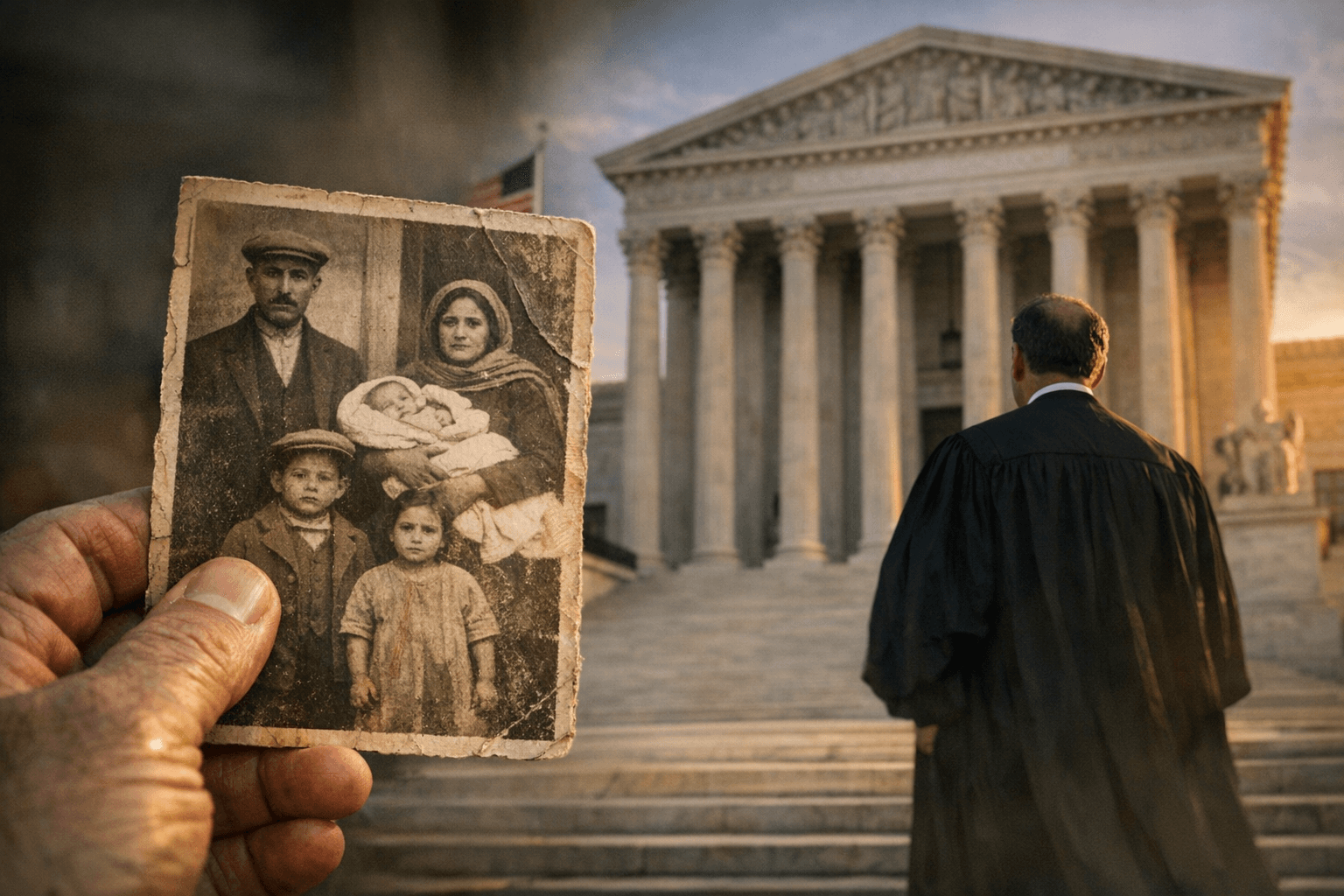
The nine justices who will hear oral arguments in Trump v. Barbara on Wednesday carry immigration stories of their own. Justice Samuel Alito's father was born Salvatore Alati in the Calabrian village of Saline Joniche in 1914, carried to the United States as an infant when his family emigrated and his name was Americanized. Chief Justice John Roberts descends from English and Slovakian immigrants; his great-great-grandfather Richard Glover, a miner in the English village of Atherton, crossed to America in 1863 alongside his Irish wife, Mary Linskey, driven by famine and political strife.
Those personal histories form a quietly charged backdrop to the landmark case now before the Court, in which the justices will weigh whether President Trump's executive order seeking to end birthright citizenship violates the 14th Amendment's Citizenship Clause and the federal statutes that codified it, first through the Nationality Act of 1940 and again in the Immigration and Nationality Act of 1952.
The legal question turns on eleven words ratified in 1868: "all persons born or naturalized in the United States and subject to the jurisdiction thereof, are citizens of the United States and of the state wherein they reside." The executive order would effectively rewrite that guarantee by denying citizenship at birth to children unless at least one parent holds U.S. citizenship or permanent immigration status, directly affecting children born to parents on temporary work visas, student visas, or without legal status.
U.S. Solicitor General D. John Sauer, arguing for the administration in Supreme Court filings, contended that the order corrects a "misreading" of the Citizenship Clause and addresses illegal migration, national security and public safety risks, and the rise of "birth tourism." Sauer claimed that birthright citizenship for children of undocumented immigrants and people in the country temporarily "degrades the meaning and value of American citizenship."
Opponents reject that framing. Courts have repeatedly blocked the administration from implementing the order, finding it violates the Constitution, more than a century of Supreme Court precedent, and a longstanding federal statute. Carol Rose, executive director at the ACLU of Massachusetts, said: "The 14th Amendment established birthright citizenship as a bedrock principle on which Congress and the Supreme Court, together with generations of Americans, have worked to build a modern, democratic, and pluralistic society. By creating an unlawful regime where some American babies are treated as second-class citizens based on their parentage, the Trump administration is taking a sledgehammer to the foundations of that society. The court should use this opportunity to reaffirm its century-old precedents and confirm, once and for all, that birthright citizenship is here to stay."
The personal dimensions extend across the bench. Three of Justice Elena Kagan's four grandparents arrived in the early 1900s as Russian Jewish immigrants from lands now part of Ukraine; her mother grew up in a Yiddish-speaking household. Justice Sonia Sotomayor's family roots in Puerto Rico predate the 1917 Jones Act that extended citizenship to all persons born on the island. Justices Clarence Thomas and Ketanji Brown Jackson have both written publicly of ancestors brought to America from Africa in bondage, a population for whom the 14th Amendment itself was the legal instrument of citizenship.
Trump v. Barbara is the first case in which the Supreme Court will weigh the full legal merits of one of President Trump's immigration policies. The ruling will determine whether children born on U.S. soil to parents without permanent legal status continue to receive a citizenship documented, under current law and practice, by nothing more than the hospital record of their birth.
Know something we missed? Have a correction or additional information?
Submit a Tip