Supreme Court Shadow Docket Memos Spur Transparency Debate in Legal Circles
Sixteen pages of sealed Supreme Court memos reopened a fierce fight over who gets to see the Court's emergency reasoning, and who gets left guessing.
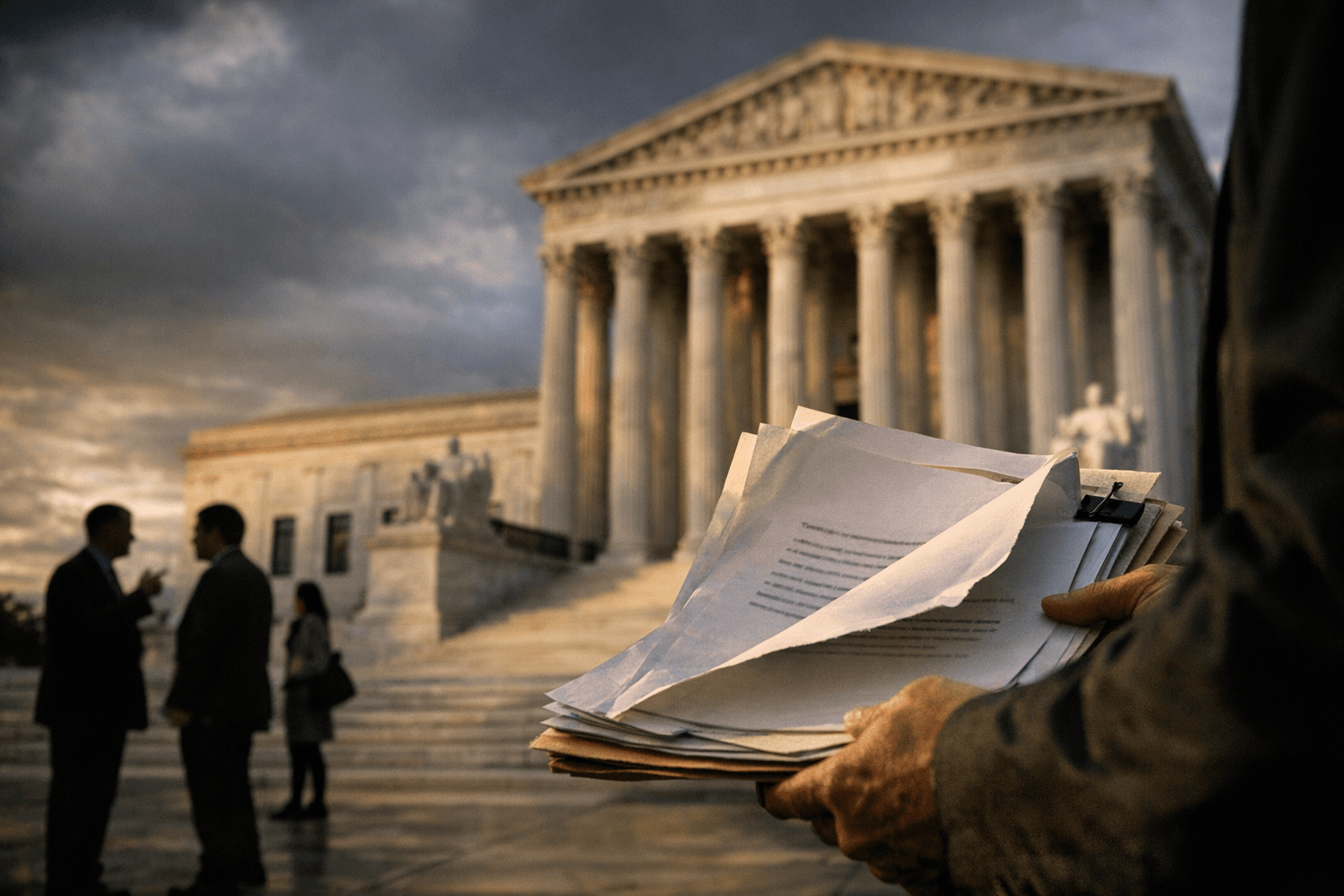
A trove of 16 pages of confidential Supreme Court memoranda has pushed the Court’s emergency docket back into the center of the national legitimacy debate, not because of courtroom drama, but because the papers expose how much of the Court’s most consequential work happens out of public view.
The materials, exchanged over five days in February 2016, dealt with West Virginia v. EPA and the Obama-era Clean Power Plan dispute, a fight over whether the Court should move quickly to block the policy with little explanation. The memos revealed internal disagreement over the pace and method of that intervention, offering an unusually direct look at how the justices discussed an emergency order tied to presidential power and climate regulation.
That glimpse has sharpened an older argument inside legal circles: when the Court acts through its emergency docket, it can move policy fast while giving lower courts, litigants, and the public little guidance. SCOTUSblog describes the docket as a vehicle for expedited applications, often with limited briefing, typically no oral argument, and unsigned orders with little or no explanation. In that setting, even a narrow procedural decision can carry national consequences without the transparency that usually comes with merits rulings.
The debate is not only about secrecy. It is also about institutional trust. The term “shadow docket,” popularized by University of Chicago law professor William Baude in a 2015 law review article, has become shorthand for a practice that legal scholars say now shapes major policy questions on immigration, elections, abortion, death penalty, religious liberty and administrative power. Harvard Law Review scholarship has noted that Justice Samuel Alito criticized the label in 2021 as misleading, underscoring the Court’s discomfort with how the public frames its emergency work.

SCOTUSblog’s 2025 coverage also showed how much more contentious this part of the Court has become, with shadow-docket dissents rising over time and reaching a high-water mark of 54 in the 2018-19 term. That pattern has fueled concern that the emergency docket is no longer a backstop for rare, urgent matters, but a major mechanism for shaping national policy before the Court speaks in fuller public view.
The reaction to the memos has now widened the focus beyond the justices themselves. It has raised harder questions for clerks, who help manage the flow of confidential deliberations; for academics, who rely on fragmentary public records to study the Court; and for a judiciary whose legitimacy depends on the appearance, as much as the reality, of reasoned decision-making. In that sense, the memos did more than reopen an old case. They exposed how fragile the Court’s claim to transparency has become.
This article was produced by Prism’s automated news system from verified source data, official records, and press releases, then run through automated quality and moderation checks before publishing. The system is built and supervised by the people who set the standards it runs under. Read our full AI policy.
Did this article answer your question?

