Supreme Court to decide constitutionality of geofence cellphone warrants
The Supreme Court will rule on whether broad geofence warrants for smartphone location data violate the Fourth Amendment. The decision will shape policing practices, tech compliance, and privacy rights.
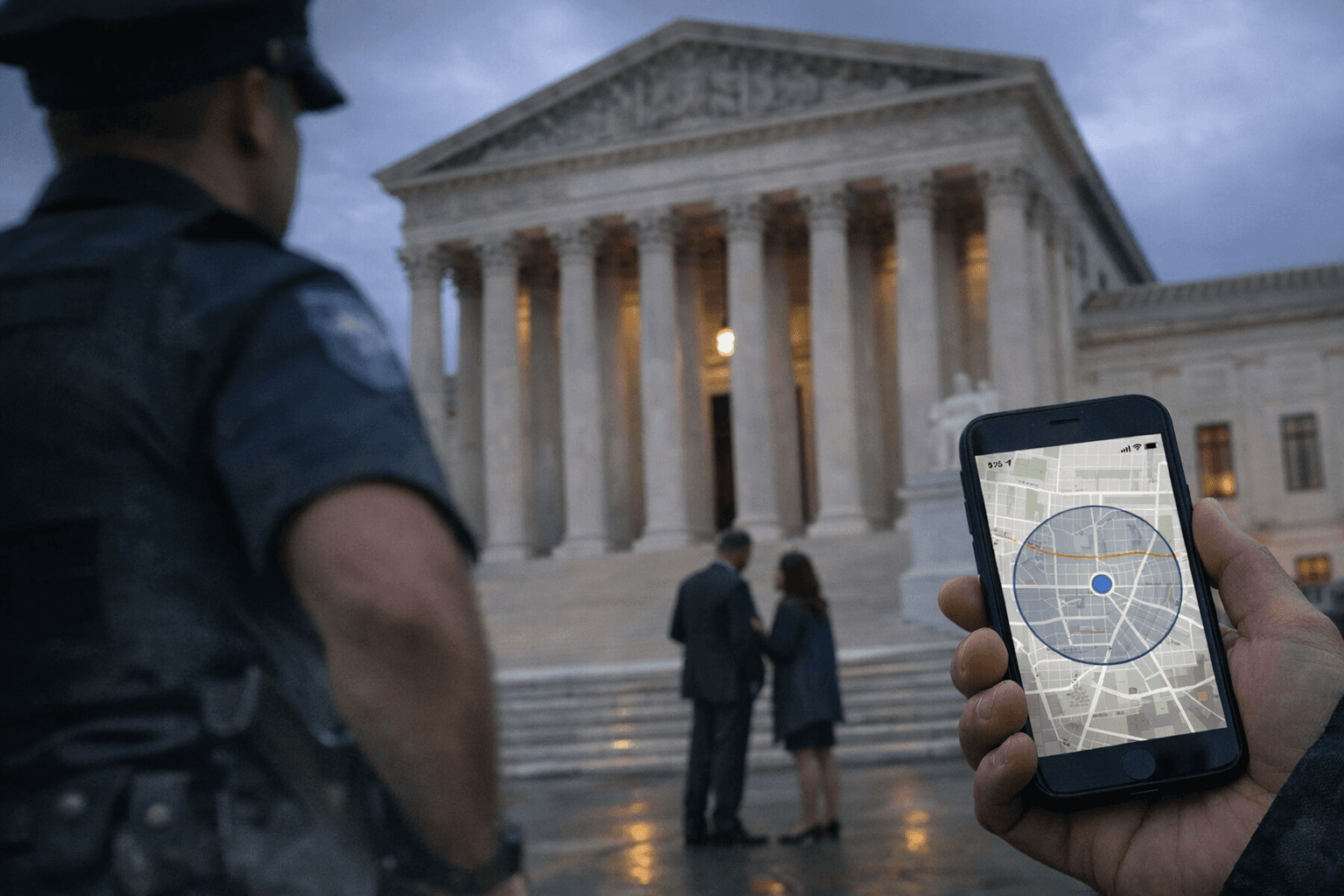
The Supreme Court agreed Friday to take up a major Fourth Amendment fight over so-called geofence warrants, broad search orders that demand historical location records for all devices within a designated area and time window. The case will test whether law enforcement’s increasingly common practice of obtaining bulk smartphone location data from tech companies amounts to an unconstitutional dragnet.
The dispute arises from a May 20, 2019, armed robbery of the Call Federal Credit Union in Midlothian, Virginia, in which investigators sought location data for every device near the bank within an hour of the crime. The geofence data tracked longitudes and latitudes that prosecutors say matched movements of the phone carried by Okello Chatrie during and after the robbery, which involved $195,000. Chatrie pleaded guilty and received a sentence reported as more than 11 years to nearly 12 years in prison. Prosecutors nevertheless permitted him to appeal the admissibility of the cellphone location evidence, producing litigation that has now reached the high court.
Geofence warrants, also described as dragnet or bulk location warrants, instruct a company to turn over historical location records for all devices present in a defined geographic area during a defined time window. Law enforcement officials argue the ubiquity of mobile devices makes the technique a powerful investigative tool for identifying suspects. Critics counter that the broad sweep of such orders virtually guarantees that many innocent people will be swept into investigations, implicating sensitive information about where people live, work, worship, and socialize.
The case arrives in the shadow of the Court’s 2018, 5-4 ruling that generally requires warrants for historical location data from cellphone service providers. Lower courts have split on whether geofence warrants are permissible. The Richmond-based 4th U.S. Circuit Court of Appeals issued a fractured decision upholding Chatrie’s conviction, while the 5th U.S. Circuit concluded in 2024 that geofence warrants are inherently unconstitutional, though it preserved evidence under a good-faith exception because officers reasonably relied on the warrant. A federal district judge in the Virginia case earlier concluded the search violated Chatrie’s rights but allowed the location evidence to be used under the same good-faith rationale.
Technological and policy developments complicate the stakes. Google changed its location-data storage policies in 2023 in ways that make it harder for the company to comply with some geofence requests, a shift the federal government has cited in urging the Court not to take the case. Government filings have argued that those corporate changes significantly reduce the frequency of geofence disputes and that users who enable location services have different expectations about how data are used.
The Supreme Court’s decision will resolve the circuit split and set key limits for magistrates, law enforcement, and tech companies. At issue are standards of particularity and minimization, the permissible scope of probable cause, and whether a good-faith exception shields evidence gathered under broad orders. The ruling will have immediate operational consequences for criminal investigations and for the compliance, storage and litigation strategies of major technology firms.
Beyond immediate legal outcomes, the case will influence long-term trends in digital privacy and surveillance. A ruling curtailing geofencing could accelerate moves by companies to limit retention of granular location logs and bolster privacy-preserving architectures. A decision upholding geofence warrants could entrench a potent investigative tool and prompt renewed debate over statutory protections and oversight. Either way, the Court’s guidance will reshape the balance between investigative efficiency and individual privacy in an era when smartphones constantly map citizens’ movements.
This article was produced by Prism’s automated news system from verified source data, official records, and press releases, then run through automated quality and moderation checks before publishing. The system is built and supervised by the people who set the standards it runs under. Read our full AI policy.
Did this article answer your question?

