Supreme Court to decide whether federal law shields Roundup makers
Justices will weigh whether FIFRA bars state failure-to-warn Roundup claims. A ruling could dismiss thousands of cancer lawsuits and reshape pesticide litigation.

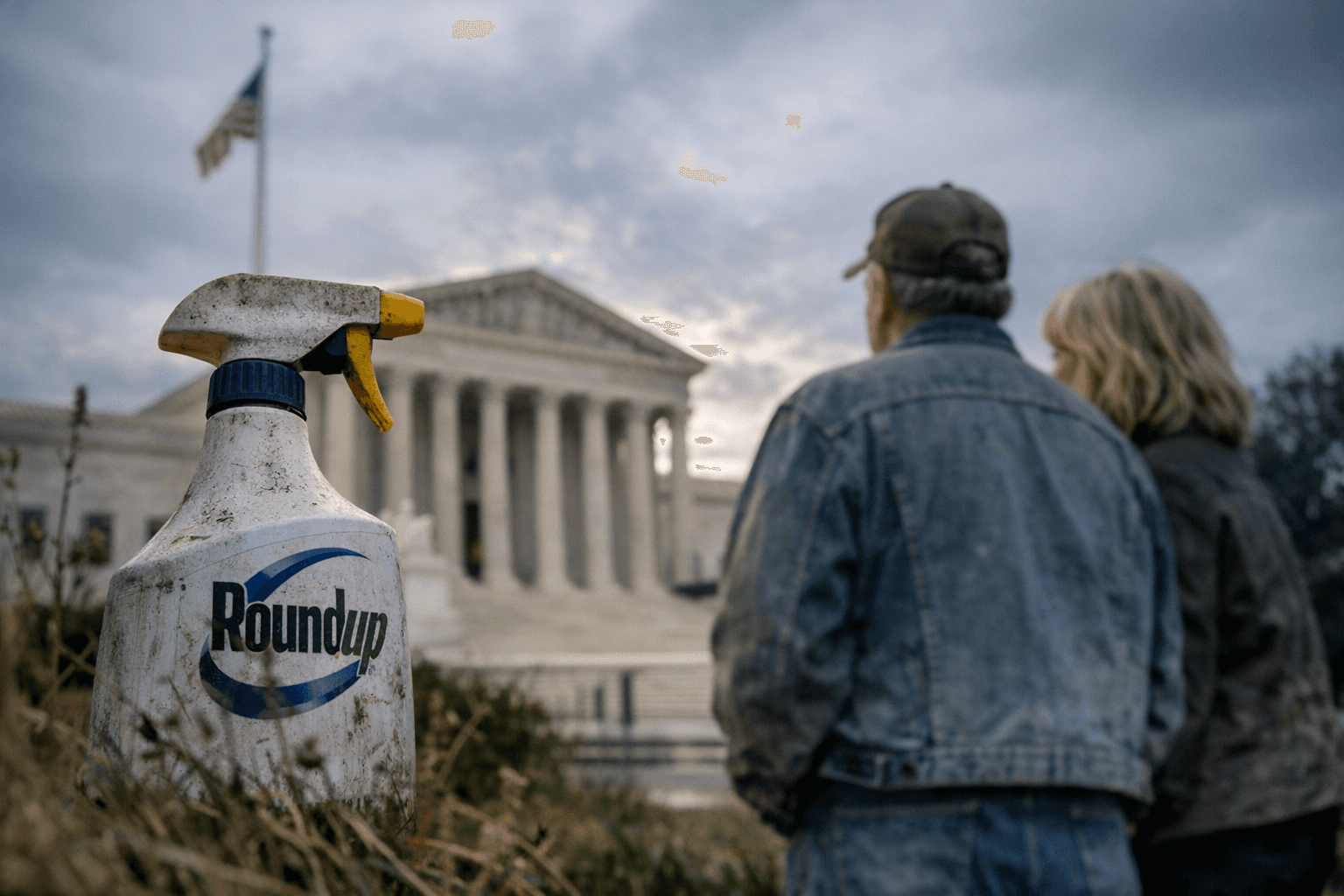
The U.S. Supreme Court has agreed to decide a narrowly framed but consequential legal question: whether the Federal Insecticide, Fungicide, and Rodenticide Act (FIFRA) preempts state-law failure-to-warn claims when the Environmental Protection Agency did not require a warning. The court’s decision to take Bayer AG’s appeal in Monsanto Company v. Durnell could determine whether thousands of Roundup-related cancer suits proceed.
The dispute arises from a 2019 Missouri case in which plaintiff John Durnell sued Monsanto, now a Bayer subsidiary, alleging years of exposure to Roundup in local parks led to non-Hodgkin’s lymphoma. A Missouri jury in 2023 awarded Durnell $1.25 million on a failure-to-warn claim while rejecting other counts and declining punitive damages. The Missouri Court of Appeals upheld that verdict in 2025. The Supreme Court’s review is limited to the preemption question raised on appeal and does not address the safety or science of glyphosate, the active ingredient in Roundup.
Bayer has framed the appeal as a bid to block or limit state-law claims tied to product labels. CEO Bill Anderson said it is “time for the U.S. legal system to establish that companies should not be punished under state laws for complying with federal warning label requirements.” The company has already removed glyphosate from Roundup formulations sold in the U.S. residential lawn and garden market, while continuing to market glyphosate products for agricultural use. Bayer has warned it may withdraw glyphosate from U.S. agricultural markets if litigation persists.
The legal fight comes against a backdrop of massive litigation: roughly 181,000 Roundup claims remain pending, the vast majority by residential users. Lower courts have split on whether FIFRA preempts state failure-to-warn suits, with the 3rd U.S. Circuit siding with Bayer in 2024 while the Missouri appellate court sustained the Durnell verdict in 2025. The Supreme Court’s intervention is meant to resolve that circuit split and could set a national rule about the interplay of federal regulation and state tort law.
The government’s position has shifted across administrations. The current U.S. Solicitor General, D. John Sauer, urged the Court to accept the appeal. By contrast, a prior brief from the Biden administration’s Solicitor General in 2022 urged the justices not to hear an earlier Bayer appeal, arguing that FIFRA does not preempt such state claims. The split underscores how legal strategies around preemption are shaped by changing federal priorities.
Plaintiffs’ attorneys maintain confidence despite the high stakes. Environmental and public-health advocates criticized the court’s decision to take the case. Lori Ann Burd, environmental health director at the Center for Biological Diversity, called it “a sad day in America when our highest court agrees to consider depriving thousands of Roundup users suffering from cancer of their day in court.”
A ruling for Bayer could narrow or eliminate label-based failure-to-warn claims nationwide, with ripple effects beyond glyphosate to other pesticide litigation such as paraquat lawsuits alleging Parkinson’s disease and to broader corporate liability strategies. The court limited review to the preemption question; accepting the case does not signal how justices will rule on the merits. Arguments could be scheduled later this spring or at the court’s next term, with a decision expected during the 2026 term.
This article was produced by Prism’s automated news system from verified source data, official records, and press releases, then run through automated quality and moderation checks before publishing. The system is built and supervised by the people who set the standards it runs under. Read our full AI policy.
Did this article answer your question?


