Surging demand for critical minerals fuels illegal mining in Brazil’s Amazon
A 1,200% surge in garimpo has turned Brazil’s Amazon into a frontline of the global mineral race, where EV demand and criminal networks collide.
The mineral race behind the violence
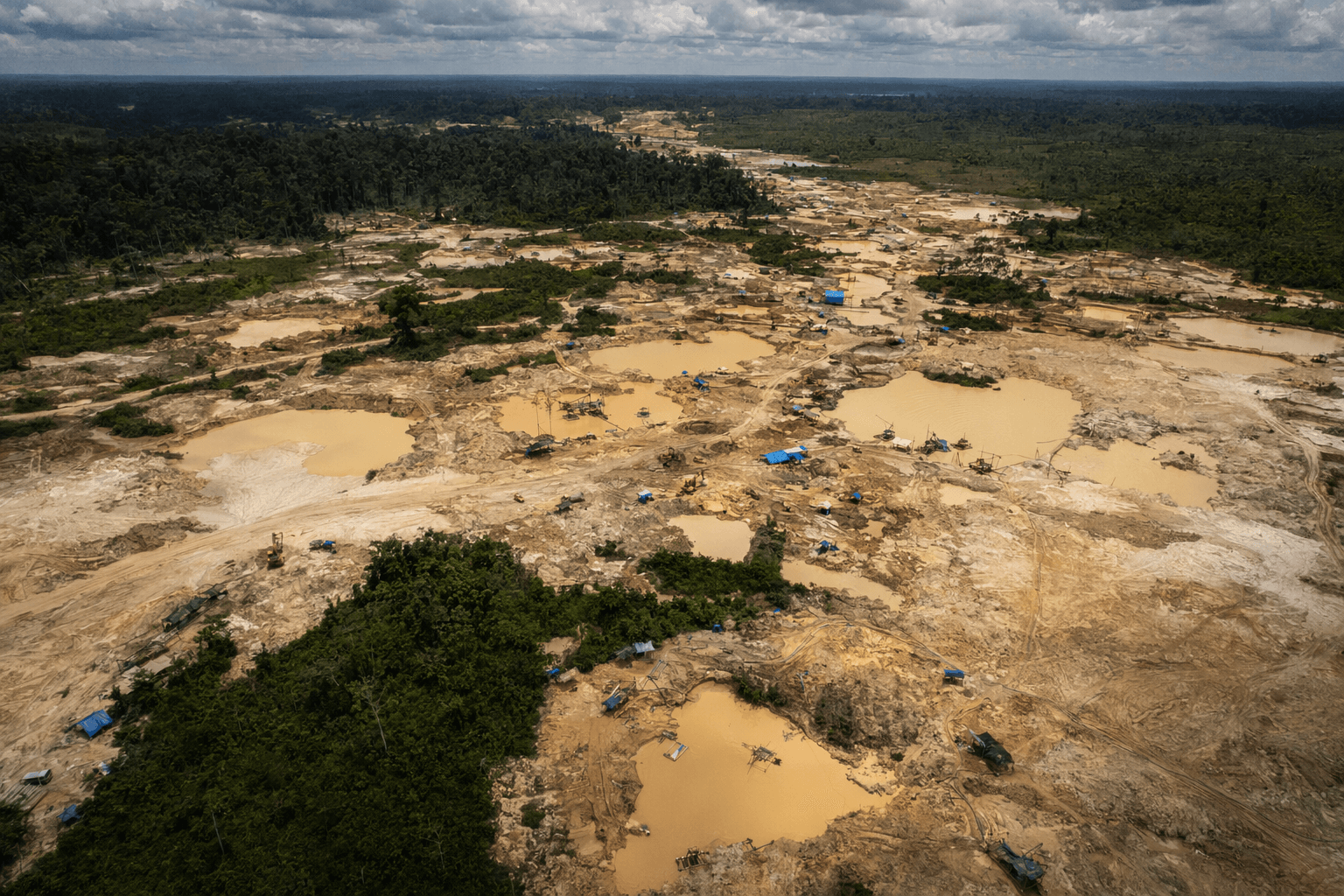
The scramble for critical minerals has pushed Brazil’s Amazon deeper into a criminal economy that is no longer limited to gold. Copper, lithium, nickel and rare earths are now sought for electric vehicles, batteries, drones, wind turbines and solar panels, and that demand is drawing pressure into the world’s largest rainforest.
What looks like a clean-energy supply chain on paper is, on the ground, a powerful incentive for illegal extraction. An InfoAmazonia survey found about 5,000 mining applications in Brazil’s Amazon biome, a sign that the energy transition is not easing pressure on the region but intensifying it.
How garimpo became entrenched
Brazil’s Amazon has long been shaped by garimpo, the artisanal and illegal mining economy that operates outside formal oversight. A 2024 Nature Communications study found that garimpo area in the Brazilian Amazon increased by about 1,200% from roughly 218 square kilometers in 1985 to about 2,627 square kilometers in 2022.
The same study found that more than 91% of garimpo activity in Brazil is concentrated in the Amazon. It also identified two periods when garimpo overtook industrial mining in the country: 1989-1997 and 2019-2022. That pattern matters because it shows illegal mining is not a marginal offshoot of the sector; in key moments, it has become the dominant force.
Why transition minerals are now part of the problem
Global Witness says illegal mining and trafficking of transition minerals is already well established in the Amazon basin, often through the same criminal networks involved in illegal gold. Its analysis points to illicit trade in coltan that has been known for at least a decade, alongside illegal trade in rare earth elements, tin and other commodities.
That convergence is central to the current wave of violence. The same minerals that feed the global push for electrification are moving through informal and criminal channels, linking international demand to local lawlessness. In practice, the supply chain for the green economy is touching the same terrain where armed groups, smugglers and corrupt brokers already operate.
Criminal infrastructure reaches beyond mining
The threat does not stop at the mine site. The World Resources Institute says criminal infrastructure built around cocaine trafficking is increasingly facilitating illegal deforestation, timber trafficking and illegal gold mining by controlling transport routes, using corruption and intimidating local authorities and communities.
That broader network helps explain why illegal mining in the Amazon is so hard to dismantle. It is supported by logistics, money laundering, coercion and territorial control, not just by the price of minerals. Once those systems are in place, they can be repurposed for different commodities as markets change.
Indigenous communities are being boxed in
The human cost is especially stark in Brazil’s Legal Amazon, where mining applications are piling up near isolated Indigenous peoples. Repórter Brasil found 1,827 mining applications for copper, lithium, rare earths and 13 other elements within 40 kilometers of at least 45 isolated Indigenous groups.
That proximity is not just a planning concern. It places communities at risk of intrusion, violence and contamination, while also narrowing the space in which Indigenous peoples can live without outside pressure. Indigenous leaders such as Miguel Guimaraes and Herlín Odicio have warned that these illicit economies are displacing state authority, deepening insecurity and threatening both human rights and the rainforest itself.
Mercury contamination from illegal gold mining adds another layer of danger. It contaminates rivers, harms public health and leaves a toxic legacy long after miners move on. In a region where waterways are lifelines for transportation, food and daily life, that pollution becomes an instrument of slow violence.
What the Yanomami crackdown shows
Brazilian authorities have not stood still. The Brazilian federal government mounted a major crackdown on illegal mining in Yanomami territory in 2023 and 2024, and the campaign significantly reduced the number of miners inside the territory, where thousands had been operating before the operation.
That result shows enforcement can make a difference when it is sustained and forceful. But it also underscores the scale of the challenge: a single campaign can weaken one epicenter while the wider illegal mining economy remains intact, adaptable and connected to broader commodity demand.
What this means for governance
The Amazon is now where several policy failures meet at once: weak land control, porous transport corridors, criminal financing, and a global appetite for minerals used in the transition to cleaner technologies. The result is not only environmental loss but also a direct challenge to state authority.
If Brazil is to contain the damage, the response has to match the structure of the problem. That means protecting Indigenous territories, disrupting transport and corruption networks, confronting mercury pollution, and treating critical minerals as a governance issue, not just an industrial one. Without that, the region will keep absorbing the costs of a supply chain that begins far beyond the rainforest and ends deep inside it.
This article was produced by Prism’s automated news system from verified source data, official records, and press releases, then run through automated quality and moderation checks before publishing. The system is built and supervised by the people who set the standards it runs under. Read our full AI policy.
Did this article answer your question?