Takaichi poised for landslide as NHK exit projections show supermajority
Exit polls show Prime Minister Sanae Takaichi's coalition headed for a supermajority, a win that could fast-track tax cuts and large defense spending. This matters for Japan's finances and regional security.

Public broadcaster NHK's exit projections signaled a commanding victory for Prime Minister Sanae Takaichi on Feb. 8, with the ruling coalition of the Liberal Democratic Party and the Japan Innovation Party potentially claiming as many as 366 of 465 seats in the lower house. NHK also projected the LDP alone could take up to 328 seats, a result Reuters noted would be the party's best since 1996 and would create a legislative supermajority capable of quickly advancing fiscal and security measures.
The scale of the projected win crystallizes both policy and market risks. A coalition majority of that size would make it far easier for Takaichi to push through her campaign agenda of tax cuts, subsidies and a stepped-up defense buildup aimed at countering China. Financial markets have already shown unease, with reporting that bond and currency markets were "spooked" by her spending promises and the prospect of large, unfunded tax cuts that could widen Japan's already large public debt burden.
Takaichi, 64 and Japan's first female prime minister after her elevation in late 2025, called the rare winter snap election to capitalize on buoyant personal approval. She campaigned on a pledge to "work, work, work." Her appeal has been unusually strong among younger voters; one poll cited by Reuters found more than 90 percent of those under 30 favored her, fueling a youth phenomenon dubbed "sanakatsu" or "Sanae-mania" for items associated with her.
Not all outlets agreed on the upper bounds of the projected win, underscoring the provisional nature of exit polling. Japan Times offered a narrower LDP range of 274 to 328 seats, while the BBC cited estimates that the LDP-Ishin coalition could "bag up to 300 of the 465 seats." Straitstimes reported the LDP had already secured the 233 seats needed for a majority roughly 90 minutes after polls closed.
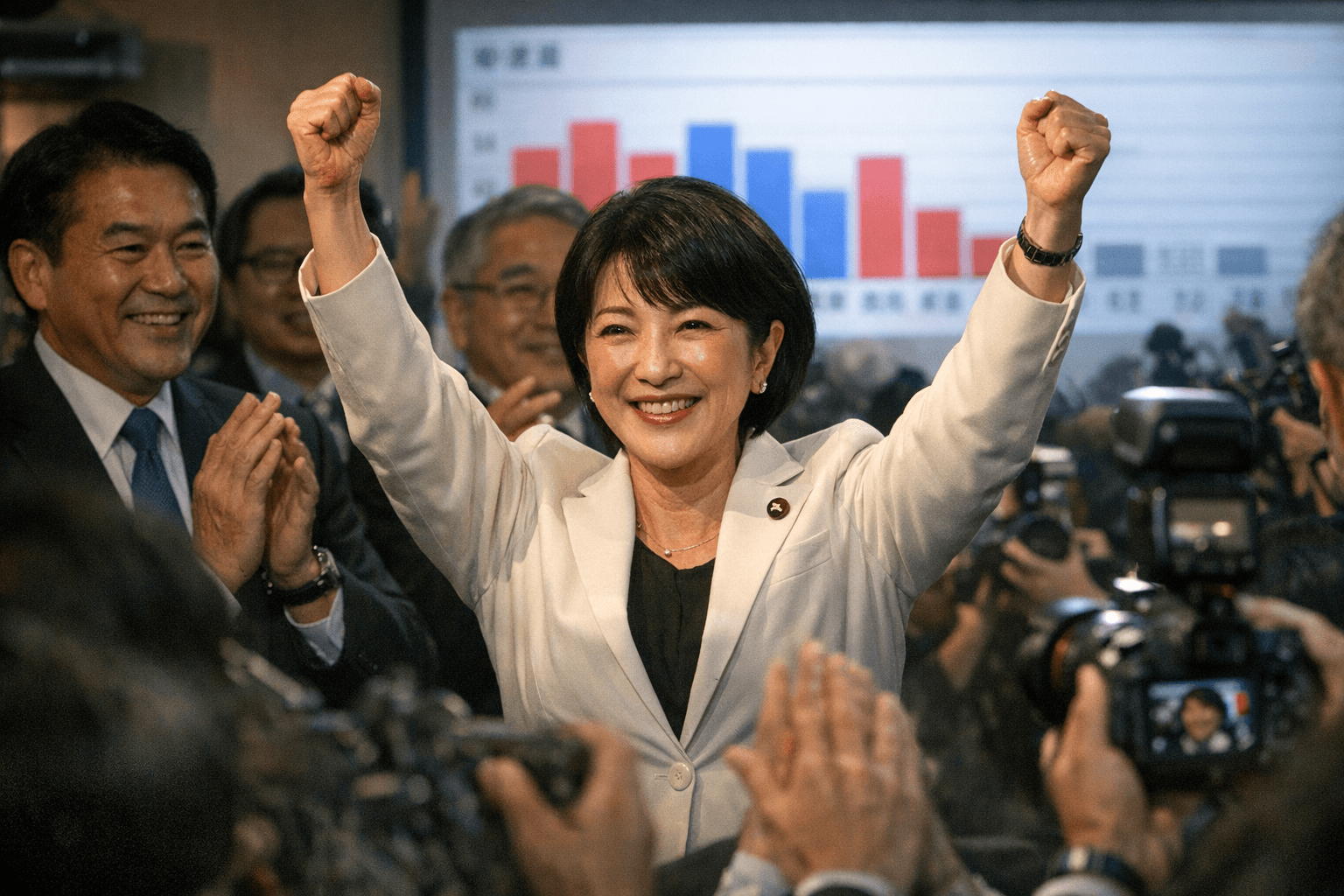
The campaign also drew an international spotlight. Multiple reports said U.S. President Donald Trump issued a "total endorsement" of Takaichi days before the vote, a development likely to be watched closely in Beijing as Tokyo signals a sharper security posture. Analysts warn that a consolidated LDP-led government could accelerate defense legislation and spending decisions that have been politically fraught in recent years.
Critics contend the program of quick tax relief and higher outlays does not address Japan's deeper economic malaise. Masahiko Takeda, a senior fellow cited by the BBC, said the government's package "fails to address the underlying problems of weak productivity and stagnant real wages." Voters voiced similar concerns on the ground; in Niigata, 74-year-old Mineko Mori told reporters she feared tax cuts could "saddle future generations with an even bigger burden."
Turnout dynamics added nuance to the headline numbers. Nearly 4.6 million early ballots had been cast a week before the election, down 2.5 percent from 2024 amid heavy snow in northern and western regions that depressed early voting. With NHK figures still subject to verification and official tallies pending, the results will be watched for how quickly they translate into concrete legislative moves and financial-market reactions.
This article was produced by Prism’s automated news system from verified source data, official records, and press releases, then run through automated quality and moderation checks before publishing. The system is built and supervised by the people who set the standards it runs under. Read our full AI policy.
Did this article answer your question?


