Tamil Nadu women farmers keep red chile crop alive, despite grueling labor
Mundu chile keeps money moving through Tamil Nadu villages, but the women who grow it still face the old limits of land, credit, and control over sales.
A crop built on women’s labor
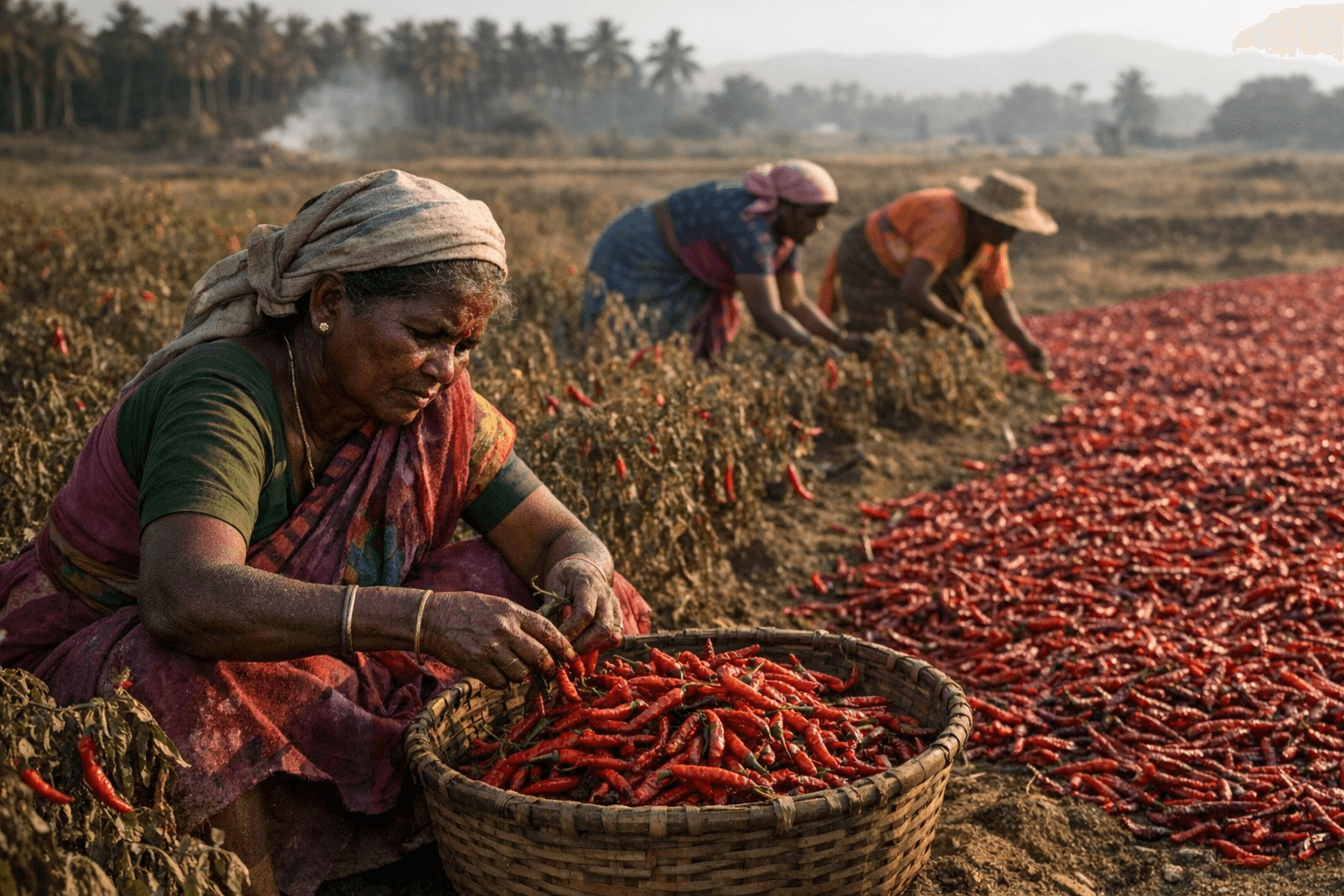
In Mattiyarenthal village in Tamil Nadu’s Ramanathapuram district, the red mundu chile is more than a spice crop. It is a seasonal income source built on the labor of women farmers, who sow the seeds from October to November during the monsoon and keep working through the January-to-May harvest. The chile is distinctive, cherry-shaped, and deeply tied to the local farm economy, even as the work remains punishing enough that many say it is too demanding for men.
That division of labor matters because the crop is not just about production volume. It is about who carries the physical burden, who handles the money, and who gets to decide what happens after the pods are picked. One woman farmer described the trade-off plainly: “In spite of the challenges, we’ve found freedom.” That freedom, though, is complicated. It comes from earning cash in a village economy where women do most of the fieldwork, but not necessarily from controlling the land, the credit, or the final sale.
Why mundu chile is so labor-intensive
The chile season follows a narrow calendar. Farmers sow during the monsoon, then harvest from January through May. After picking, the pods are dried for five to ten days before grading begins. The process sounds simple until you watch what it requires: crouching over each plant, plucking pods one by one, spreading them to dry, and sorting them by hand.
That labor intensity explains why women dominate the crop in places like Mattiyarenthal. Vallal Kannan of Krishi Vigyan Kendra says more than 70% of agricultural activities in the region have always been carried out by women farmers. The crop rewards patience and stamina more than machinery. It also demands a level of close handling that makes the work feel endless, especially when the farmers must stay alert to quality differences that directly affect price.
Those differences matter at the market. Lower-quality pods are stored separately and can fetch about half the price of the best chiles. For households depending on a few months of farm income, that gap is more than a pricing detail. It is the difference between a harvest that stabilizes the year and one that leaves cash flow tight from the start.
Seasonal income, not year-round security
The mundu chile keeps some money circulating, but it does not create steady employment. Because the season lasts only about six months, many farmers have no work for the other half of the year. That makes the crop a fragile pillar of rural livelihoods, especially for households that depend on agriculture for both wages and food security.
This is where the gender story becomes an economic story. Women are doing the hardest physical work in a crop that generates cash only part of the year, while men often move into the finance, supervision, and sales roles. That split can leave women visible in the fields and less visible in the transaction room, where prices are negotiated and profits are realized. In practice, the person who bends over the plants may not be the person who holds the leverage at the end of the season.
The result is a labor system that can preserve a village crop without necessarily strengthening women’s bargaining power. A crop can survive because women keep it alive, yet still fail to translate that effort into equal ownership of the earnings.
The land gap shapes the power gap
The mundu chile story fits a wider pattern across India. TechnoServe India says nearly one out of every two self-employed farmers in the country is a woman. Another major reporting analysis found that more than 75% of India’s rural women workers are in agriculture, yet only 12% own land. That gap is not symbolic. Land ownership often determines whether a farmer can access loans, credit cards, and government support.
Without land titles, women farmers are more exposed to middlemen, informal borrowing, and household power imbalances. Even when women do the farming, the asset base may sit in someone else’s name. That means less direct access to formal finance and less control over how income is used or reinvested. In rural households, that can shape everything from school spending to crop choices next season.
This is why the mundu chile economy deserves attention beyond its harvest cycle. If women do most of the work but men control the finance and sales, then the crop reproduces a broader rural hierarchy even while it depends on women’s labor. The issue is not whether women participate. They already do, at scale. The issue is whether participation becomes power.
Why policy makers should care about the numbers
The policy case is strong because the productivity loss from unequal access is large. The Food and Agriculture Organization’s 2010 to 2011 State of Food and Agriculture report found that if women farmers had equal access to productive resources, their yields could rise by 20% to 30%. FAO estimated that closing that gap could increase agricultural output in developing countries by 2.5% to 4% and reduce hunger by 12% to 17%.
Those figures make the mundu chile question bigger than one district. Tamil Nadu cultivated chilli on about 0.5 lakh hectares in 2021 to 22 and produced 26,380 metric tons, according to a 2024 academic article. That is not a marginal crop. It is part of a sizable agricultural economy, and Ramanathapuram’s mundu type chile is one of the distinctive forms within it. If women are already central to its production, improving their access to land, credit, and market power would likely lift both household income and regional output.
There are signs that local officials understand the stakes. A 2024 district seminar in Ramanathapuram focused on mundu chilli cultivation, value addition, and marketing strategy. That is the right frame. The challenge is not only how to grow more chiles, but how to ensure that the women who crouch through the fields and hand-grade the harvest also gain a stronger claim on the profits.
What the crop reveals about rural resilience
Mundu chile survives because women keep the system moving through the season’s hardest tasks. They sow, pick, dry, sort, and manage a crop whose quality spread can cut the value of the lower grades in half. They do so in a labor market where agriculture is seasonal, ownership is unequal, and control over sales often remains elsewhere.
That is why the crop matters as an economics-and-gender story. It shows how rural resilience can depend on women’s work while still leaving them short of the assets that turn work into lasting power. The fields of Mattiyarenthal are proof of both realities at once: women are keeping the chile alive, and the next step is making sure they keep more of what it earns.
This article was produced by Prism’s automated news system from verified source data, official records, and press releases, then run through automated quality and moderation checks before publishing. The system is built and supervised by the people who set the standards it runs under. Read our full AI policy.
Did this article answer your question?


