Tesla Delivers 358,023 Vehicles in Q1 2026, Full Results Due April 22
Tesla's Q1 production outpaced deliveries by 50,000 vehicles, a gap that signals softening demand heading into the company's April 22 earnings call.

Tesla built far more cars in the first quarter of 2026 than it managed to sell, a mismatch that cuts to the heart of whether the world's most closely watched electric vehicle maker faces a demand problem or simply a timing quirk.
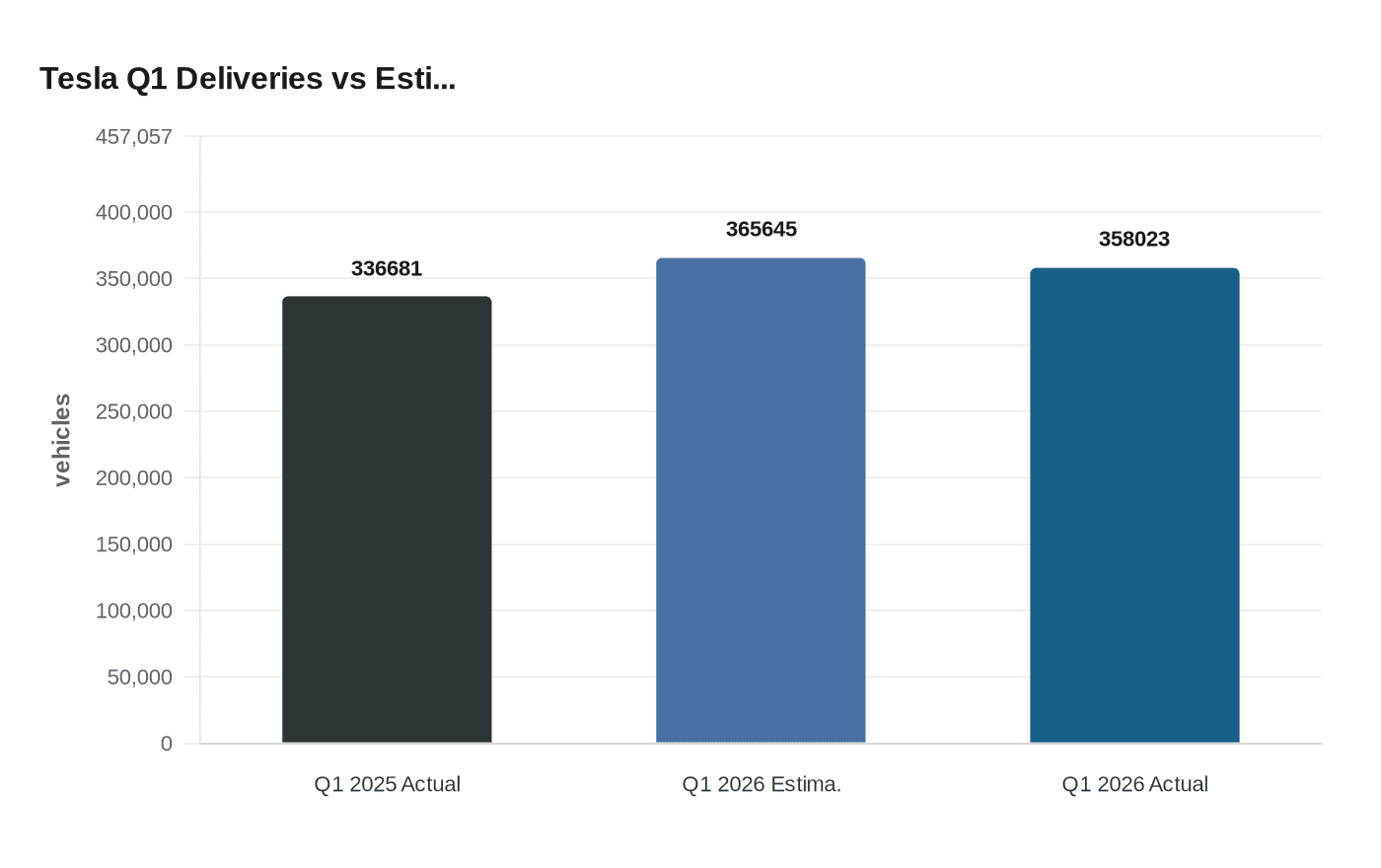
The company delivered 358,023 vehicles while producing 408,386, a gap of 50,363 units that went straight into inventory in a single quarter. Wall Street's consensus had pegged deliveries at around 365,645, leaving Tesla roughly 7,600 units short. The results pushed Tesla's stock down roughly 4% in early Thursday trading, extending its year-to-date decline to around 20%.
The 358,023 deliveries represent a 6.3% year-over-year increase from Q1 2025's 336,681 vehicles. But that comparison requires a significant asterisk: Q1 2025 was Tesla's weakest quarter in years because the company shut down Model Y production lines for a major refresh, making the year-over-year rebound look more robust than underlying demand conditions suggest.
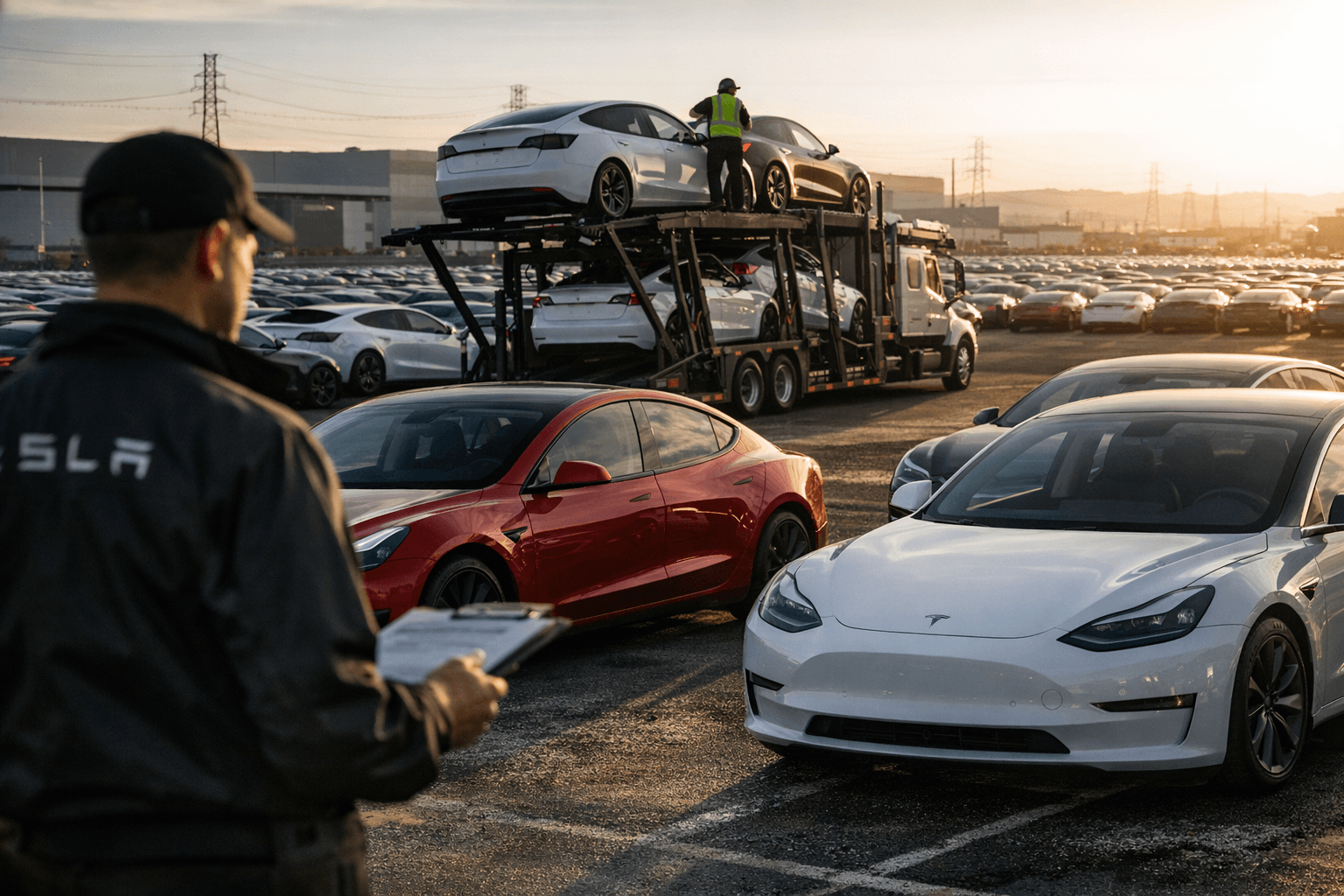
The production-delivery gap is the more telling signal. A company that once prided itself on building to order is now sitting on excess five-figure inventory, implying that recent price adjustments and incentive programs have not been sufficient to clear vehicles at the rate Tesla's factories are producing them. The Model 3 and Model Y, Tesla's highest-volume nameplate duo, accounted for 394,611 units produced and 341,893 delivered in Q1, comprising the overwhelming majority of the gap. Other models, including the Cybertruck and the winding-down Model S and X lineup, contributed 13,775 produced against 16,130 delivered.
On energy storage, Tesla deployed just 8.8 gigawatt-hours in Q1 2026, a 38% drop from the record 14.2 GWh posted in Q4 2025 and well below the analyst consensus of 14.4 GWh. The energy storage business had been Tesla's most reliable growth story over the past year while vehicle deliveries declined, so a miss of this magnitude removes a key pillar of the bull case heading into earnings season.
Tesla is coming off a year of declining deliveries due in part to increased competition from rivals in China offering lower-cost models. The company is also poised to ramp up deliveries of its fully electric Semi in 2026, a Class 8 truck with a promised range of 500 miles. That ramp, along with any commentary on Cybertruck sell-through rates, will be closely parsed when management hosts its earnings webcast after market close on April 22.
For investors modeling Tesla's Q1 financials, the volume figures are only the opening data point. Tesla itself cautioned that deliveries do not translate directly to quarterly earnings, which will depend on average selling prices, cost of sales and foreign exchange movements. A production surplus of more than 50,000 units raises immediate questions about whether Tesla leaned on incentives or discounts to move metal in the quarter, which would compress margins further. Any confirmation of that on April 22 would force a harder reckoning with the divergence between Tesla's manufacturing scale and actual market demand. Inventory levels, regional mix between North America, China, and Europe, and the gross margin trajectory are the numbers that will determine whether Q1 2026 is a blip or a trend.
This article was produced by Prism’s automated news system from verified source data, official records, and press releases, then run through automated quality and moderation checks before publishing. The system is built and supervised by the people who set the standards it runs under. Read our full AI policy.
Did this article answer your question?

