Thailand, Cambodia Agree to Consolidate Ceasefire, China Mediates
Thailand and Cambodia agreed in trilateral talks hosted by China to gradually consolidate an immediate ceasefire after weeks of intense border fighting that killed at least 101 people and displaced over 500,000. The accord matters because its success will determine whether a large humanitarian crisis stabilizes, bilateral trade and border economies can resume, and regional diplomatic dynamics shift toward Beijing or ASEAN.
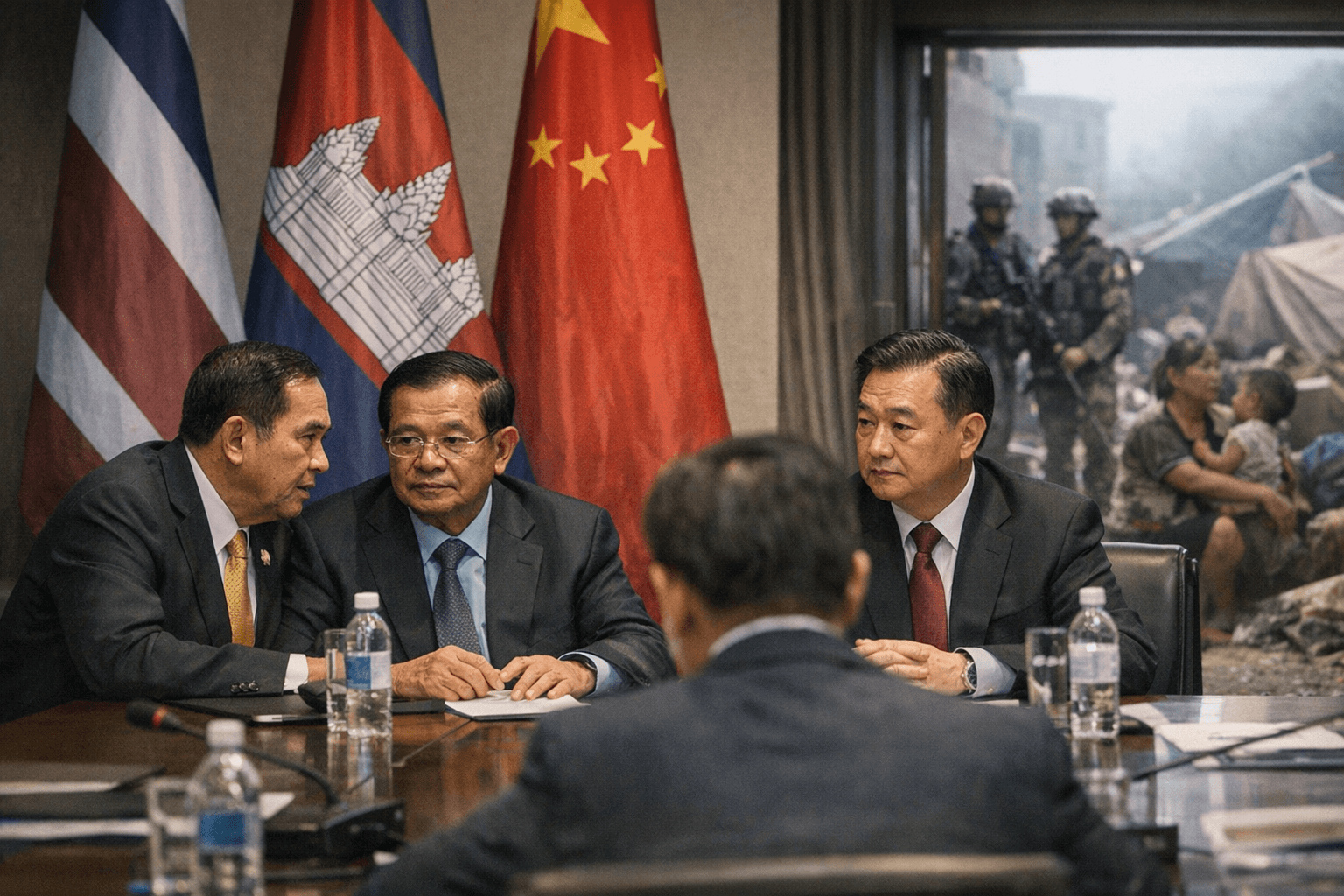
Thailand and Cambodia said they would move step by step to consolidate a ceasefire and rebuild trust following talks in Yuxi, in China’s Yunnan province, on December 28 and 29. The meeting, convened by Chinese Foreign Minister Wang Yi, brought together Wang and the foreign ministers of Thailand and Cambodia, Sihasak Phuangketkeow and Prak Sokhonn, with military representatives from all three countries also participating.
The talks came hours after Bangkok and Phnom Penh announced an immediate ceasefire on December 27, the second truce since clashes erupted in late October. The confrontations over control of border areas spanned weeks, left at least 101 people dead and displaced more than half a million, according to official tallies cited by the parties. The human cost and mass displacement have heightened pressure for a rapid and verifiable end to hostilities.
A joint communique and a Chinese foreign ministry release set out a five point follow up agenda. The two sides committed to gradually consolidating the ceasefire, resuming exchanges, rebuilding political mutual trust, turning bilateral relations around, and safeguarding regional peace. China framed the talks as timely and constructive, and as an effort to provide a platform for continued communication rather than a final settlement. Chinese officials described the ceasefire as hard won and urged both parties not to abandon it.
For markets and local economies the stakes are tangible. Border provinces on both sides host agriculture, cross border trade and tourism that depend on stable movement and predictable security. The displacement of more than 500,000 people disrupts labor supply and consumption in local markets, and will translate into immediate humanitarian and reconstruction costs for national budgets. Bangkok and Phnom Penh face mounting pressure to allocate resources for emergency shelter, food and medical services while restoring confidence among traders and investors operating along the border.
Policy implications extend beyond immediate relief. The inclusion of military representatives in Yuxi underlines that confidence building will require concrete, verifiable measures such as coordinated patrol reductions, agreed buffer zones, or third party monitoring. The communique emphasized step by step trust rebuilding, but left open how verification will be conducted and who will observe compliance. Notably, ASEAN was not mentioned in the Chinese statement, a diplomatic omission that highlights Beijing’s assertive mediation role and raises questions about the regional grouping’s capacity to manage interstate conflict.
Longer term, the episode reinforces two trends. First, recurring border friction between Thailand and Cambodia shows how unresolved territorial and political disputes can periodically flare with outsized humanitarian effects. Second, China’s centrality in brokering the talks may deepen its influence in Southeast Asian security affairs, testing ASEAN’s traditional centrality in regional diplomacy.
Observers will be watching whether the ceasefire holds, whether humanitarian agencies and the United Nations can verify casualty and displacement figures, and whether concrete mechanisms for monitoring and military confidence building emerge from the Yuxi platform. The success or failure of those steps will determine whether the region moves from fragile truce to durable stability.
This article was produced by Prism’s automated news system from verified source data, official records, and press releases, then run through automated quality and moderation checks before publishing. The system is built and supervised by the people who set the standards it runs under. Read our full AI policy.
Did this article answer your question?


