Thailand growth likely slowed in first quarter as tourism softens
Tourism weakness and soft household spending are threatening Thailand’s growth engine, even as AI-linked exports keep factories busy.

Thailand’s growth engine looks increasingly narrow as a tourism slowdown threatens to offset gains from export demand tied to artificial intelligence. With visitor numbers softening and household spending losing momentum, the question is whether the economy has become too dependent on one source of strength.
A survey of 17 economists taken from May 8 to May 14 put first-quarter 2026 gross domestic product growth at 2.2% from a year earlier, down from 2.5% in the previous quarter. On a seasonally adjusted quarterly basis, the median forecast was just 0.1%, with estimates ranging from a contraction of 1.0% to growth of 0.9%, a spread that underscores how uneven the recovery has become.
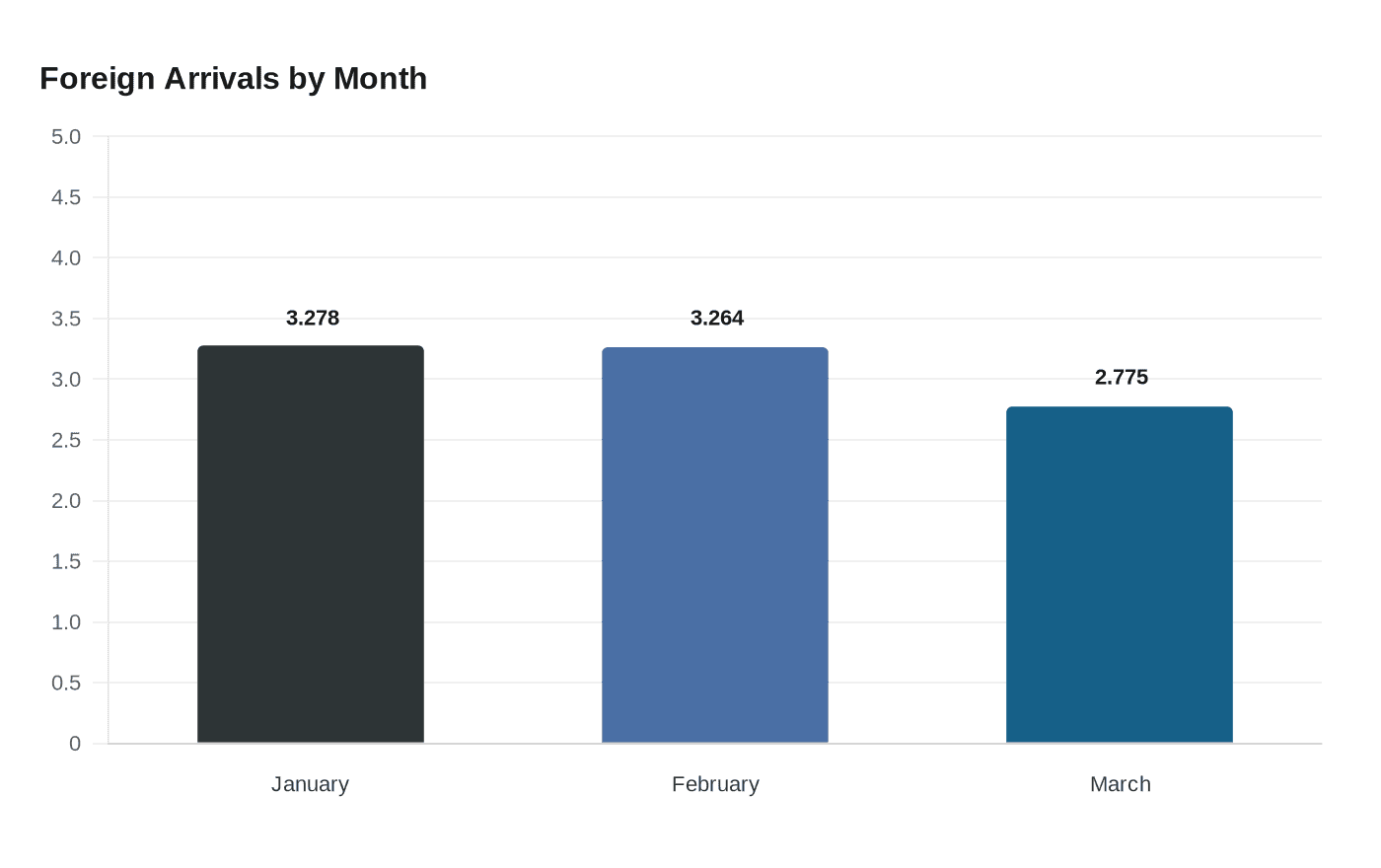
The Bank of Thailand said on April 30 that March activity was broadly stable, but that spillovers from the Middle East conflict had started to show up in tourism, trade and consumer demand. It said foreign arrivals from the Middle East and Europe declined sharply, while tourism receipts rose only because travelers stayed longer as flight services were reduced. The central bank’s tourism table showed foreign arrivals at 2.775 million in March, down from 3.264 million in February and 3.278 million in January.
Chayawadee Chai-anant, the Bank of Thailand’s assistant governor, said Gulf tourism fell to close to zero in March because attacks from Iran closed regional airports. Reuters also reported that tourist arrivals fell 1.8% in February and 8.7% in March, a sharp reversal for a sector that underpins hotels, restaurants, transport operators and thousands of small businesses across the country.
The hit to travel matters because domestic demand has already been fading. Oxford Economics’ Jun Hao Ng said weaker consumption and lower tourism arrivals were the main drag on growth, and that private spending likely slowed after the government’s co-payment programme ended in the fourth quarter of 2025. The Ministry of Finance said the scheme ended after more than 9.21 million participants fully used their benefits, with spending reaching 84.18 billion baht and adding an estimated 0.2% to growth.
Exports have been the main offset. Shipments rose 18.7% in March to $35.16 billion, the 21st straight month of export growth, and overall exports were up nearly 18% in the first quarter, helped by global demand for electronics, especially AI-related products and data-center equipment. Even so, the broader picture is fragile. The Asian Development Bank said Thailand grew 2.4% in 2025, down from 2.9% in 2024, while foreign visitor arrivals fell to 32.9 million from 35.5 million and remained below the pre-pandemic 40 million level. The tourism ministry said arrivals reached 9,174,586 from January 1 to March 29, down 2.29% from a year earlier, with visitor spending estimated at 446.8 billion baht. With tourism softening and exports vulnerable to any global slowdown, policymakers may have to lean harder on domestic stimulus to keep growth near trend.
This article was produced by Prism’s automated news system from verified source data, official records, and press releases, then run through automated quality and moderation checks before publishing. The system is built and supervised by the people who set the standards it runs under. Read our full AI policy.
Did this article answer your question?

