Tony Dokoupil finds Las Vegas charm in its calculated inauthenticity
Las Vegas sells imitation so openly that it becomes trustworthy, turning fake Rome and fake Paris into a very American form of honesty.
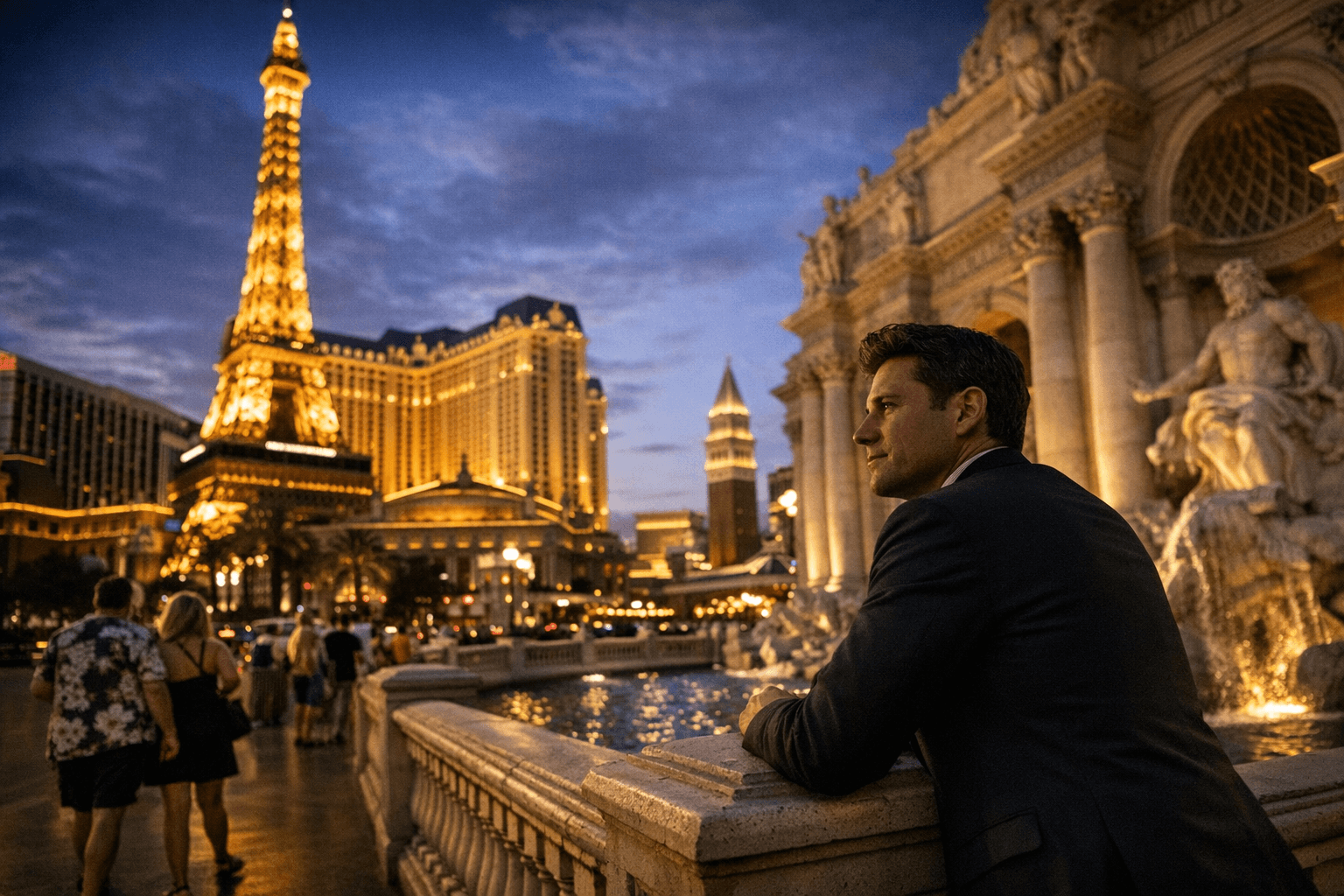
Las Vegas works because it never pretends to be real
Tony Dokoupil’s point about the city lands with unusual force in Las Vegas: its charm comes from the fact that it is obviously built, staged, and repeated. That calculated inauthenticity is not a flaw to be tolerated but the city’s central appeal, the same quality that lets fake Rome, fake Paris, and fake Egypt feel less like gimmicks than like the clearest expression of the Strip’s promise.
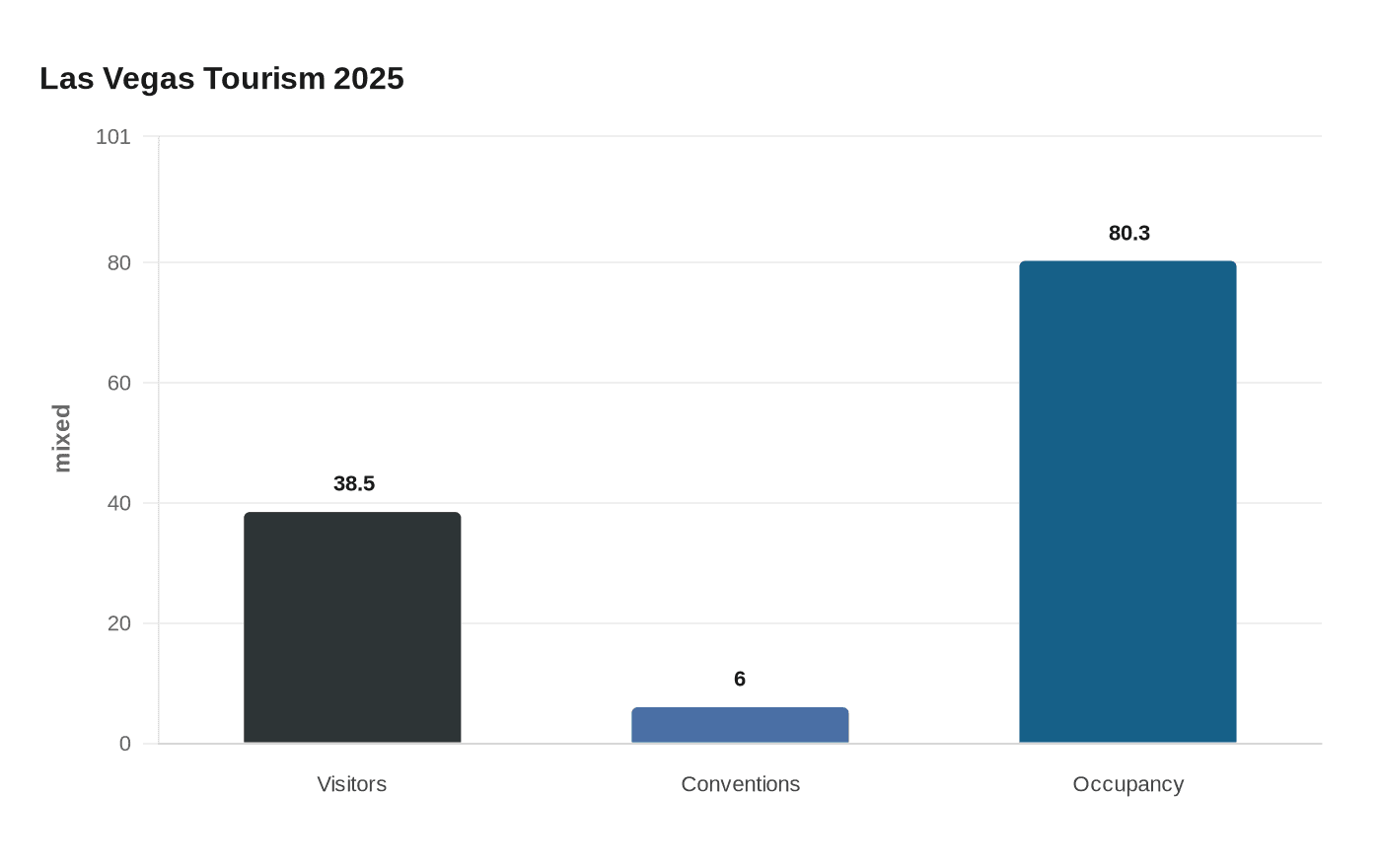
The scale of that promise is enormous. Las Vegas welcomed 38.5 million visitors in 2025, even after a 7.5% decline from 2024, while convention attendance still reached 6.0 million and hotel occupancy averaged 80.3%. The city’s tourism machine is anchored by about 150,300 hotel rooms, the largest hotel inventory in the United States and the second-largest in the world. Even when travel patterns shift, the place keeps absorbing volume because it is built to perform volume.
The numbers behind the illusion
The Las Vegas Convention and Visitors Authority tracks the city like an operating system for spectacle. Its monthly tourism summary draws on data from the LVCVA itself, Harry Reid International Airport, the Nevada Gaming Control Board, and the Nevada Department of Transportation, and it maintains visitation records stretching from 1970 to the present. That long view matters because Las Vegas is not just a destination, it is an economic record of how Americans spend on escape, convention travel, gaming, and themed consumption.
Conventions remain one of the city’s stabilizers. Even with overall visitation down in 2025, 6.0 million convention attendees helped keep the market from slipping harder, and the 80.3% occupancy rate shows how efficiently the city fills beds across a vast hotel base. In a place where almost everything is designed to look more intense than ordinary life, the statistics tell the same story: the business model depends on managing the spectacle with industrial precision.
Why the Strip’s fakery became an American landmark
The logic behind the Strip’s look is not accidental. Robert Venturi, Denise Scott Brown, and Steven Izenour’s 1972 book Learning from Las Vegas grew out of a 1968 study of the city’s signs, symbols, lighting, patterns, styles, and commercial vernacular. Their work helped turn the Strip into a canonical example of postmodern architecture, because it treated commercial imitation not as low culture to be dismissed, but as a serious architectural language.
That insight explains why the Strip’s themed resorts are central to the brand rather than distractions from it. Las Vegas does not hide behind authenticity claims the way many destinations do. Instead, it packages imitation as experience, and the result is strangely transparent: visitors know they are entering a manufactured world, and that knowledge is part of the pleasure.
Paris, Luxor, and the power of the copy
Paris Las Vegas shows the idea at full scale. The resort opened on September 1, 1999, and includes a half-scale Eiffel Tower that rises 540 feet, along with 3,672 hotel rooms wrapped in a Paris theme. The attraction is not that it is indistinguishable from the real city, but that it compresses a recognizable image of Paris into a walkable, booking-friendly fantasy.
Luxor Las Vegas takes a different route with the same logic. It opened on October 15, 1993, uses an ancient Egyptian theme, and is organized around a 30-story pyramid whose interior contains the world’s largest atrium by volume. Both properties make the same economic argument: imitation is not a substitute for experience, it is the experience. That is why their artificiality reads less like deception than like a contract with the visitor.
A city designed to move people through a story
The Strip itself is about 4.2 miles long, and that compact stretch concentrates the resorts and casinos that drive the city’s economy. Its design encourages movement from one set piece to another, with each property offering a different fantasy, a different skyline, a different version of elsewhere. In practical terms, that means the city is not merely a collection of hotels; it is a conveyor belt of curated identities.
That structure mirrors a larger national economy of spectacle. Tourism, themed consumption, and branded environments now shape everything from shopping districts to sports arenas to airport terminals. Las Vegas feels unusually honest because it admits what much of modern American commerce already does: it sells atmosphere, symbolism, and a temporary self.
Why fake can feel more honest than authenticity marketing
The city’s appeal lies in its refusal to oversell reality. Many places market “authenticity” while carefully staging it, from rustic interiors to local color packaged for tourists. Las Vegas simply admits the trick, then executes it with enough confidence and scale that the artifice becomes the point.
That openness gives the city a peculiar moral clarity. A visitor knows the Eiffel Tower is half-size, the pyramid is a hotel, and the Roman or Parisian setting is a designed backdrop. Yet because the city is so explicit about its fiction, it can feel more trustworthy than destinations that hide their curation behind claims of authenticity. The fake is not a failure here; it is a more direct language for a country that increasingly lives through images, brands, and programmed experiences.
Steve Hill, the president and CEO of the LVCVA, has said the destination had to remain nimble amid shifting travel dynamics in 2025, and that flexibility will matter as the city adjusts to changing demand. But the deeper advantage of Las Vegas is harder to dislodge: it has built a durable economy on the idea that people do not only want reality, they want reality transformed into a well-lit performance. In that sense, the city is not a departure from modern America. It is one of its most accurate reflections.
This article was produced by Prism’s automated news system from verified source data, official records, and press releases, then run through automated quality and moderation checks before publishing. The system is built and supervised by the people who set the standards it runs under. Read our full AI policy.
Did this article answer your question?

