Trade Court Weighs Legality of Trump's 10% Global Import Tariff
A 3-judge trade court panel heard arguments Friday challenging Trump's 10% global tariff, imposed under a never-before-used 1974 law the day the Supreme Court stripped his prior tariff authority.
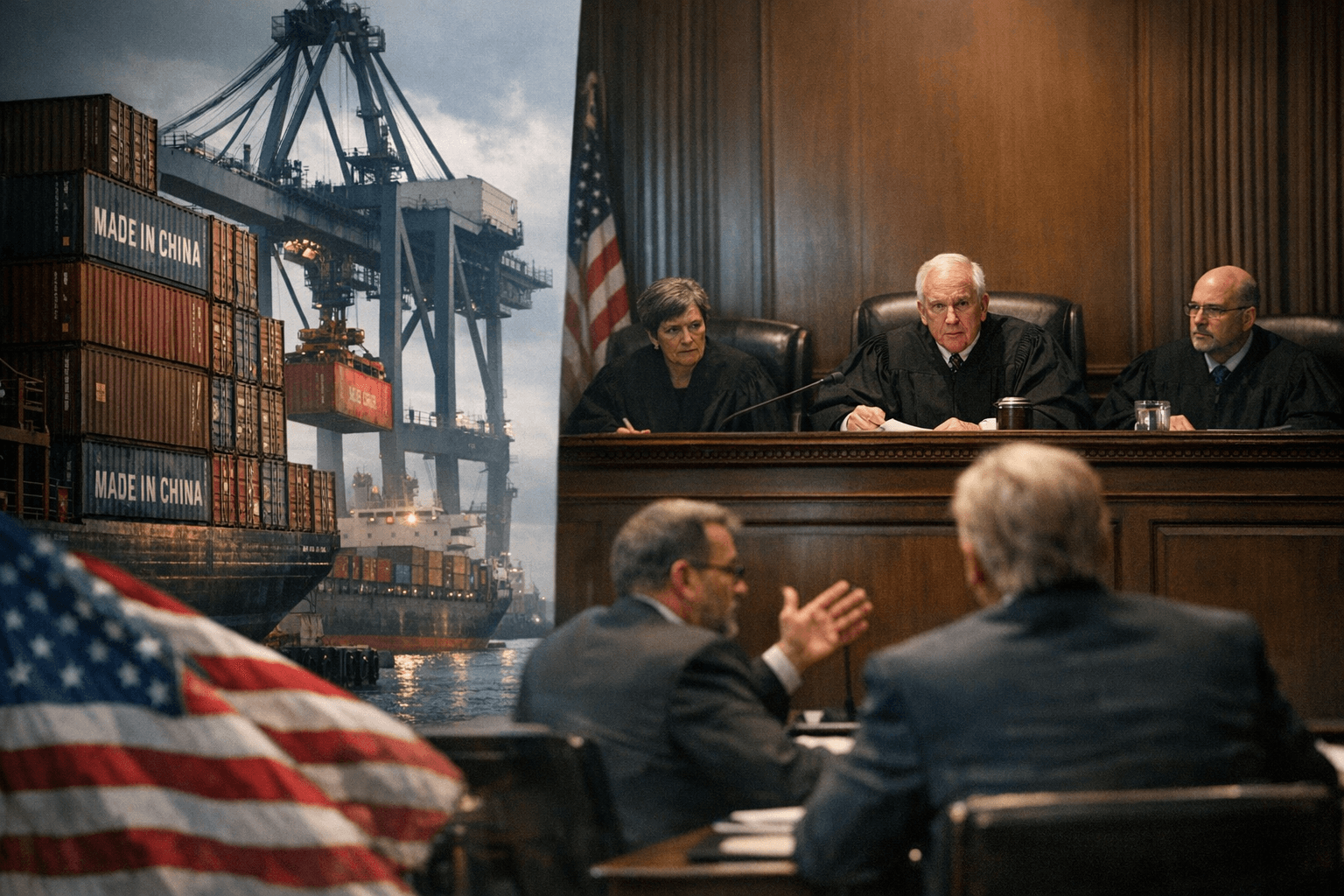
The same afternoon the Supreme Court handed President Donald Trump a stinging defeat on tariffs, he signed a new executive order reaching for a different legal hook. That sequence, playing out over a single day in February, is now at the center of a landmark hearing before the U.S. Court of International Trade, where a three-judge panel in New York examined Friday whether Trump's 10% global import levy can survive its own legal assault.
Trump announced the new tariffs on February 20, the same day the Supreme Court handed him a defeat when it struck down a broad swath of tariffs he had imposed under the International Emergency Economic Powers Act, ruling in a 6-3 decision that the law did not give him the power he claimed. In their place, Trump invoked Section 122 of the Trade Act of 1974, which authorizes the president to impose tariffs of up to 15% for up to 150 days to address "large and serious balance-of-payments deficits." He indicated the following day he would subsequently raise the rate to 15%, though the tariffs are currently scheduled to expire July 24.
The case, styled Oregon et al. v. Trump et al., was filed on March 5, 2026, by a coalition of 24 state attorneys general and governors led by Oregon. The two lawsuits do not challenge other Trump tariffs made under more traditional legal authority, such as recent tariffs on steel, aluminum, and copper imports.
The challengers argue that Section 122 simply does not authorize what Trump did. The states contend that "a balance-of-payments crisis is a currency crisis that was of great concern when Congress enacted Section 122, but which can no longer exist," given that the United States abandoned the gold standard and fixed exchange rates in the 1970s. The states also argue that Trump's proclamation fails to meet the statute's requirements and that the tariffs are not applied "consistently," as required, given the large scope of carveouts and exceptions.
No U.S. president before Trump had used IEEPA or Section 122 to impose tariffs. That novelty cuts both ways in court. The CIT itself, in its earlier decision striking down the IEEPA tariffs, had pointed to Section 122 as a tool available to counter trade deficits, a posture that awkwardly undermines some of the challengers' arguments. Department of Justice lawyers pressed that point Friday, arguing that plaintiffs had previously agreed Section 122 could be used to impose tariffs and now claim it is ineffective, which would suggest Congress passed a law with no purpose.
The economic stakes are substantial. The tariff took effect on February 24 and applies broadly across import categories, squeezing just-in-time supply chains and raising costs for importers who would be entitled to seek refunds if the court vacates the levy. If the administration prevails, the tariff stands through its 150-day window and provides negotiating leverage in ongoing trade talks, while a loss would constrain future unilateral tariff actions and reopen congressional debate over the precise limits of executive trade authority.
The statute requires only a presidential determination that a qualifying deficit exists and does not mandate an interagency process or formal investigation, a procedural minimalism the administration argues insulates the proclamation from challenge. Whether a three-judge panel agrees will define the outer boundary of presidential tariff power for years to come.
This article was produced by Prism’s automated news system from verified source data, official records, and press releases, then run through automated quality and moderation checks before publishing. The system is built and supervised by the people who set the standards it runs under. Read our full AI policy.
Did this article answer your question?

